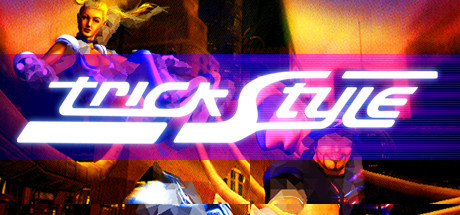
TrickStyle is a distinctive relic of the late-90s experimental era of arcade racing, and even today it remains memorable for its futuristic flair, bold visual identity, and unconventional take on hoverboard competition. Developed by Criterion Games—years before the studio became famous for the Burnout series—and later published on Steam by Throwback Entertainment, it represents a moment when developers were pushing hard to imagine what the next generation of racing could look like. Instead of cars, the game arms players with high-speed anti-gravity boards that glide through neon-lit cities, twisting sky rails, massive loops, and towering urban landscapes. This commitment to style above realism sets the tone from the beginning, inviting players into a world where momentum, acrobatics, and futuristic architecture blend into a unique kind of kinetic playground.
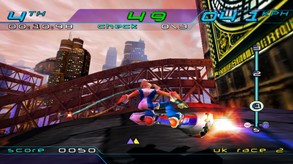
From the standpoint of aesthetics, TrickStyle still has an unmistakable personality. The game’s three world hubs—American, Japanese, and British cityscapes—are designed with a strong futuristic sensibility, each a blend of late-90s sci-fi vision and exaggerated metropolitan design. While the graphics are clearly dated today, their bold colors, dramatic angles, and stylized environments retain a retro charm. Riders themselves embody the era’s fascination with cyberpunk fashion and extreme sports culture, sporting oversized clothing, sharp silhouettes, and hoverboards that glow with wild energy. The soundtrack, composed of pulsing electronic tracks, further reinforces the game’s identity as a stylish arcade racer rather than a grounded simulation. Even now, it’s easy to appreciate how much effort was put into crafting a coherent and memorable atmosphere.
Mechanically, TrickStyle splits its gameplay between two core experiences: competitive races and stunt challenges. Races take players through high-speed courses filled with tight turns, overlapping ramps, airborne conveyors, and occasional environmental hazards. The hoverboards handle differently than traditional racing vehicles—they drift in broad arcs, accelerate in fluid surges, and require a combination of timing and spatial awareness to master. There’s a sense of floaty momentum that gives TrickStyle a unique rhythm, making even straightforward tracks feel slightly unpredictable. Stunt challenges, on the other hand, emphasize acrobatics over speed. Within the Velodrome, the game tasks you with performing airborne spins, flips, grinds, and multi-trick chains to pass instructor tests and unlock new abilities. These challenges expand your skillset and add variety to the progression, even if the trick system itself is ultimately more shallow than the game initially suggests.
As fun as the concept is, TrickStyle’s limitations become clear once you spend extended time with it. The stunt system, while flashy, lacks depth; many tricks are easy to execute, and the game doesn’t offer the intricate combo-building mechanics seen in later extreme-sports titles. Likewise, the racing AI often oscillates between overly aggressive and oddly passive, which can make races feel inconsistent or unfair. Collision detection can be frustrating, sometimes stopping your momentum abruptly or causing crashes that don’t feel deserved. The track design, while creative, can also feel cramped, funneling players through narrow pathways that limit the sense of freedom the hoverboard theme naturally suggests. These elements give the game an uneven difficulty curve and make certain events more about memorizing layouts than honing technique.
Despite its flaws, TrickStyle has an undeniable charm driven by its ambition and energy. There’s something inherently enjoyable about hurtling through cyber-futuristic skylines on a hoverboard, chaining flashy spins, and weaving between obstacles at high speed. The game’s pick-up-and-play structure means it excels in short sessions, offering bursts of stylish racing without overwhelming the player with complex systems or lengthy campaigns. Modern players approaching the game with appropriate expectations—understanding that it represents a transitional moment in arcade design—will find enjoyment in rediscovering a title that dared to pursue a vision quite different from the racing genre norms of its time.
In the end, TrickStyle is a product of its era: innovative, stylish, a bit rough around the edges, and not nearly as deep as its futuristic premise suggests. But it remains a fascinating piece of racing-game history, one that stands out precisely because it tried something unconventional. For fans of retro futurism, arcade racers, or Criterion’s early work, the game offers a nostalgic and entertaining trip into a version of the future as imagined in 1999. It might not satisfy players looking for modern polish or mechanical depth, but for those who appreciate bold concepts and kinetic style, TrickStyle still has plenty of spark left in its circuits.
Rating: 7/10