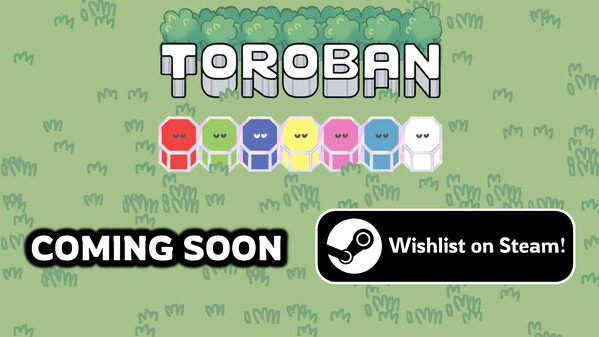
Toroban is an infinitely wrapping puzzle game.
Modeled estimate, not a reported figure. How we estimate →
Media

About
Toroban is an infinitely wrapping puzzle game. Explore a nonlinear overworld full of interconnected puzzles. There are various biomes to experience, each with unique mechanics and themes. The game initially launched with 270 solvable puzzles, but the final endgame area is still under development.
This is the starting area, which contains simple toroidal puzzles with blocks, buttons, and gates.
The walls have crumbled in this area, allowing access to puzzles from the outside world. Objects can be transferred between puzzles. Players must alternate between activating the toroidal puzzles and interacting with the puzzles from the outside world.
This area contains X and Y axis blocks, that when moved, shift the alignment of the toroidal grid.
The characters in Toroban are called toros. There can be multiple toros in a puzzle, and this area explores the concepts of how they can work together to solve puzzles.
All of the mechanics combine together in this area. Completely new kinds of puzzles emerge!
Various overworld mechanics are used within puzzles here. NOTE: This area is still under development, but is beatable in the current state.
Stats
All-time low is the lowest price we've recorded for this game since we started tracking it.
Languages: English
Engagement
Reviews
Themes across 40 recent reviews and how positive each mention is. A keyword signal, not full sentiment analysis.
Reviews
This review is painful to write. In theory, I love the ideas in the game, and I did put in quite a lot of hours into the game. But the execution is bad enough to leave a sour taste in my mouth. [b]TL;DR:[/b] Area 2 (Ruins) is full of smart puzzles and ideas. The rest of the game doesn't quite hold up. It's probably worth getting at 50% off. [b]Note:[/b] The first half of this review has a few early mechanics. The second half dives deep into many more mechanics, so they are all spoilers. [hr][/hr] Toroban starts with a simple premise: Sokoban on a toroidal grid. This, by itself, isn't too meaningful, and the game recognizes it because it immediately introduces another mechanic: buttons and gates. And throughout the game, you get introduced into more and more mechanics. Each "puzzle" is outlined by a region, so naturally you have regions inside regions, including ways to smuggle objects between regions. Restarting a puzzle has a few quirks, and it becomes a full-blown mechanic. The toroidal grid doesn't have to repeat exactly in a lattice pattern, and offset blocks are introduced that change how the grid repeats. There are also a few mechanics that come from more "normal" Sokoban: water, multiple characters, sticky blocks, etc. The game is divided into multiple areas, further divided into several sub-areas. Each sub-area has several puzzles, concluding with a single overworld block. Since Sokoban rules apply, you can move this overworld block anywhere you want; in particular, you can move it to the hub, which lets you unlock new overworld gates to access more sub-areas. This is a pretty clever way to unlock new levels. Every single sub-area is worth exactly one block, and beyond the first sub-area for each mechanic, there are a ton of sub-areas that get unlocked. That means you can choose which sub-areas you want to do; find whichever mechanic clicks to you. (Although in a sub-area, it's all or nothing; you need to finish all the puzzles there, or you don't get your block.) I play a lot of thinky puzzle games. Usually, "meta" overworld stuff is a late-game mechanic, even though there has been a trend to have meta mechanics earlier and earlier. This game gleefully introduces it to you in Area 2 (Ruins), likely the earliest from games I own. For me, that's delightful. It's basically entirely made of these kinds of meta mechanics, and it's a joy to explore and solve. So, what's the problem? It's ultimately still Sokoban. There's a ton of pushing blocks, often through a long way. It's ultimately up to the puzzle design to make sure it doesn't get mind-numbingly boring to solve a level. And I think Toroban fails this. Terribly. For instance, one of the puzzles in Area 1 shows how to implement one-way paths, so that you have to cycle through the level several times to bring a block throughout the level. One later puzzle has this exact same pattern, but extended four times: you have to bring the block four times as long, [b]and[/b] each step you have to traverse the entire level four times as long. What? And this is not just this one puzzle. There are many, where the core idea is simple, but the level is sooo long and requires you to repeat the same sequence of actions multiple times for no reason. [hr][/hr] I called out that the level design is poor, but even the mechanics aren't exempt. While I in general love the entirety of Area 2 (Ruins), and I don't have any issues with Area 1 (Grasslands) for being the tutorial, the other areas have some problematic mechanics. Area 3 (Fall) introduces multiple toros that move together. Toros of the same color stick together, too. So obviously you have levels about carefully nudging the toros around to construct a huge structure. You know what you want to do, but you're making a ton of little steps just to avoid toros sticking together at the wrong point. It's pretty bad. Also, while this area does have some uses of the toroidal mechanic -- including being able to make an "infinitely large" group of toro -- I think it's a bit detached from the rest of the game. Area 4 (Snow) introduces offset blocks. Maybe it's just me, but offset blocks are so hard to wrap my head around. The level design isn't helping much either. A common example is this. The grid is 11 units wide. You have a sequence of moves that lets you offset the grid by 8 units horizontally. You need to ultimately offset the grid by 4 units. So what you need to do is, you repeat the 8-unit offset 6 times, offsetting the entire grid 48 units in total; because the grid is 11 units wide, this is equal to 4 units of offset. There is no simpler way to do it; you need to do the offset that many times. So once again you're repeating the same sequence of moves many times without any new clever idea. Area 5 (Desert) is about combining the mechanics in previous areas. That comes with new ways of getting mind-numbing solutions. Using offset blocks to separate multiple toros that got stuck together is a clever idea in theory, but repeating it many times to convert 9 toros stuck horizontally to become stuck vertically isn't interesting. Area 6 (Cosmic) has a ton of new mechanics, including overworld stuff, and I think this area has the most egregiously bad mechanics. One sub-area is about overworld restarting. Did you know you can restart the overworld? The puzzles in this area aren't too problematic; it's usually about the overworld toro entering a puzzle to help something, and then restarting the overworld to escape getting stuck in the puzzle. Fortunately, it keeps all the puzzles solved. Unfortunately... Remember how the reward for solving a sub-area is a block you can bring into the hub or anywhere else? Yes, that block gets reset. Have fun bringing it over to the hub again. Yes, you can run. It's still tiresome to bring a block for over 100 squares of movement. Another sub-area introduces the inverted world. You can already see this from the very beginning of the game, because inverting the world is listed under controls. That's probably a problem. (They explain that you're supposed to go to the inverted world by zooming in/out all the way past the limits.) Anyway, I don't think this mechanic holds it weight. What happens is, you have land and water on different places on the two worlds, so you invert liberally to see where you can move next. Speaking of inverting the world, there are some secret puzzles you can only access when you invert the world. As in, not just access the locations of the puzzles; the puzzles themselves only appear when inverted. I think the color scheme for inverting the world is pretty jarring to look at, and being forced to solve many levels with this color scheme kind of sucks. Yet another sub-area of Cosmic introduces overlapping puzzles, which feels right at home in Area 2. But the puzzle design leaves a lot to be desired. I remember, in one of the levels here, I had to swap between puzzles for like 60 times, each time making incremental progress on one puzzle before restarting the other puzzle to pull out everything. Maybe I didn't find a more clever solution there, but it still feels weird. And after I completed Area 6, I was rewarded with the endgame. Sorry, I mean the end-"game", because apparently the endgame is unfinished. It's weird and a bit worrying to see this trend in some puzzle games; they have an expansive world, but the endgame isn't done at the time of release. I would assume this is the use case of Early Access? [hr][/hr] So, that's about it. In theory, I love the concept and a lot of the mechanics explored in this game. In practice, many of the levels are boring, and even some of the mechanics are worrying. I love a lot of Ruins, and if the game had been only about it (and expanded it more), I think I would be pretty happy with it. So, I'd recommend it for Ruins, but I'm not sure I can recommend it for the other areas. And at this price point for the area alone, it's probably a bit much.

Related
Related
Trends
Concurrent players on Steam, sampled daily since tracking started.
Hours played at review time, across 40 reviews with recorded playtime.
positive critical· bar length = how often the theme comes up
I was playing to see the endgame and all I got was this crummy sign The game isn't finished and there was no indication of this from the store page. The concept is incredible and I will enjoy the rest of the puzzles that are here, but It feels very much like a scam to not realease the game with an ending a few months from now.
最初は面白いのに進むほど退屈になる、ちょっと残念な変形倉庫番パズル。 盤面のループをコアシステムとし、様々な「システムの理解」をプレイヤーに伝えながらメタ構造化したパズルを解体・再構築して解いていくパズルゲーム。その仕組み自体は素晴らしい! なので評価したかった!! のですが!!! 肝 心 の パ ズ ル が 面 白 く な い ! ・レガシー倉庫番のような「目的地の隣に置いてある箱を、遠くまで運んで折り返して戻ってくる」類の単純作業の繰り返し ・箱2つで成立してるアイデアを「次は箱8つ」でやらされるような、無意味な肥大化 ・類問が多い。全然違う解き方になるならいいけど、似たことをやれば解けてしまう ・手垢のついた複数プレイヤー操作で正確な位置合わせを強いる面倒なだけのエリア(盤面ループ関係ないし) ・すごく面白くなりそうだったのに、結局試行錯誤以外の解決策が無い、面倒で厄介な[spoiler]X/Y Offset[/spoiler]は上記の作問の悪さと相まって非常に相性が悪く、最悪な体験に ・[spoiler]せっかく集めたアイテムを強制的に初期化させられるHard Resetを使わないと解けないエリア[/spoiler] ・[spoiler]わざわざ奥に用意した裏世界なのに、表世界の没レベル集かと思うくらい全く同じことをもう一度やらされる、存在する意味が分からない[/spoiler]エクストラ要素 ・というか、エンドコンテンツがまだ完成していないらしいです。 など、全体的に作問レベルが「手数が多い=難しい」という評価だった前時代的なデザインになってしまっています。これは本当に残念。「分かってることを何回もやらされる」「分かってるのに面倒臭いからモチベーションが下がる」ゲーム体験になってしまいました。 しかし、[spoiler]矢印自体を動かしてループ領域を動的に変えたり、ボタンの仕組みを考えたりするRuins[/spoiler]エリアはパズルとして面白いものだったので、このエリアはプレイする価値あり。 一部のギミック・パズルはしっかり退屈である事を理解した上で、この変なループシステムの世界に興味があったら遊んでみるとよいです。 https://www.youtube.com/watch?v=WSt1k3QuXNc
yeah, this has the problem the ufo 50 sokoban had: a lot of the puzzles are just tedious. you'll solve them, but you are like 300 moves from completing it because of how the level is laid out. you'll see the answer, but in order to finish the puzzle, you gotta make your character walk around the whole thing in a big circle to go move a modifier then go all the way back to move a block a little bit and rinse and repeat a bunch. it also does that thing every sokoban seems to do where there are just difficulty spikes vs. more gradual difficulty increase. some sub areas will have like 5 puzzles, 4 will be getting slowly more difficult and well done, then the final puzzle will just expect you to figure out a new mechanic or something. it's like when I took programming classes, what would happen every time is you get a nice progression for the 1st dozen lessons, then suddenly, oops, didn't teach you this, google it mother ♥♥♥♥♥♥. but in the context of a puzzle game it's like, either figure it out, or look up a guide, which like, ugh, I don't want to do that when I hit a wall. with how the levels are set up, that harder puzzle is crucial to getting the block you need to unlock more puzzles. so yeah, don't think I'll finish this one. just kind of annoying after a while...
This game is not actually complete yet. I'm pretty annoyed that all the culmination of my learning interesting mechanics and interactions resulted in "THE FINALE IS A WORK IN PROGRESS" sign that I didn't even believe at first. Yeah I'm giving this a thumbs up because I enjoyed the part that's available but *THIS GAME IS INCOMPLETE* SHOULD BE LISTED ON THE STORE PAGE
Well, we were a bit overdue for the every-third-year complete reimagining of sokoban, this is as good as any a representative! And yeah, this one's... veeeery very clever. Not afraid to get weird and freaky fast, either - really, anything outside the forest area is stuff you won't see in any other sokoban, and I love it for that. Lots of mechanics come at you fast but not too fast, and the puzzle difficulty is satisfying as heck, much harder than Patrick's Parabox on the whole in my opinion. Plus, there's a ton of content here - currently 270 puzzles that took me about 27 hours to clear all of, and while the game is not quite complete at the moment (wish this was advertised), it's got more than enough bang for your buck. I will say that... some of the puzzles. Maybe not a huge fan of. A lot of the offset puzzles, especially the harder ones, tend to get really fiddly and annoying in a way that no other puzzle type really encroaches on because getting things in just the right alignment is... not difficult, just annoying. Some puzzles I'd already pretty much "solved" but had to spend a ton of time getting things aligned just right and it was never, uhh, fun. There's a lot of lategame puzzles than kinda descend into tedium but these tended to be the most egregious. I also feel like the [spoiler]inverted[/spoiler] puzzles broadly come off as filler - for whatever reason they trend [i]easier[/i] than the other puzzles in the game despite being essentially the secret/postgame puzzles of the game, like, they're fine to have but frankly I almost never felt challenged by them. I don't really want to get too deep into the specifics because seeing all the mechanics naturally emerge from the core premise and all the ways they interact over the course of the game is most of the fun - this part of the game does admittedly feel frontloaded and there's not much of the Cosmic realm to really add onto those base mechanics by the end, which is a biiiit of a shame, but I'm eagerly awaiting whatever proper endgame content this game is supposed to receive - just wish I'd had that content from the start, I guess!
我想用內容欺詐來形容這款遊戲,我只推薦玩到第二區域(Ruins)。這款遊戲的第二區域展現了令人驚艷的謎題與機制,但後面大部分都糟透了。 分點說明為何我不推薦這款遊戲的絕大部分: 一、過度騰挪 我自認是個騰挪題愛好者,個人認為好的騰挪題可能有兩個標準,一個是避免單純只是重複機械性騰挪,而是設計了不同的阻礙;另一個是擁有匹配其騰挪步驟的美感,可能是謎面足夠優雅有趣抑或是解法帶來令人耳目一新的感受。很可惜,這款遊戲沒有做到。裡面的騰挪基本全是很快就知道自己要做什麼,然後花好幾分鐘實現,過程中除了手痠沒有任何障礙。 二、引入一些糟糕的機制,卻沒有用糟糕的機制帶來足夠的樂趣 我想特別提及的是第三區域的機制、第六區域的全局重置與相反色(第五點展開說明)。第三區域引入了非常讓人困惑的機制,設計出的題目沒有足夠的樂趣,這點在其他人評論中多有提及。此外,第六區域的全局重置每次重置後也很讓人煩躁(第三點展開說明)。 三、令人枯燥的跑圖體驗 遊戲中只設置了六個傳送點分別傳送到六個區域。而重置點位設置在第一區域的開頭而非傳送點。每次跑到目標可能都要花30秒左右,相當不便。此外,而解鎖區域的方式是搬磚跑圖;我相信很多人把所有磚塊搬出來後,見到第六區域的全局重置機制就傻眼了。即使在第六區域有快捷的全局解鎖方式,依然讓人不爽。 四、這是未完成的作品,但商店頁面沒有明確說明(這也是我認為欺詐的主因) 這款遊戲的後期謎題尚未做完,同時塞入了不少與前面完全雷同的題目。遊戲簡介說第六區域存在"more advanced sub-puzzles",很遺憾的是,目前基本是使用廢案關卡填充。 五、相反色美術 看這遊戲宣傳片的美術很正常──但倘若把所有東西都用相反色呢?如果你想100%這款遊戲,有一半的謎題要在相反色中進行,十分瞎眼。 這款遊戲我只建議不追求100%、不介意半成品、不反感機械勞動且不在乎價格的玩家遊玩。不推薦不滿足這些條件的玩家遊玩。
一款以四向连续地图为基础机制的推箱子游戏,结合一些原创机制和一些常见的推箱机制如多控、黏连等。 原创机制部分很优秀,初见让人眼前一亮。 尤其是[spoiler]region机制[/spoiler],和四向连续天然很契合,直观且有深度,玩[spoiler]ruins区[/spoiler]的时候有一种“这就是meta谜题该有的样子”的感觉。 [spoiler]offset机制[/spoiler]虽然也很神,但是玩起来好累。它很难被熟练掌握,即使到游戏后期,我还是需要不停试错。大部分游戏时间都花在这些关卡上了。 关卡设计方面有优秀机制加持,自然会有一些比较好玩的点子。但是一些关卡的规模稍大了一些,有不少需要重复腾挪的关卡,有些无聊。 undo设计需要优化一下,速度太慢了。尤其是[spoiler]hard reset关卡,每次reset回来都要跑挺长一段路[/spoiler],如果发现布局错了就要undo很久。 如果没有[spoiler]offset和苦力腾挪关卡[/spoiler],我会强烈推荐这款游戏。 但是现在,看在[spoiler]ruins的份上[/spoiler]做稍微推荐。
Having solved all 270 puzzles and solved every overworld secret that are currently implemented (the true endgame puzzle is currently missing in the full release), I must say that while this is a great game and the puzzles are a lot of fun (for the most part), there is something strange about how the puzzles are laid out, difficult wise. Without getting in the how, later in the game you find hidden puzzles that, you would think should be harder than the main puzzles, because, well, they're hidden and meant to be found later on. But they, for some reason, are easier to solve most of the main puzzles, and in fact, some of them tutorialize less obvious mechanisms better than in the main game puzzles. This is an odd design choice, to say the least. As for the puzles themselves, they're generally pretty good, you can usually infer a solution by looking at what is in front of you. An exception to that would be some of the offset puzzles, where visualizing a solution is almost impossible, and solving them is mostly trial and error until the level layout just become the specific state you need it to be, which is just frustrating. Some of the puzzles are also simply too complex for no reason, and you have solved them in your head way before you have inputted the very long sequence of move that gets you to the solution. The most egregious example of that is a puzzle where you have to shifts blocks in a rotation around a set path, and it could have involved only 3-4 blocks, and you would get the concept. But no, there's like 8 blocks or something, and so you have to repeat what sequence of move that many times. But to be fair, most of those puzzles are (funnily enough) part of the main game, and would not be needed to be solved to solve the eventual endgame (which seemingly would involve solving every single one of those easier, extra puzzles), so that could probably be excused. But it is kind of a lame way to pad out the playtime. Overall, it was pleasant experience and I would recommand it to sokoban fans. But be ready to have to suffer through a few duds to get to the good stuff.
[h1]The short version[/h1] [b]Toroban[/b] is a sokoban style puzzle game where the levels loop, The game [b]starts out strong[/b], exploring its mechanics feels rewarding for the first leg of the game. [b]the final[/b] area though has multiple puzzles that exist only to [b]waste your time[/b]. With the game's [b]endgame not implemented yet[/b] the store page lacking [i]Early Access[/i] tag on the store page makes me not recommend the game yet. [h1]A comprehensive review[/h1] Toroban has a lot of areas, this section each area will be discussed one by one. To avoid confusion this review will use the games terminology, the following are needed to understand this review: [list] [*]Toros: These are the critters you control during the game. [*][i]Italics[/i] are used to notify the names of subsections. [/list] [h3]Spoilers ahead[/h3] [h2]Grass[/h2] The opening of the game, these puzzles are very basic intentionally, it teaches you the very basics followed by the mechanic named after the section [i]Gate Holding[/i] which is a mechanic used for the rest of the game. The puzzles after that especially in [i]Too Many Blocks[/i] are a exercise in patience being more about play length rather then puzzle complexity with [i]Advanced Gates redeeming it slightly[/i] [h2]Ruins[/h2] The largest and probably best area in the game, Levels within levels are the main theme here. The game teaches you how to manipulate the borders of levels, some levels are simple while others ask you to understand the game better before progressing. The same area also teaches you to [i]Restart[/i], where the option to reset is part of the solution, In a good Quality of Life feature it is possible to rewind trough a reset. The section [i]Region Gates[/i] is where the weakness of the game starts showing, the second to last puzzle asks you to repeat a step six times. The final section titled [i]Ruins Challenge[/i] combines all the mechanics learned in this zone and are among the better puzzles in the game. [h2]Snow[/h2] Initially a slow introduction to the most complex mechanic in the game titled [i]Offset[/i], these are push-able objects that change how the loops occur. The first section is simple but for a good reason, the second section [i]More Offset[/i] show the potential of this mechanic. [i]X Y Offset[/i] ups the complexity further only for some weird choices to be made in [i]Extreme Offset[/i]: three of the four puzzles use a math style puzzle where you need to figure out how to get the right offset by combining multiple blocks but the fourth is a standard puzzle where the environment changes as you progress trough the puzzle. [h2]Fall[/h2] The weakest of the standard sections in the game, the puzzles have you control multiple Toros at the same time and in some cases asking you to eliminate some them to solve the puzzle. [i]Separated Toros[/i] asks you to do that whilst there stuck together. separating them by egress and re-entering the level. In the end the puzzles in Fall ask for very careful movement, this is a matter of taste on whether you enjoy these type of tight movements or not. [h2]Desert[/h2] Desert combines the mechanics of the previous three sections leading to some of the more complex puzzles of the game, [i]Offsets & Toros[/i] has some clever overlap between the mechanics found in Fall and Snow. Other then that it is a natural escalation of the game thus far. [h2]Secrets[/h2] Each area up to this point has a secret area found trough a mechanic learned in the final one. These each hold puzzles that are a remix of a already existing puzzle, The majority of which are just the same as the puzzle it is based on without being meaningfully changed thus asking you to solve them again just with a few extra steps making the vast majority of them a waste of time. [h2]Cosmic[/h2] This area is "incomplete" but more on that later, it has five sections each with their own mechanics serving as a tutorial for the end game. [i]Overworld Restart[/i] is the worst part of the game, the puzzles are simple but each step of the journey asks you to full overworld reset making you walk back each time to solve puzzles that would otherwise belong to Grass. Next is [i]Parallel World[/i] which uses one of the simplest puzzle mechanics where you swap between two different versions of the level, this same mechanic is used to access the secrets of the other areas but as a puzzle mechanic it is just a extra button to press. [i]Overlapping Puzzles[/i] is a good section, a natural evolution of the mechanics already found in Ruins and serve as decent brain teasers. [i]Portals[/i] I have very little to say about, it is a simple mechanic used decently despite the best puzzle being better suited for Snow. And finally we have [i]Overworld Paths[/i], a interlocking set of puzzles requiring overworld interactions. Something the game could have introduced earlier but to the game's credit this puzzle is genuinely difficult. [h2]The endgame... (and conclusion)[/h2] ...or lack there of, your final reward for finishing the game is a sign telling you that the game is not yet finished. This is not uncommon for small puzzle games however most of those at least feel rewarding when you complete them. Had this game labeled itself as early access then it would safe itself from this criticism, but the fact there are pieces of the world that cannot be accessed with a number of puzzles that are nothing but a slog to get trough makes me ultimately nor recommend this game.
Momentum
Pace estimated from the game's recent review growth (our daily snapshots) at its own sales-per-review ratio — a momentum signal, not booked sales.
Audience
Estimated from the language of this game's reviews — a proxy for where players are, not official Steam demographics.
Related
| Thekku Island | $22.8K | 149 | 87% | $7.99 |
| おしゃべりキング!コミュ力診断ゲーム | $22.8K | 71 | 97% | $8.99 |
| Healer's Quest | $22.8K | 321 | 84% | $3.74 |
| Dance of Death | $22.8K | 335 | 64% | $0.99 |
| Incoming + Incoming Forces | $22.8K | 357 | 57% | $2.99 |
| Detective Ridelle | $22.8K | 88 | 99% | $14.99 |