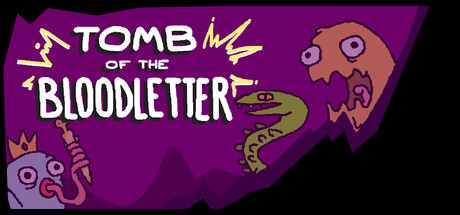
Tomb of the Bloodletter is a strategic word roguelike where your keyboard becomes your arsenal. Use your wit to unleash deadly words through tactical combinations of your letters to defeat the denizens of this dingy tomb and claim the Bloodletter for yourself...
Modeled estimate, not a reported figure. How we estimate →
Media

About

Your keyboard is your arsenal. Your words are your weapons.
Tomb of the Bloodletter is a strategic word roguelike where each letter of your keyboard channels unpredictable Magicks. Combine them into tactical words to unleash devastating attacks, clever defenses, and absurd effects as you battle your way through the cursed halls of a dingy, haunted tomb.

Whether you play as the Heretic, Adventurer, Scholar, or Prophet, every character brings quirks and abilities that twist the rules of the game and change your approach to combat. A Scholar whose brilliance fades turn by turn. A Prophet indebted to a demanding “lord.” No matter who you choose, you won’t survive unscathed.

At the start of each floor, you’ll craft a word to form your path. Choose between rooms that strengthen your arsenal, restore your health, or twist your Magick rerolls. You can have it all… if your vocabulary is sharp enough to forge it.
Enter a floor and your letters hum with Magicks. Create tactical combinations by mixing Magicks that should probably never interact. They obey peculiar rules, and mastering them is half the fun. One might strike harder if placed at the end of a word, another might heal you, and a third might hurt you simply for using too many vowels. The most cursed can become your greatest weapon… if you’re clever or desperate enough.
As you descend, you’ll acquire new Magicks, whether you want to or not, slowly turning your keyboard into a deck of magnificent, uncontrollable chaos. It’s not just your loadout; it’s your spellbook, your weapon rack, and your greatest liability.
Success isn’t a big vocabulary, it’s tactical combinations: sequencing the right letters, at the right time, in the right word.
The Tomb crawls with cursed beasts, deceitful specters, and entities best left unspoken. Each foe is handcrafted with unique mechanics that demand clever thinking and precise wordplay to overcome. Use every ounce of your tactical and verbal acumen to overcome their dastardly tricks!

Claim the Bloodletter—or else it shall spell your doom.
Stats
All-time low is the lowest price we've recorded for this game since we started tracking it.
Languages: English
Engagement
Hours played at review time, across 41 reviews with recorded playtime.
Reviews
Themes across 41 recent reviews and how positive each mention is. A keyword signal, not full sentiment analysis.
positive critical· bar length = how often the theme comes up
Reviews
So, basically, this is a word game. Okay, why not. I like this kind of games. BUT You can't type words that are 12+ letters long. You "fight" enemies with random powerups, 50% of them will actually hurt or kill you in your OWN "deck". Each enemy has a gimmick, for instance, there is one that will one shot you the next turn, if you don't kill yourself first with the negative effects on your letters. Another one limits your capacity to write maximum 6 letter words. So you can not inflict enough damage or heal enough, I dragged a fight for 40 minutes, using a power up that heals both player and the enemy for the same amount (what's the point apart dragging on, really....) before giving up on this one, it was absolutely impossible with only 6 letter words. An awful lot of words aren't recognized so I have to type whatever comes to mind until it just works. I don't want to be mean. There is a good idea behind this game, but there is no balance whatsoever. If what I said can frustrate you, well, you will be frustrated. If you don't mind it, play the game. EDIT : to add insult to injury, I managed to get to the 3rd world, just to discover that healing doesn't work, against an invincible enemy with too much armor and attack.
Nothing but respect for the developer for trying something new and fresh. It is truly an amazing concept for a game, and I will keep an eye on their future games, but unfortunately the execution on this is not what I expected. If you want TL:DR, the game is just not fun, that's the core problem. It also feels like a quick game jam proof of concept, rather than a finished game. I would keep this game if it was an early access or a demo, but I'm kinda surprised this took two years. It is so bare bones, with stock animations and sound design (which I had to turn off), very few items, few attack types, very few art and enemies, who have no patterns, no types, just random everything. UI is also either very confusing, or very misleading, I would know which for sure if I figured out what it was trying to say in some cases. What the game promises is that your keys will have "quirks", some good, some bad, and you have to navigate your way and find a fitting word. In reality, you have mostly bad quirks, that are getting worse and worse, and sometimes game decides to spit out -1 damage for you to use (not always, believe it or not) on enemy with 20 health, while it does 6 in return, which somehow damages you with 9? and also burns 5 of your letters and then your vowels are gone? Even if you mitigate this and win, the game just straight up punishes you with "rewards". Each reward comes with a downside that is just agonizing, they can just kill your chances of finishing the run. They're just really really ♥♥♥♥♥♥, man. The "reward" system sucks so much. You just have no incentive to win the battle, there is nothing really good waiting for you, nothing you will get excited by. It's just not fun at all. This is the weirdest execution of the roguelike formula I've seen. If you want an example of what a battle in this game looks like: I faced an enemy who took away one of my letters each turn, and on each of my turns I would just get a single, one (1) attacking boon that did -1 damage, each time on "J" key. I just used the word "Just" 4 times and won the battle.
There are too many issues with this game as if they haven't even played it. Some of the enemies will just soft lock you from beating them or even hurting them. There are magics that don't work correctly and instead of doing what they say do the opposite. There are too many effects that reduce the fun of the game, and make it very frustrating to play. Getting your abilities stuck on letters like Z or Q or X and then not able to really use them in any ways outside of using one of your very limited rerolls. It's just really annoying and sucks the fun out of the game. The price is really good but it feels like a demo and not a full release.
Enemies are too spongy, most of the "power-ups" actually hurt you instead of the enemy, the amount of damage you can do with your powerups is miniscule compared to the amount the enemy can do, and the rate at which you gain more powerups is painfully slow 5 is not enough. Basically completely unbalanced with the only redeeming factor being the art, and that's just personal preference. Needs to be worked on some more and rebalanced and it could be cool.
it's pretty unbalanced, feels like it relies too much on luck alone
small edit: a theme with a lot of the negative reviews is that they didn't understand the Fury mechanic. where you can damage yourself to gain an increase to all damage you deal during a given fight; in other words, *self-damage is a deliberate and well-thought-out mechanic, abilities don't cause self-damage just because the game hates you, and engaging with it is often necessary to do well in the game*. this is why many abilities involve damaging yourself to some degree, these reviews likely indicate that Fury could've been explained better in the game, and i could definitely see that argument; but it is entirely a reasonable game mechanic. just wanted to preface this review by addressing this specific point ——— easily my favorite word-based roguelike i've tried so far. it differentiates itself (from the ones i've tried and subsequently lost interest in) by not trying to be scrabble-flavored balatro, but something altogether different. the game does not, by default, limit the letters you can use. you can write any up-to-12-letter word you can think of, but you must account for the magicks—what keys are they on right now? what order do you want them to activate in? how many times can you use this letter in a single word, so that the magick procs multiple times for this usage? should you leave a magick on a certain key so that you can use it in a later turn instead? considerations like these make the game feel quite dynamic in a way that others haven't, to me. of course, on top of this, Bloodletter is oriented around a combat system in which you must manage your health and healing, fury (a meter which adds +1 damage to your attacks whenever you damage yourself for 4 health), and things which attack or debuff the enemy. different magicks play with these mechanics in different ways, and finding the right word to do exactly the combination of magicks you need is massively satisfying. the fact that word length or complexity isn't a constant factor feels good; play the word that does what you need it to. sometimes that will be a long and obscure word that tests your vocabulary, and other times, it'll be a simple one with 4 letters or less. the magicks get distributed randomly onto the keyboard, and, while this can sometimes lead to "bad hands," you can use a resource called "prayers" to get a new "hand", helping to mitigate the effect of sheer randomness. i think it needs to be there to some degree to prevent overly static strategies from trivializing the game. there are also tools you can acquire from carpenter rooms, which are items you can activate when you need them, separate from the magicks on your keyboard. additionally, there are various status effects in the game, such as one that prevents you from using an afflicted letter; these statuses (often inflicted by enemies) are generally the only thing that will limit your letter selection, which is fair. indeed, the way enemies are designed in this game, i often feel like i have to approach each one noticeably differently than the others (especially on later floors). all of these factors serve to add a good deal of variety to the your runs. you are also tasked to create a word at the start of each of the 3 floors which will define the rewards you get after each fight (with at least a couple room types guaranteed to be vowels, so as to prevent empty rooms being unavoidable). i have so far always been able to create a word that has a reward after each room, though it's usually difficult to get exactly what i want, which is, again, fair. every room will also permit you to choose a new magick regardless of the kind of room you were in, though these are always accompanied with some extra effect (usually a bad effect if the magick is good, and maybe a more positive effect for a more mediocre one). some negative reviews have said that this feels like you're always punished for trying to improve your deck, but this is not the case with the room-based rewards (including the room that gives you a choice between 5 magicks), not to mention most of the negative effects only last for 1 fight, so i don't think that makes sense to say. you are also allowed to opt not to take a magick in this way a limited number of times. the presentation is really charming, i think. i quite enjoy the art and sound design/OST, and the enemy designs are fun. i will say, one thing that's a little disappointing is that, as things are right now, the runs seem to just kind of End—but i also have not beaten a basic run with alll 4 characters yet, which the game all but tells you is hiding some Slay the Spire-esque final floor, or something of that sort. i'll reserve most of my judgment until then, but i still think this point stands, because as it is, there aren't really bosses so much as just a set amount of fights per floor, and having to beat 4 runs minimum to (maybe) have something like that would still be a bit unfortunate, imo. overall, tho, i'm genuinely enamored with the game so far and look forward to doing more runs! the game is quite satisfying to play, and i really do enjoy finding the best word to take advantage of the magicks i have in front of me on any given turn. definitely recommend for any word-game/roguelike enjoyers, especially any who are looking for gameplay that departs from the realm of Scrabble-esque point-maxing
It's a fun game but it's EGREGIOUSLY unbalanced. I know roguelikes tend to be very luck oriented but unless you get a god run you're basically confirmed to lose at some point when you run into an enemy that has some BS buffs and gimmicks. Despite that i still do recommend it. It's still a fun game despite how unbalanced it is, and it's only 8 bucks. I dont regret my purchase, but they do gotta rebalance some stuff with this game ngl.
Tomb of the Bloodletter is a strikingly inventive roguelike developed by Ethan’s Secretions and published by indie.io, built around a simple but bold premise: your keyboard is your weapon. Rather than swinging swords or casting spells through hotkeys, every action in the game is performed by forming words. It blends turn-based dungeon crawling with word construction in a way that feels both cerebral and tense, creating an experience that rewards vocabulary, creativity, and strategic planning in equal measure. The game places players inside a cursed tomb filled with grotesque enemies and unpredictable magical forces. Each descent into the dungeon is structured as a roguelike run, meaning death resets progress and forces you to start anew. What sets it apart from traditional roguelikes is how deeply the typing mechanic is integrated into its systems. Every letter on your keyboard is tied to a magical property—some inflict damage, others provide healing, and some trigger special effects that can benefit or hinder you depending on how they are used. Combat unfolds through carefully crafted words, where letter placement and combination matter as much as the word itself. Strategic depth emerges from how these letter-bound magicks interact. Certain letters may amplify effects when placed at the beginning or end of a word, while others may introduce risks that force players to think twice before using them. Crafting a word becomes a tactical puzzle: do you aim for maximum damage, prioritize survival through healing letters, or attempt a risky combination that might trigger powerful but unpredictable effects? Because enemies also possess unique mechanics, each encounter requires adaptation rather than rote repetition. The roguelike structure ensures that no two runs feel identical. Procedural generation determines the layout of encounters, available upgrades, and the combination of magicks assigned to your letters. Over the course of a run, players can unlock new magical properties that reshape how the keyboard functions. This evolving system transforms familiar words into new tactical tools, keeping the experience fresh even after multiple attempts. Character classes further diversify gameplay, with each offering distinct strengths and limitations that encourage different approaches to word-building and risk management. Visually, Tomb of the Bloodletter embraces a stylized, illustrated aesthetic that complements its unconventional mechanics. Enemies are depicted with expressive, sometimes grotesque designs that give personality to each confrontation. The interface is clean and functional, ensuring that players can easily track letter effects, health status, and available actions without feeling overwhelmed. Although the game does not rely on flashy animations or high-end graphics, its presentation reinforces the sense of descending into a mysterious, arcane world where language itself holds power. Difficulty is a defining aspect of the experience. Because runs are unforgiving and healing opportunities can be scarce, mistakes carry weight. Randomized magick assignments can also introduce unexpected challenges, sometimes forcing players to work with less-than-ideal letter combinations. While this randomness may occasionally feel punishing, it also heightens tension and replayability. Success depends not only on vocabulary but on adaptability and foresight. One of the most compelling aspects of Tomb of the Bloodletter is how it transforms a familiar skill—typing—into a strategic battlefield. It is not a game about typing speed alone; instead, it emphasizes thoughtful construction and tactical awareness. Each word becomes a calculated move, and each turn is a negotiation between risk and reward. This fusion of linguistic creativity and roguelike structure makes it stand out within both genres. Ultimately, Tomb of the Bloodletter is a bold and original take on dungeon crawling. It challenges players to think differently about combat, turning letters and language into weapons and shields. While its difficulty and reliance on typing may limit its appeal to some audiences, those who appreciate innovative design and strategic wordplay will find a deeply engaging and refreshingly unique experience within its haunted corridors. Rating: 8/10
It's fun game, but it does suffer from being too random and unpredictable - there's not enough control to allow you to have more control.
The recent (16/04/26) negative reviews here are... weird. Even leaving aside the game costs less than $10, none of them make any sense. "All the buffs have a negative!" Yes, because the entire game is spelling words, and you can use literally any word. Without penalties there'd be no stakes. "It requires you to make up words!" Like, that's the game? If you don't like thinking of words why did you buy a word-making-up game? It's like dungeon-crawling Scrabble - no notes.
Related
Related
Trends
Concurrent players on Steam, sampled daily since tracking started.
Audience
Estimated from the language of this game's reviews — a proxy for where players are, not official Steam demographics.
Related
| REDNEG ALLSTARS SWING-BY EDITION | $21.7K | 91 | 100% | $10.99 |
| ION Shift | $21.7K | 158 | 91% | $5.99 |
| Memories Off #5 Togireta Film | $21.7K | 89 | 89% | $14.99 |
| Warm Monkey | $21.7K | 58 | 91% | $14.99 |
| De-Void | $21.7K | 143 | 62% | $7.99 |
| Humanity Asset | $21.7K | 509 | 31% | $1.99 |