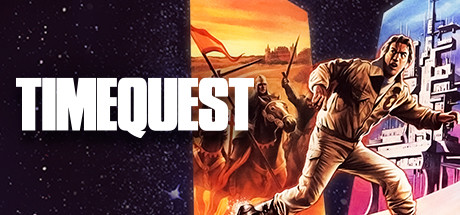
Timequest is a classic graphical text-based adventure game of breathtaking scope and astonishing depth. Travel to 80 locations to see the effects of your actions unfold over 3 millennia.
Modeled estimate, not a reported figure. How we estimate →
About
Genres
Stats
All-time low is the lowest price we've recorded for this game since we started tracking it.
Languages: English
Reviews
A good adventure game that hasn't aged too badly. Runs well without screwing around, parser generally cooperates with what you want to do. Puzzles feel about right, difficulty-wise, maybe a little too easy in some cases. The game is often funny without being a comedy. As far as the time travel thing goes, there's a lot of places that seem static or underdeveloped, but it (unintentionally?) creates a sort of commentary on how things change and don't change throughout history. It's insane that the same tavern and shed has existed since Stonehenge, but strangely deep that the same guy has been polishing the same mug in it the whole time. Anyway, good game.
Timequest, originally developed by Legend Entertainment and brought back to modern platforms by Ziggurat, is a classic adventure title that captures a very specific moment in gaming history—when text-based storytelling was beginning to merge with graphical presentation. Set within a science fiction framework built around time travel, the game places players in the role of an agent tasked with repairing a disrupted timeline after a rogue operative interferes with pivotal historical events. The premise is simple on the surface, but it quickly opens into a sprawling journey across multiple eras, each filled with its own problems to solve and details to uncover. What defines Timequest most is its non-linear structure. Rather than guiding players along a fixed path, it allows access to a wide range of time periods early on, encouraging exploration and experimentation. Players jump between historical settings, from ancient civilizations to more modern contexts, searching for inconsistencies and figuring out how to correct them. This open-ended approach gives the game a sense of scale and freedom that feels ambitious even by today’s standards. At the same time, it demands a great deal of attention and patience, as the connections between different events are not always immediately obvious. Gameplay is rooted in traditional interactive fiction mechanics, combining typed commands with a graphical interface that displays locations and available actions. Players interact with the world by examining objects, speaking with characters, and using items in specific ways to progress. The puzzles are intricate and often interconnected across different time periods, requiring players to think beyond immediate surroundings and consider how actions in one era might influence another. This design can be deeply satisfying when solutions come together, but it also contributes to moments of frustration, especially when progress hinges on subtle or obscure clues. The narrative unfolds gradually through exploration, with each time period offering its own small story that ties into the larger mission of restoring the timeline. Encounters with historical figures and events give the game a sense of authenticity, even if the portrayal leans more toward imaginative interpretation than strict accuracy. The writing is one of the game’s strongest elements, delivering detailed descriptions and occasional humor that help bring its world to life. While the overarching plot remains straightforward, the richness comes from the individual scenarios and the way they interconnect. Visually, the game reflects its early 1990s origins. The graphics are static and relatively simple, serving more as a visual aid than a centerpiece of the experience. Compared to modern adventure games, the presentation can feel dated, but it still complements the text-driven nature of the gameplay. The interface, which blends typed input with clickable options, represents an important step in making interactive fiction more accessible, even if it now feels somewhat cumbersome by contemporary standards. One of the most striking aspects of Timequest is its ambition. The sheer number of locations and the breadth of its timeline create a sense of scale that few games of its era attempted. However, this ambition comes at the cost of accessibility. The lack of clear guidance, combined with complex puzzle design, means that players are often left to figure things out through trial and error. This can be rewarding for those who enjoy methodical problem-solving, but it may feel daunting or even frustrating for players accustomed to more streamlined experiences. Despite its challenges, the game offers a rewarding journey for those willing to engage with its systems. Completing it requires careful observation, logical thinking, and sometimes a willingness to revisit earlier assumptions. While replay value is limited once the puzzles are solved, the initial experience is substantial enough to leave an impression. It’s not a game designed for quick sessions or casual play, but rather one that rewards dedication and attention to detail. In the end, Timequest stands as a testament to a different era of game design—one that prioritized depth, experimentation, and player-driven discovery over accessibility and convenience. It may feel dated in both presentation and structure, but its core ideas remain compelling. For players who appreciate classic adventure games and the challenge of unraveling complex systems, it offers a rich and engaging experience that still holds up in spirit, even if it shows its age in execution. Rating: 6/10
while im to old to figure these out so i just find a walkthrough to go on the adventure, im really enjoying it so far, i made it to Rome , tho they didn't remove the copy protection so i had to google it and screenshot the INTERKRON TROUBLESHOOTING GUIDE i guess it isn't a big deal but it could have been at least noted but outside of that, it is def a great text adventure with awesome active visuals!
Related
Related
Trends
Concurrent players on Steam, sampled daily since tracking started.
Momentum
Pace estimated from the game's recent review growth (our daily snapshots) at its own sales-per-review ratio — a momentum signal, not booked sales.
Related
| Food and Girls | $315.6 | 51 | 86% | $0.99 |
| Bongo Quest | $315.6 | 51 | 45% | $0.49 |
| Glasses and Girls | $315.6 | 51 | 82% | $0.99 |
| Dances and Girls | $322 | 52 | 83% | $0.99 |
| Anime Sunset Ride | $334.4 | 54 | 67% | $0.49 |
| Carnival and Girls | $334.4 | 53 | 85% | $0.99 |