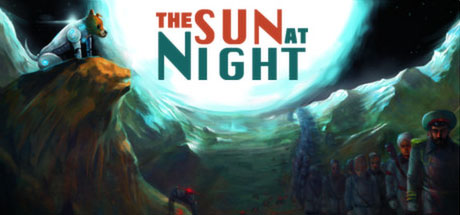
Explore, blast, and shield your way through massive branching levels as Laika the space dog. This 2D adventure features customized gameplay and an incredibly deep narrative.
Modeled estimate, not a reported figure. How we estimate →
Media

About
Stats
All-time low is the lowest price we've recorded for this game since we started tracking it.
Languages: English
Engagement
Hours played at review time, across 45 reviews with recorded playtime.
Reviews
Themes across 44 recent reviews and how positive each mention is. A keyword signal, not full sentiment analysis.
positive critical· bar length = how often the theme comes up
Reviews
[b]The Sun at Night[/b] Rating: 8/10 (Already had this game via Humble Widget, now on Steam) Great, great game. Platformer in metroidvania style but with a lot more exploration added. Has a unique graphic style I have not seen before. It looks like you've seen it before, but when you play it it's just a bit different but quite nice. Controls can be a bit quirky and getting used to; background story is interesting but you need to like sci-fi and astronaut stuff. Music and sound is just fantastic and really hit home. Oh, you play as a dog :-) ( late addition: you can buy the soundtrack from their website. It's one of the better one's )
In Soviet Russia, space dog talks to YOU! ...And does enough fetch quests that the dog jokes write themselves. The Sun At Night is a weird game, and tough to recommend. Not because it's weird, but because it's...well, not very good. The controls are looser than a Russian harlot, the resolution is such that you'll constantly be assailed from enemies off-screen before you can react, the interface might as well be in Cyrillic for all the use it is, and the game seems to translate 'Metroidvania' into 'have giant confusing levels with large patches of nothing and a lot of backtracking' Which is a shame, because in the moments it's not a chore to play, it's a charmingly off-beat little game with a lot of heart. I wanted to like it, you'll probably want to like it too. - It's clearly a labor of love. But sadly, even if you love something, once you send it into orbit on an experimental one way mission, it's going to crash and burn. And much like its namesake, Laika is not a glorious success - it's an ignominious end for a loveable mutt - death by faulty systems, and frankly she deserves better.
The Sun at Night is a metroidvania game set in a strangely unique setting. You're Laika, the first dog sent into orbit. However, instead of miserably burning along with the ship, you're now a robot dog, joining the Rebel force against the Soviets, who seem to dominate the Earth (and beyond). I'll give you some time to take that in. Even the game's characters find it strange that you're a talking dog in silver armor. With a gun mounted on your back. Yes. The concept probably got your interest already, I assume. Execution isn't nearly as great, and I'll try to explain the best I can. I usually try to describe the games I review on the whole, but that takes up way too much space, and makes for a not so informative review. So I'll just try to sum up the general aspects that make the game succeed or fail as a game, and then make a few longer paragraphs of particular aspects. [b]Presentation[/b]-wise, it's a mixed bag. The bosses were usually pretty nicely designed, but there are several problems with the backgrounds. Some are simply ugly (and low-res), with lots of empty space (that's literally black, at times), but others make a big mistake by making the [b]background and foreground exactly the same color[/b]. The first screen of the game has this problem. It makes it really hard to distinguish platforms from nothing, especially in a 2D game (not 2.5D). Tied to that, is the fact that interactable and non-interactable objects in the game have no distinction. This means that instead of looking for an actual object when walking around, you'll have to look for a text pop-up. It makes exploration far less interesting. Overall, is feels very un-polished and reminded me of Valley Without Wind. It's likely a hit or miss. [b]Sound Design[/b] was mixed as well. The sound effects were generic, and not very [b]pleasant[/b], I would say. The music was pretty good, though! If not misplaced, at times. It was very game-y, like taking old MegaMan style music and giving a slightly more modern sound. It's not as catchy, though. But it's not bad at all! Combining these two, a problem I've had, was the fact that there was [b]very little audio-visual response[/b] when you took damage or were close to dying. This led to many deaths in the start of the game, because I was simply not aware of how close I was to death. As a segue, the game felt very [b]weightless[/b]. The controls were a bit floaty, the weapons didn't really pack a punch, etc. etc. It didn't feel very good to actually play, which is unfortunate, as it is one of the most important aspects. The game itself is mission based. There are 4 missions, and they're pretty huge. You have to follow a main objective, but you'll also find side-objectives. There's a LOT of backtracking in these maps, and you're likly to get lost. Why? Well, while the game is 2D, the maps connect in a 3D planes, with inumerous intersections between the smaller rooms. The map function is useful, sure, but it takes a while getting used to. The problem I have with this, is the fact that the maps are [b]needlessly[/b] big. Most of the rooms are there to simply fill the map. There's a lot of empty space, meaningless rooms with a few enemies. This makes the game a lot more boring than it could have been, if the rooms were actually interesting. There's also no fast travel function, which means that you'll have to navigate the complicated maps a lot. To aggravate the problem, the map marks some rooms with a door, but doesn't tell you it's locked. So you might want to just see what's left, walk for 15 minutes, and then walk back, disappointed, because it was simply a locked door (it also happened that some rooms were locked from one side only -- I tried going through one door that was open, and then had to walk for 20 minutes because I couldn't go back the way I came). In these maps, you'll fight enemies, and explore for Nano Batteries (which you use to buy upgrades), new Weapons, and Ammo. There are also lots of terminals and notes spread across, for you to learn about the story (these prove a problem, however, which I'll talk about later). You have 3 Upgrade Sections: Utility, Offense and Defense. You can upgrade your speed, get Double/Wall Jumps, get a better Shield, upgrade each Weapon, etc. I liked the upgrade system, actually. It gave me a good sense of progression, and significantly altered some of the gameplay. There's also a sort of crafting system for ammo and health/shield packs. You have Raw Nano, which you can use to fabricate these. You can also reduce them, if you have more than you need, and use it to get something more scarce. There's an upgrade that makes it more efficient, which is very useful. The problem with this, is that it takes like 3 clicks to reduce or fabricate something. It would take 20 times that number to fully fabricate ammo, for example. It takes a loong time to do this. Especially when you're reducing and fabricating repeatedly (since you get major returns, with the upgrade) to give yourself "infinite" resources. This could be solved with a simple [b]counter[/b]. You could set it to fabricate 20 at once, and there, problem solved. But as it is, it's a very inefficient system overall. But it's good that it's there, I guess. Last aspect about the mechanics, is the Save System. There are checkpoints spread out through the map ([b]unevenly[/b] so). If you die, you'll have to replay everything from the last time you saved at the checkpoint. This could be fine, but it's not, since they're so far apart. Besides, it's easy to die because you were distracted. So, it leads to even more backtracking. It could be easily solved by saving at when entering a new room, or just manual saves. Or even get you all the way back to the checkpoint, but keeping your progress and collectables. --- That's all. Now, what the game did interestingly, it how it wanted to construct its universe, with ideals and views on communism and war in general. This could have been stellar, but... When you start the game, you're thrown into the rebel camp. The characters there have real personality, despite exchanging very few words with you. But as I said, some seemed genuinely good, and it would have been great to have a component focused heavily on them. But you're introduced to all these characters, and they're never developed. They're only in that first section, and then abandoned. That's the first problem. The second, is how it tries to pass its ideology to the player. It's all done through notes and terminals spread across the levels. However, it usually throws terms at you, without giving them proper context. If you're not familiar with communism and the cold war, then you're very likely not to understand 90% of it. This is important. [b]Context[/b]. You can't explain an ideal without its context or reasons. It will simply fall on deaf ears, understandably so. Tied to this, is a huge overload of incoherent information. The notes spread across are often disconnected from each other, so you'll just be getting bits and pieces of an overall message, all fragmented. And there's A LOT of them in the game. So, after a while, since the player isn't getting the whole idea, he will simply start filtering through all of those, and closing his mind. I ended up reading most of them in diagonal, as the game went on, because of the sheer amount of text that didn't provide as much use as it should. This could be helped by compressing the notes a bit more. There were more paragraphs of text it each than was necessary. If there were simply short, concise phrases, the game would have benefited more. - Overall, I think it was an overambitious project. You could see all the great ideas, but they seemed poorly executed and too rushed. Maybe they can solve all these problems in a future game. Because the ideas are there, definitely!
I wouldn't say the Sun At Night is a good game; but it was entertaining enough to spend 7 hours playing through it. A few of the things I really hope they address if continuing the trilogy are: [list] [*]The map is really confusing and difficult to use. It works fine at a smaller scale; but once you explore more of the map it becomes cluttered and difficult to follow. [*]Sun at Night levels are designed using x, y, and z-axis, in comparison to Metroid or Castlevania that uses only the x and y-axis. This allows for more complex level design; but I think it actually hurts the game. It makes the areas difficult to navigate with a lot of boring sections that feel like place filler. [*]The camera is very tight in most parts of the game causing you to get hit by enemies off-screen. You can keep you're shield on at all times; but I would prefer for the camera to be pulled out for a better view. [*]The game starts off really slowly, with a lot of exposition. [*]The skill menu UI is really poorly designed. I shouldn't have to scroll horizontally and vertically to see the entire skill tree. [*]Some primary missions don't provide NAV data. This is pretty annoying since the map is confusing to read and navigate. I would prefer seeing secondary objectives have no nav data; but provide higher rewards while primary objectives always having nav data. [*]There is a general lack of save points. The maps are large and there is a lot to explore; but with infrequent save points you could lose 10 to 15 minutes of time if you die. I got to the point where exploring just wasn't worth the risk. [/list] Overall, if you're a fan of Metroidvania style games I would recommend giving it a try; but don't expect to be blown away by it. There are just too many things wrong with it that hold it back.
The sun at night. It's platformer where you play as a cybernetic Dog in alternate reality , fighting soviets with your back-mounted plasma cannon. I couldn't be making this sh*t if i tried, trust me. The game runs okay, 30fps at all times, and while the video options are limited, it looks decent. But, it is a Love or Hate kind of game , either it grabs you by the balls, or you just leave. If i were to go with recommend, or not, i'd go with Recommend, Because it isn't that bad, but it lacks few things.
The Sun at Night is a fun action/platformer with metroidvania vibes (though it isn't really a metroidvania) that unfortunately ends on a major cliffhanger. The story appears to take place in an alternate history, perhaps post-apocalyptic, Soviet Union. You play as Laika, a cybernatically enhanced dog who has no idea where she came from or who made her. After Laika wakes up, she falls in with what appears to be a group of anti-Soviet revolutionaries, and accepts a mission from them, which leads into another and then another, and then ... full stop. Lots of questions are raised about what the hell is really going on, but aside from a couple vague hints which only raise more questions, nothing is answered. I guess that's left for the next game, or the one after that, or the one after that - who knows? The gameplay itself is great. You run around [b]humongous[/b] levels laid out in 3 dimensional layers, fight soviet soldiers, robots, and mutated, cybernatically enhanced wildlife, find new weapons and nano batteries to aquire and upgrade your skills (hint: make double-jump and wall-jump your first two upgrades), and get lost while exploring. There's a helpful automap which takes a while to get used to - for those to whom it means anything, think of what Descent and Daggerfall automaps were like, and make them bigger by an order of magnitude. The optional nav arrow you can trigger at any time for *certain* quests was a life saver. You can fire in any direction, twin-stick style, though you have to press the trigger to fire making it kinda impossible to jump, aim and shoot at the same time when using a 360 controller - but that turned out to be a none issue, and I didn't bother switching to keyboard + mouse. The game uses a checkpoint save system, and the checkpoints are relatively rare, but I still found the game pretty easy perhaps because of the build I made. The fully upgraded LaserBeam with the two Energy skills made short work of enemies, upgraded armor kept my health from coming to 0 too quickly, and the Nano Trader skill tree, when maxed, effectively gave me unlimited ammo and health packs. Which kinda broke the game, probably. I even won a fight I wasn't supposed to, which actually broke the game for real and forced me to quit and restart at the last checkpoint to lose the fight like a good little doggy. But I was genuinely addicted to the game for the 11 or so hours I played it. Could've probably finished it in half the time if I didn't spend so much time looking around for secrets, so I would recommend it to anyone who wouldn't mind that they're getting the equivalent of Fellowship of the Ring here.
The Sun at Night is a wonderful mixture of real history and fantasy. Nonetheless, a mere idea won't make a great game. But still, you should give a try.
I was intrigued at first, since the game's art is lovely, its twinkly electronica well above par and its central concept freaking awesome: a rag-tag group of revolutionaries fighting an evil empire with a cute cyborg pooch of mysterious origin -- sort of a nifty "Lassie meets Gundam" thing. But The Sun at Night isn't awesome. Here's what's wrong with it. 1. Combat is too generic. Same strategy works on all foes, and there aren't enough different foes. 2. The 2D maps are a rambling, sprawling mess with too much repetition. 3. The story is all over the place. There are just way too many concepts and plot threads flying around and the longer the game goes on, the more confusing it gets. 4. The writing in the dialog, reports, journal entries, etc. needs to be tighter. These written bits just go on forever, meandering hither and thither and who knows where else. By the time you get to the end of Private Yuri's letter, you can't even begin to put your finger on what he was trying to say. I hear that MiniCore is making a sequel. I know they are [i]capable[/i] of making a great game, and I'd really love to see them do it since the presentation and core ideas of The Sun at Night are so appealing -- but they need to try a lot harder this time.
The bigger your game is, the more support you have to provide players in approaching it. Tiny hour-long games don't need complex mapping systems or journals, but a title that stretches across a dozen hours is going to need those features so players don't get lost in it. I bring this up because after two hours in The Sun At Night, I have no idea what I'm doing. I think I can find my way back to the plot, and I would like to because it's entertainingly bizarre, but it's going to take some effort and not everyone is going to be willing to do the same. Where other games give little nods to alt-history, The Sun At Night is built entirely around it. The Soviet Union has conquered the world and is perched precariously atop the global power structure. A few scattered bands of rebels exist to thwart their will, and into one of them appears Laika, a talking dog from space wearing powered armor. Not one to look a gift cyberpooch in the mouth, the resistance enlists her to strike back at the Soviets and restore freedom to the world. Playing The Sun At Night is just as insane as it sounds. The plot unfolds across a wealth of sprawling, open levels comprised of dozens if not hundreds of interconnected halls and rooms each. Laika can charge through these at a breakneck pace, speeding past foes and hazards with her shield or gunning them down with her unlockable arsenal of weapons. Locating nano-batteries also lets her upgrade her systems to do more damage in more ways, avoid damage through shields or special skills, or run even faster, wall-jump, and hover. Then there are terminals to hack, secret codes to uncover, and multi-part events to turn up if you can find them. Providing you guidance in the gargantuan levels are colorful NPCs who are more than happy to share their aims and opinions with you. The writing here is quite a few notches above most game text, with plenty of flavor and depth worked into each character, no matter how minor. This even extends to the terminals and notes you find which do an excellent job of fleshing out the world through simple diagnostics or reminders. Many of your interactions and discoveries will give you quests that are tracked on your map and advance the branches of the story, unlock new abilites, or provide other bonuses worth chasing. I say "tracked on the map" but honestly that doesn't mean a whole lot here. The Sun At Night has incredibly complicated levels of intersecting hallways, multiple floors, and regional connections, and it's all displayed in a 3D grid of colored planes that is intensely difficult to parse. The only things marked on the map are doors, save points, and objectives so using it to navigate is unnecessarily tough unless you're checking it every time you approach a door. It doesn't help that most rooms are nearly featureless as well, with whole regions like the prison and missile silos having shared backgrounds between all the rooms. Finding your way to your objectives is going to be a challenge, and that's to say nothing of the quests with hidden objectives. If you're going to sit down with this title, you're going to have to play it as long and as frequently as possible or you're going to get lost in a hurry. The levels require so much memorization to navigate that putting it down for more than a day or two is going to leave you confused as hell. That goes double for the quests, as your log only records the most basic directive for each. One quest I was on required three different 4-digit codes that I found and didn't think to write down, and the next day when I found the consoles for them I had forgotten what they were AND where to find them again. Some of the quests I'm on now I don't remember the context or the guidance for at all, because while the writing is good there is a LOT of it and the key information doesn't really stand out in any way. The Sun At Night is a game of impressive scope that doesn't include all the polish necessary to make it work. There's still a fascinating world and tons of secrets to find in its massive levels but you need to devote yourself to it fully to really enjoy, and it wouldn't hurt to keep a notebook handy either. The graphics are simple but get the job done and I literally can't remember anything about the sound design even though I just played it an hour ago so don't expect anything remarkable from the aesthetics, either. What it lacks in player friendliness it definitely has in depth, so players looking for something to go hard on will be well-rewarded here. Did you enjoy this review? I certainly hope so, and I certainly hope you'll check out more of them at https://goldplatedgames.com/ or on my [url=http://steamcommunity.com/groups/audish#curation]curation page[/url]!
Это - настоящая, правдивая история первого советского космонавта: собаки Лайки. На самом деле она не погибла, а потерпела крушение. Кроме того, она была киборгизирована, могла использовать различное оружие, броню, силовые щиты и умела разговаривать! Ну а по игровому процессу - обычный платформер. Музыкальное сопровождение занудное.
Related
Related
Trends
Modeled estimate over time, reconstructed from Steam's monthly review histogram.
Audience
Estimated from the language of this game's reviews — a proxy for where players are, not official Steam demographics.
Related
| Slit Mouthed - 口裂け女 | $5.1K | 81 | 81% | $4.99 |
| Escape from Skull Dungeon | $5.1K | 81 | 72% | $4.99 |
| Into Blue Valley | $5.1K | 60 | 50% | $4.99 |
| Angry Putin | $5.1K | 205 | 91% | $0.89 |
| The Puppy | $5.1K | 75 | 72% | $1.99 |
| HOLEHOLE | $5.1K | 124 | 87% | $2.99 |