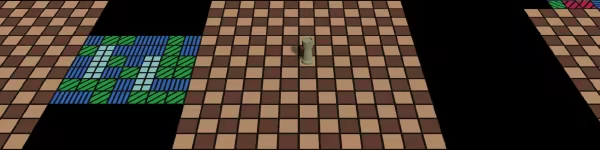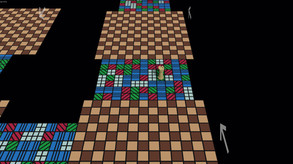
Use the moves of chess to solve puzzles. Find your way with six different pieces, through six different worlds. Use a varying way of thinking in each world.
Modeled estimate, not a reported figure. How we estimate →
Media

About

Stats
All-time low is the lowest price we've recorded for this game since we started tracking it.
Languages: English**languages with full audio support
Reviews
[quote][url=https://store.steampowered.com/curator/32732116-IndieGems/]Follow our curator page: [b]IndieGems[/b] if you like and want to see more reviews like this one.[/url][/quote] [i]The Steps As We Know Them[/i] is a nice restricted-movement path-finding puzzle game using some movements as per usual of chess pieces. While it uses the chess pieces and in some ways imitate the standard moving patterns of the pieces, the actual game has very little to do with chess. The game could be given a completely different skin and would still make perfect sense without the chess pieces. [h1]Gameplay[/h1] The game is set up in a series of 6 chapters/worlds, with sequential puzzles within each. The goal for each puzzle is just to move one side to the other while obeying the set rules for the game. The final puzzle in each chapter requires you to reach the middle tile from any of the edges. There are several different tiles on the board that offer movement alterations or restrictions. The restrictions are easy to follow with a few simple rules, and as follows: 1. The regular tiles are blue, green, and red. You cannot step from one tile to the next same tile. 2. You cannot move between green and red tiles or vice versa. The piece that you control for each chapter is different, but everything moves in a single orthogonal direction based on your command. The puzzles have different tiles that give some additional movement options, and are as follows: 1. Light blue tiles that act like sliding ice. You will step and skip past this and as many of these in a row, as expected. 2. Purple tiles that will change the orientation of the puzzle board 45 degrees, so movement still in the up/down, left/right oriented puzzle will now act as diagonal movements. Once you turn the board diagonal, the board stays that way until you either complete the puzzle or fail it and it resets. 3. The chapter with controlling the bishop piece, the puzzles are all oriented in the diagonal to begin, and there are orange arrow tiles outside of each puzzle that will allow you to alter the position of the piece to the adjacent one. This is because diagonally you can only access half of the tiles in the puzzle, the change allows you to access the other half. 4. Only in the final chapter with the knight, you will see a few orange tiles in the puzzle that allows you to step onto it and then move off in a L-shape pattern as your next move, as a knight would normally move. But normally, the piece will still move in a standard single-step orthogonal pattern as everything else. The game allows for 3 different save profiles. The game auto-saves after stepping off each puzzle. If you make a mistake and step backwards from the end of a puzzle back to the beginning, then the game will auto-save as if you didn't finish that puzzle to begin with. It's not a big deal, I just thought it was rather funny for me when I solved a couple of puzzles backwards before realizing it at one point. After asking the developer to add the option, now the game allows for a world selection from the main menu and so you can play them separately. I am happy to see this option. [h1]Controls[/h1] You use WASD or the arrow keys to move the pice around, and that's it. [h1]Graphics[/h1] Simple without any extra fluff. There are the puzzles in each chapter and your piece. My only visual complaint pre=release has been addressed by the developer. [h1]Music[/h1] There's a simple soundtrack that just loops. This is rather pleasant to listen to but if you try to solve through the whole game in one sitting, it's bound to get repetitive. If you get sick of it, you can turn down the volume all of the way and play some other music in the background. [h1]Audience[/h1] This is a perfectly fine game for anyone who enjoys puzzles, as the puzzles are fairly well designed and offer increasing degree of difficulty from beginning to end of each chapter. I am fairly mediocre at solving puzzles and had fun. The game took me a little over 4 hours to complete the game. [h1]Pricing[/h1] At a little over 4 hours of gameplay for me and quite a bit of thinking needed to solve through, I had a lot of fun. The game is valued at $4.99 US at baseline, so that's pretty reasonable. However, that being said, there are similar games for cheaper with equal or more puzzles, and the puzzles here are finite. So if that's a price that's too high, it's okay to wait for a sale. [h1]Conclusion[/h1] [i]The Steps As We Know Them[/i] is a rather fun and simplistic puzzle game that's a nice addition for people who enjoy puzzle games. With simple concepts to learn and to follow, the game's complexity only comes from the design of the puzzles, and are arranged in increasing difficulty for each chapter. Recommended: 7.5/10 [quote]I received the product for free. I did not receive any compensation to write this review. The opinions represented here are entirely my own and were not influenced in any way.[/quote]
all I know about chess is how each piece moves, and it's more than enough for [b]the steps as we know them[/b]. in fact, you can go in completely blind, as the game will tell you all the relevant rules as they come up. [b]6 worlds[/b] are laid out like chess boards connected with colored areas serving as separate puzzles. each world features a different chess piece, though their movement doesn't immediately or always match the real thing. for example, the bishop moves like a pawn until it steps on a special purple tile that unleashes its signature diagonal move. the point in each puzzle is simply to get to the other side, like the proverbial chicken. the first rule of chess club is not to step on the same color twice in a row, the second says you can't step from green to red or vice versa, then some slippery blocks get introduced, after that the bishop comes into play, then the knight, and so on. [b]no move counter or timer[/b] and there's a checkpoint after each puzzle. in fact, the game saves every time you enter the colored area, so making a mistake won't only take you back to the side, but to the exact tile you entered the puzzle from. I found this helpful. [b]no undo[/b], but it's not a dealbreaker in this case, though it would obviously help in certain situations. while the mouse works in the menus, controls are keyboard-only. wasd or arrows to move, q and e rotate the camera, esc brings up the menu. can't hold a button for continuous movement, but since a wrong move resets the current puzzle, it's probably for the best. some levels are off-center, their other side is barely visible, but camera rotation makes it less of an issue. diagonal movement needs some getting used, as the camera angle changes, but it remains consistent with the camera: pressing left moves left, but if you rotate the camera, it will still move the piece left, no need to re-orientate yourself. 3 profiles/save slots are available, a single volume slider (no sound effects, so it's fine), and windowed mode with a few resolution options. unfortunately, level selection is called world select for a reason: [b]there's no way to replay individual puzzles later, only worlds from the start[/b]. no level numbers anywhere either. I have zero patience for something like this, so gave up at the end of world 5, pretty close to the end, but from what I can tell, it's relatively short (probably [b]around 2-3 hours[/b]). overall, good enough for what it is, a chess-based pathfinding game with okay presentation, and as mentioned above, no preliminary chess knowledge is necessary and [b]there's a demo[/b] to try.
Je joue sur Linux. Version Linux : excellente. [h1]Le jeu[/h1] Un casse-tête, le but est de déplacer la pièce d'échec qu'on contrôle de l'autre côté d'une grille. La seule règle qui compte : on ne peut avancer que sur une case d'une couleur différente de celle sur laquelle on se trouve (en gros, on alterne entre vert et bleu). Il n'est pas nécessaire de connaître les échecs pour y jouer, les mouvements des pièces dans le jeu n'étant que vaguement liés à leurs homologues dans les échecs. Il y a une certaine logique tout de même, par exemple le cavalier se déplacera comme un vrai cavalier lorsqu'il passe sur une case spéciale, mais le reste du temps il se déplace comme un pion. NIveau graphisme, sans être laid c'est tout de même assez basique. La caméra n'a que 4 angles, il aurait peut-être été intéressant de pouvoir la déplacer librement avec la souris par exemple. Le jeu se joue entièrement au clavier (le menu est accessible avec la souris cela dit), avec les touches fléchées ou WASD - pas de problèmes en azerty donc avec les touches fléchées. La musique d'ambiance est correcte bien qu'un peu répétitive sans être agaçante. Niveau difficulté, c'est un bon casse-tête. Ni trop facile ni trop difficile, bonne augmentation de la difficulté et introduction de nouveaux éléments au fur et à mesure. [h1]Rejouabilité, achievements[/h1] Les achievements consistent simplement à terminer le jeu, comptez environ 2h. [h1]En bref[/h1] Un petit casse-tête sans prétention, j'ai apprécié. Recommandé. [h1]GNU/Linux[/h1] La version Linux est excellente, je n'ai rencontré aucun problème. OS: Linux Mint 19 x64, MATE edition. Hardware : i7 7700K OC@5Ghz, Nvidia 1080GTX, 32GB ram. Screens : Dualscreen, 1x 4K & 1x 1920x1200, un seul screen X.
The Steps as we know them transforms the classic game of international chess into quite a challenging puzzle game, which fairly quickly ramps up the difficulty as it gets more complicated with the rules and layout of the paths. It provides enough of levels for the player to solve, so you can expect to be playing for a while; Of note, it's good to have quite a bit of patience with this game. Each chess piece's movement is how you find your path through each section of the puzzle, in a board game like setting from start to finish. You can play this game without any prior knowledge of chess, though the movements make more sense if you are familiar with it. The music is rather basic and repetitive, so I would have hoped for more in that regard, so felt that this let down the game. You may still find the music relaxing, but it can get old relatively quickly. The background is just a black screen, which helps to keep focus on the puzzle itself, but perhaps would be more immersive with an appropriate background. Arrows are strategically placed to help the player know which way they need to go. Overall, not a bad minimalist game for lovers of the puzzle genre. Themes: No violence or adult themes, making it family friendly. *** ~ House Blythe, curator for Non-violent Entertainment: https://store.steampowered.com/curator/35899705/
Düşünebilen her kişiye tavsiye ederim.
Related
Related
Trends
Concurrent players on Steam, sampled daily since tracking started.
Momentum
Pace estimated from the game's recent review growth (our daily snapshots) at its own sales-per-review ratio — a momentum signal, not booked sales.
Related
| Zodiac Girls | $489.2 | 79 | 84% | $0.99 |
| Circularity | $490.5 | 66 | 61% | $0.49 |
| Where Foxes 狐狸在哪里 | $487.7 | 64 | 95% | $0.49 |
| Devilish Girl | $495.3 | 80 | 74% | $0.49 |
| Art of Beauties | $482.9 | 78 | 74% | $0.99 |
| Desktop Agents - Cov1d-999 | $481.6 | 50 | 94% | $0.49 |