
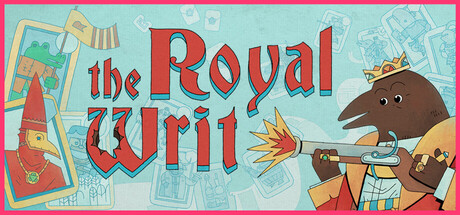
Sacrifice creates stories in this medieval roguelike deckbuilder. Watch your cards march to glory or permanent death as they battle toward the enemy. Each fallen hero becomes part of your kingdom's legend. Command wisely... some sacrifices are necessary.
Modeled estimate, not a reported figure. How we estimate →
Media

About

In The Royal Writ, you don't just play cards - you command them on the battlefield. Place your loyal subjects strategically as they advance toward the enemy, dealing damage. But beware: any card that reaches the enemy base before victory is permanently destroyed and removed from your deck for the rest of your run.
Sacrifice isn't just a risk - it's an essential strategy that creates memorable sub-stories with each run. Will you honor the subjects who gave everything for your cause? Every fallen card tells a tale, and their glory lives on in the legacy you build.

Lead an army of adorable yet battle-hardened animals with abilities to shape your strategy. Your ranks may comprise a frail and wounded flamingo, a short sighted chicken bowman, or even a crafty lizard who cheats death by only losing its tail! From the renegade red ants to the sacrificial lamb, every card in your deck has a personality and purpose.
As they march toward glory or death, their individual stories become part of your kingdom's legacy, and their sacrifices will never be forgotten. You may even come across some peculiar creatures on your journey, like the crazed mantis dentist, the goat tactician or the impatient boar shopkeeper - just don’t ask them where they got their credentials.

Conquer the realm through two distinct adventures:
The First Campaign pits you against a growing rebellion as you try to maintain the king’s good and just rule (objectively). Battle your way through a challenging environment filled with deep pits and poison swamps as you try to suppress your enemies. As you progress, you may start to wonder if there are more to the kingdom’s troubles than meet the eye?
The Second Campaign introduces a new threat - gunpowder. As new experimental weapons now enter the battlefield, your strategy must change. No longer are you simply avoiding the environmental hazards - you must dodge an onslaught of bullets to ensure you and your troops are not fatally wounded as you march forth.
Each campaign features unique cards, bosses, and strategic challenges. The battlefield awaits your command!

Intuitive Yet Deep Gameplay - Easy to learn without compromising on the challenge
Roguelike Progression - Every run is different
Card Permadeath - Lost cards stay lost!
Charming Art Style - Picture-book visuals blend with medieval absurdity and dark humor
Memorable NPC Encounters - Are they friend or foe?
Special Boss Mechanics - Unique challenges that will test you
Gradual Difficulty Ladder - Climb through harder and harder difficulties as you progress
Challenge Modes - Test your skills in special modes with unique rules
Relics - Collect relics with various effects that change how you play
"The art of war is simple. Send forth your subjects to die gloriously in your name. Their sacrifice ensures your legacy... and if they happen to win, all the better!"
Will you write your name in the annals of history, or become just another forgotten monarch? The balance between loss and triumph is yours to master.
All hail! May your fallen be remembered and your victories sweet!
The Royal Writ is inspired by other amazing games: Balatro, Monster Train, Slay the Spire, Inscryption, Across the Obelisk and many other amazing deck builders! Check them out too if you have not already!
Genres
Stats
All-time low is the lowest price we've recorded for this game since we started tracking it.
Engagement
Hours played at review time, across 40 reviews with recorded playtime.
Reviews
Themes across 40 recent reviews and how positive each mention is. A keyword signal, not full sentiment analysis.
positive critical· bar length = how often the theme comes up
Reviews
Oh man, what a hidden gem! It's a shame that this does not get the coverage it deserves. I am glad I stumbled upon it nonetheless and was immediately intrigued by the fantastic art style which reminds me of picture-books with many small details in the background etc.! It's a joy to observe the original character design and detailed animations! First sceptical, the game mechanics quickly hooked me. The game starts with a tutorial which gives a general overview for the most important mechanics but you will still discover a lot of additional mechanics which allow for elements, rules and combinations I have never seen in a video game before (and I played my fair share). The core gameplay loop features elements from *Inscryption* (cards moving forward on the board), *Balatro* (blue damage and red multiplier) and *Slay the Spire* (World Map with events and bosses) and adds a lot of own ideas. I especially loved the character cards which needed their description first to be unlocked by triggering their hidden abilities. I wish the game would have more of those! When I thought I got the hang of the mechanics in Act 1, I started Act 2, which feels more like an extensive sequel than a second part: Introducing an all new set of cards! Based on the previously established rules but doubling down by introducing even wilder game elements and ailments! And then the final boss: When I was glad to finally have reached it, this juggernaut intimidates with its humongous amount of hit points, special rules and aces up its sleeves. It's a final boss truly worthy of that title and a lot of fun to take down with different card combos. I 100%ed the game and do not regret a single second. This game is special! It's brimful of attention to detail, witty, beautiful, and very shrewd! And I feel like for all the joy I had with this game and all the effort I can feel the devs poured into this gem, it clearly doesn't nearly get enough recognition. On the downside, the game does have a few bugs. Not game breaking and mostly just weird. Very rarely impacting actual gameplay and I always found a way around them. Worst thing I had to do was "Save and quit" my run and continue immediately where I left off. Unfortunately, since the game was not a bigger success, I am afraid the game might not see a fix for many of these bugs in the future :( I understand that for some people this combination of deep gameplay and occasional bugs could result in avoiding the game but I argue that you would miss out on one of the best indie games of the last years and a love child of wits and passion for the medium. The high quality of animations, music design and interlocking gameplay gears is mind-boggling. Taking that and the huge amount of joyful play time I got out of this jewel, it's an undisputed recommendation for every card game aficionado who wants fresh ideas and passionate execution.
DOn`t. The game has 2 acts. The first act is fun... and the tutorial more or less. The second act ist hitting a brick wall from the get go. And imo its not worth running through that wall.
went from a game i loved in the first act to a game that felt completely different in the second and not what i signed up for. a shame
I really liked the game itself. The mechanics are really nice and it the visuals are fun, also the music is fitting. If it would not be the painful Act II. I tried to fight against the boss Prior Im and did not manage after so many tries. Then I tried a custom seed where you get a good card at the start. So I beat the prior with it but the last end boss has 444.444 hp which is so ridiculous. After losing to him I did not want to grind again hoping for good cards or to invest so much time to maybe find a strategy by myself or in the community. So all in all the game is not worth your time, just too frustrating, too much RNG.
This is a beautiful, charming, deckbuilding roguelite. Have you played Cobalt Core? If so, I think you'll like this too. It does something few deckbuilding roguelites do. It has a bit of a story. Like Cobalt Core, the story is revealed in short vignettes, which never drag or include any padded out dialogue. They are short, quirky and colourful. These play out in your first playthrough, but once you have successfully completed Act I and Act II, they do not repeat, so repeat plays are not burdened with scenes you need to skip or endure. There is a of variety here, including: Your core deck, which has two types of cards, cards with an additive value, like +10, and cards with a multiplier value, like x20. The basic gameplay has you using these on the battlefield to produce a number which reduces the enemy health. The significant variety, enough for many playthroughs, comes from: > Ways to enhance the card values that remain persistent throughout the rune > Trinkets that add bonuses or mechanics > Different stage bosses, with some very different mechanics to learn and counter > Status that effect cards, seemingly negative, but very exploitable for benefit > Finding smart combinations of cards for synergy, and the card pool is deep enough. I've found at least 8 very viable team builds Then there is a difficulty system, running I think from 1 to 10, which you unlock 1 at a time, very classic Slay the Spire like. Regarding Act II . . . there are a lot of reviews mentioning brutal difficulty. If you are used to the higher end of Slay the Spire like difficulties, I do not think it likely you'll find it so challenging. Relative to Act I, there are some new mechanics, and you do not carry across your Act I deck. I think the renewed learning curve may trip up even some capable players. Personally, I found the default Act II difficulty modestly challenging, but by no means a big struggle.
I really loved this game, and I wanted to share my thoughts and feedback with both potential players and the developers. First of all, I didn't have any high expectations of the game, but the art style caught my attention and it is truly good [h1] Story [/h1] The story follows the Crow King, an anthropomorphic bird(?) ruling a kingdom and expanding his lands further and further. That's actually the whole story. It's quite simple, but it's still interesting to follow, and the game actively keeps you engaged. [h1] Gameplay [/h1] A few words about the mechanics: I'm not fond of deck-builder genres, so I was quite skeptical before I ran it. Here's how the gameplay works: you start with a deck on a battlefield. The field consists of columns and the final column is the base that you need to destroy. Every turn your cards (that you put at the first column) advance further and each new column buffs your card. However, if you hit the final column (the enemy's base), your card will die. The gameplay is based on collecting cards on your way to the boss, defeating them and continuing the cycle. There are tons of things that may happen to your cards and you can create unique combinations. For instance, I had a card that gives me money and boosts morale for each poisoned card, so I made half my deck poisoned and that way I could farm money. [h1] Replayability [/h1] The thing that I found cool is that the game is divided into two Acts and the mechanics in each Act are distinct, which allows you to replay both of them and it feels genuinely different. The story is not that long, but endless mode solves this problem. [h1] Drawbacks [/h1] After all of the above, there are some drawbacks that developers may take into account for their future projects (and I hope there will be more games from them). Maybe it's my personal problem, but it was hard to understand the descriptions of some cards. English is not my native language, so sometimes I switched to Russian to make sure I got everything right, but it didn't clarify much, and the only thing left was to test it in practice. Moreover, there are some cards whose purpose I can't understand even now. Why would I even use them? Some cards can cause freezing or bleeding and I don't know how I'm supposed to use them to gain an advantage. Yes. there is tutorial and manual in game but it lacks details Another small element that I found annoying is that the history of your dead cards shows only their name and the cause of death. But sorry guys, I don't remember what the cards are called. It would be much better if I could hover over the name to see what the card is, or if I could name a card myself, because two the same card types can exist in your deck with the same name. [h1] Final Thoughts [/h1] Honestly, all these drawbacks didn't affect me much and the game still feels amazing and draws me back to try new combinations or find the rest of the unopened cards. And remember... send the letter
The Royal Writ, developed by Save Sloth Studios and published by Yogscast Games, is a roguelike deckbuilding game that sets itself apart by transforming cards into active participants on a battlefield rather than static actions. Instead of simply playing cards for immediate effects, each card represents a unit that physically advances across lanes toward an enemy objective. This design creates a blend of deckbuilding and positional strategy, where success depends not only on the strength of your deck but also on how you deploy and manage your units over time. The core gameplay revolves around carefully timing and placing units so they can advance across the battlefield and deal damage before being lost. Units grow in power as they move forward, creating a natural escalation that rewards patience and planning. However, once a unit reaches its target, it is removed from play, forcing players to constantly balance offense with sustainability. This system introduces a unique tension, as committing too many strong units early can leave you without resources later, while holding back may result in missed opportunities to deal critical damage. Deckbuilding is a central pillar of the experience, offering a wide variety of cards, relics, and modifiers that can significantly alter how each run unfolds. Players are encouraged to experiment with different combinations, building synergies that amplify their effectiveness. Some strategies may focus on maximizing damage output through stacking effects, while others emphasize control and careful positioning. The flexibility of the system allows for diverse playstyles, making each run feel distinct and encouraging repeated experimentation. As a roguelike, the game relies heavily on randomness to keep the experience fresh. Encounters, rewards, and events are procedurally generated, ensuring that no two playthroughs are exactly the same. This unpredictability adds excitement but also introduces an element of risk, as players must adapt to whatever options they are given. Over time, players unlock additional cards and upgrades, expanding their pool of possibilities and providing a sense of long-term progression that rewards persistence. The game’s structure is divided into multiple stages, each introducing new challenges and mechanics that build upon the core system. As players progress, they encounter increasingly complex scenarios that require a deeper understanding of timing and positioning. These additions help maintain engagement by preventing the gameplay from becoming repetitive, though they can also contribute to a steep learning curve. New mechanics are not always immediately intuitive, and players may need several attempts to fully grasp how to respond effectively. Visually, The Royal Writ adopts a colorful and stylized presentation that contrasts with its strategic depth. The characters and environments have a playful, almost storybook-like quality, which makes the game approachable at first glance. Beneath this lighthearted aesthetic, however, lies a system that demands careful thought and planning. The audio design complements this tone, with music and sound effects that enhance the atmosphere without overshadowing the gameplay. Despite its strengths, the game is not without its challenges. The reliance on random elements can sometimes lead to frustrating situations where success feels dependent on luck rather than skill. Certain encounters or combinations of events may be difficult to overcome regardless of preparation, which can make some runs feel unfair. Additionally, the complexity of the mechanics can be overwhelming for newcomers, as the game provides limited guidance and expects players to learn through trial and error. Even with these issues, The Royal Writ succeeds in delivering a distinctive and engaging experience that stands out within the deckbuilding genre. Its combination of strategic positioning, evolving mechanics, and replayable structure creates a gameplay loop that is both challenging and rewarding. For players who enjoy experimenting with systems and refining their strategies over multiple runs, it offers a compelling and memorable experience. Rating: 8/10
核心玩法有趣,细节上也有很多小巧思。但是存在一些十分影响游戏体验的问题: - 整体难度高,必须培养具有成长能力的卡牌或寻求卡牌间机制联动。因此虽然卡牌众多,但大多数意义不大 - 游戏中大量debuff与随机要素导致战损无法避免,如果关键牌损失很容易暴毙,负反馈很强 - 机制复杂,许多卡牌的描述与实际效果不符
负面惩罚太严重,体现在:养成卡牌必须多操作→绝大部分操作是有风险的→风险大量叠加,而收益积累很慢→负面体验占上风。 而且就算有负面惩罚,也应该给玩家相应的解法,不能让玩家只能干瞪眼。 说的就是给×-1惩罚的boss,效果无法逆转,杀也不一定杀得掉(献祭、特殊交易的时候不一定能把这些牌刷出来),只能让它占着栏位恶心人。万一碰到主C遭重,那直接重开吧。
나만 이거 어려움?
Related
Related
Trends
Concurrent players on Steam, sampled daily since tracking started.
Audience
Languages: English, Japanese, Simplified Chinese, Traditional Chinese, Korean, French, German, Spanish - Spain, Hungarian, Portuguese - Brazil, Russian, Turkish +1 more
Estimated from the language of this game's reviews — a proxy for where players are, not official Steam demographics.
Related
| Bang Bang Barrage | $203.7K | 1K | 96% | $7.99 |
| TASOMACHI: Behind the Twilight | $203.7K | 579 | 76% | $19.99 |
| Flowers -Le volume sur automne- | $203.7K | 772 | 98% | $19.99 |
| BEYBLADE X XONE | $203.6K | 171 | 79% | $49.99 |
| Dead Reset | $203.8K | 764 | 88% | $14.99 |
| World Ship Simulator | $203.8K | 268 | 21% | $19.99 |