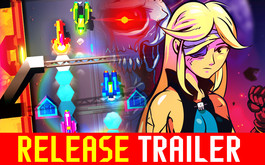
Set in a futuristic Odyssey, "The Next Penelope" is a fast paced action racing game with loud colors, an original story and a challenging risk-reward system. Weapons can be mixed and used at any time, but all these abilities cost vital energy!
Modeled estimate, not a reported figure. How we estimate →
Media

About

Stats
All-time low is the lowest price we've recorded for this game since we started tracking it.
Languages: English*, French, Italian*languages with full audio support
Engagement
Hours played at review time, across 40 reviews with recorded playtime.
Reviews
Themes across 40 recent reviews and how positive each mention is. A keyword signal, not full sentiment analysis.
positive critical· bar length = how often the theme comes up
Reviews
frustratingly difficult for the wrong reasons. very pretty and a nice idea but execution holds it back
The Next Penelope is an audacious indie title that refuses to stay within the boundaries of a single genre, instead fusing arcade racing, shoot-’em-up combat, and exploratory action into a fast, neon-soaked experience. Developed by Aurélien Regard and published by Plug In Digital, the game reimagines Homer’s Odyssey as a futuristic space epic, casting Penelope not as a passive figure waiting at home, but as a relentless pilot racing across hostile planets in search of her missing husband, Ulysses. This bold reinterpretation immediately sets the tone for a game that thrives on momentum, experimentation, and constant pressure. From a gameplay perspective, The Next Penelope is built around speed and survival. Your ship accelerates automatically, pushing you forward at all times and forcing you to focus on steering precision, energy management, and tactical combat. Energy acts as a shared resource for boosting, firing weapons, and activating special abilities, meaning every decision carries weight. Choosing when to spend energy aggressively or conserve it for tight turns and evasive maneuvers becomes central to mastering the game. This design creates a sense of perpetual urgency, making even short races feel intense and demanding. The structure of the game encourages exploration as much as racing. Instead of a linear campaign, players navigate a star map, choosing which planets to visit and in what order. Each planet introduces unique track layouts, environmental hazards, enemies, and bosses, ensuring that the experience rarely feels repetitive. Boss encounters in particular stand out, blending racing mechanics with bullet-hell-style patterns that require sharp reflexes and an understanding of your ship’s capabilities. These battles feel like climactic tests of everything learned so far rather than simple interruptions to the racing flow. Visually, The Next Penelope is striking and instantly recognizable. Its vibrant color palette, glowing outlines, and minimalist shapes evoke classic arcade games while still feeling modern and stylish. Environments are abstract yet expressive, using color and motion to convey danger, speed, and atmosphere rather than relying on detailed textures. Character portraits and story moments complement this aesthetic, presenting mythological figures through a futuristic lens that reinforces the game’s unique identity without slowing the pace. The narrative itself is intentionally light but effective. Story elements unfold gradually as Penelope travels from planet to planet, encountering gods and adversaries inspired by Greek mythology. Dialogue is concise and often playful, serving more as flavor and motivation than as a driving force. This restrained storytelling works well with the game’s structure, giving context to the action without disrupting the relentless flow of gameplay. The focus remains firmly on the journey rather than elaborate exposition. Difficulty is one of the game’s most defining traits. The Next Penelope can be punishing, especially for players unaccustomed to arcade-style challenges that demand quick reactions and repeated attempts. Some tracks and bosses require precise execution and a deep understanding of energy usage, which can lead to moments of frustration. However, for players who enjoy mastering systems through repetition, these challenges are also deeply rewarding, offering a strong sense of accomplishment when a tough segment is finally conquered. Beyond the solo experience, the game includes local multiplayer modes that lean into its arcade roots. Split-screen races and battles transform the high-speed mechanics into chaotic, competitive fun, making it an excellent party game despite the absence of online multiplayer. These modes highlight how well the core mechanics translate to direct competition, reinforcing the game’s versatility. Ultimately, The Next Penelope stands out as a confident, genre-blending indie project that prioritizes speed, style, and mechanical intensity. It may not appeal to players seeking a long or forgiving experience, but for those drawn to arcade racers, shmups, and games that demand focus and skill, it offers a distinctive and memorable ride. Its bold aesthetic, inventive mechanics, and reinterpretation of myth combine to create a game that feels both nostalgic and refreshingly unconventional. Rating: 7/10
Not fun
A fun racing game that doesn’t overstay its welcome. The story is very short, but I don’t see that as a downside. After completing the main story, there are some interesting challenges to take on. I had a lot of fun finishing them and unlocking all the achievements.
I don't know if the developer reads the reviews or even still updates the game, but i pray both happen so maybe some change for the better may occur. I am giving this game a thumbs up because this game is incredible in some areas, and in the areas it isn't already great there is massive promise showing through. I've heard this is a one-man dev team and that seems to show through, and for that alone the game deserves a little recognition in the wider public eye. however every game has its problems, and unfortunately this game is not only no different, it has them in spades. a very common complaint across every review is that the controls suck. personally i believe this is skill issue, as the controls are responsive and work perfectly, they just take getting used to. however an ACTUAL problem isn't your player character, its the computer players. the biggest problem i have seen in this game so far is the INSANE difficulty differences of some of the computer players. some races will have computers so inept and slow that even the second place contender will be easily lapped with a little skill, however on the other side of this, there are races where the computer players have such insane and wild rubberbanding and speed that you will be staying in the lead by only the skin of your teeth if at all. Another massive problem the game has with computers is how death is balanced. if the player character dies, its gameover and you restart the race. this isnt entirely unfair and it shouldnt be changed, however the computer players in those same races not only respawn, they respawn so fast and will catch up so fast that killing them is functionally useless as a mechanic. this is compounded with the fact that the weapons you use take MASSIVE amounts of energy to fire, and suddenly you are sitting in first place with no boost, no health, and about 2 seconds before 2nd place passes you and makes you fail the level anyways. even worse than this is the requirement you use the weapons, as to my knowledge it is completely impossible to actually beat the more difficult races without using them or attempting to slow down the opponents. this creates an incredibly unfun and unfair loop where you start the race, you shoot the enemy (wasting your energy which doubles as health f-zero style), they die, and then come back and overtake you forcing you to repeat the process ad nausem. the problem with this process is that you as the player will ALWAYS lose this interaction by its end. there is no winning through this method and it makes races an incredibly tedious, (in a quite ironic twist) almost sisyphean repeating of trial and error to pray you skip something or get lucky enough to pass the finish line first. to top this off, the bosses unfortunately suffer the EXACT same fate, they will either be pathetically easy and almost a joke, or they will be cryptic and infuriating to attempt to figure out and properly execute. to reiterate, despite the negativity in this review i am desperately praying for the game's success. The person who did the work to get it this far deserves recognition for their work, and i hope more eyes on it may inspire the dev to give the project more work in the future.
[h1]5/10[/h1] [h3]Random game key: 14/152[/h3] I want to like this game since it's apparently made by just one person. But I didn't enjoy it a lot because of some annoying flaws. The biggest one is the camera, it's way too zoomed in to be able to see what's going to appear before you, this was especially annoying during the tank boss fight. Another one is the handful of bugs forcing you to restart a level, the first one I encountered was during my first race, the laps stopped counting so I had to restart, and then it happened again, needless to say, I was getting slightly annoyed by this already. The second bug I encountered was getting stuck on the terrain, again forcing you to restart. I really like the visuals and soundtrack, but those things don't carry past the flaws that annoy me too much to be able to continue. However, you might like this game and I can definitely see why someone would.
The game is well crafted in almost every way. But the difficulty curve is not. After some years later, I grabbed this for a second time and I can still say that is hard as hell to make some progress here, what turns the game from a beautiful experience to a punishing one. For hardcore players that have plenty of hours to play and progress slowly as a snail, I recommend this. I'm not enjoying it anymore, though.
Likes - Fast-paced, stylized, action-packed micro machines - Fun abilities and tight controls - Varied levels and bosses Dislikes - Last couple bosses are just side-scrolling shmups
Vraiment plombé par cette durée de vie gonflée artificiellement : on gagne l'XP au compte goutte ce qui va obliger à refaire en boucle les niveaux déjà terminés. Le jeu devrait durer moins d'une heure mais va typiquement en nécessiter 3 ou 4.
Damals habe ich die SNES-Besitzer:innen allzu sehr um ihr F-Zero beneidet und habe bei "The Next Penelope" skeptische, aber doch leicht leuchtende Augen bekommen. Zeitgemäße Grafik und eine Oberfläche wie bei Micro Machines. Letztlich nervt mich die Implementierung der Story bei diesem Rennspiel doch viel zu sehr, als dass ich da länger dran bleibe. Ich wünschte, die könnte ich hier abstellen und der Fokus wäre stattdessen mehr beim Streckendesign geblieben. So habe ich da nicht lange Lust drauf, ständig Sprechblasen wegzudrücken. Ich will doch nur ein paar Rennen fahren und Gleiter anpassen und erweitern.
Related
Related
Trends
Modeled estimate over time, reconstructed from Steam's monthly review histogram.
Momentum
Pace estimated from the game's recent review growth (our daily snapshots) at its own sales-per-review ratio — a momentum signal, not booked sales.
Audience
Estimated from the language of this game's reviews — a proxy for where players are, not official Steam demographics.
Related
| Ninja Ming: Wu | $4K | 64 | 100% | $1.99 |
| PENTALOOP -ペンタループ- | $4K | 58 | 74% | $3.99 |
| VITATIO 2 | $4K | 533 | 71% | $0.49 |
| Incandescent | $4K | 176 | 69% | $0.99 |
| The Walking Vegetables | $4K | 198 | 89% | $0.99 |
| Light Fairytale Episode 2 | $4K | 63 | 95% | $2.49 |