The Magic Circle is one of the most inventive and unconventional indie games released in recent years, blending first-person exploration, puzzle-solving, and metafictional storytelling into an experience that constantly challenges player expectations. Rather than presenting a traditional fantasy adventure, the game places players inside an unfinished project trapped in endless development, where broken mechanics, missing content, and developer arguments become central parts of both the gameplay and the narrative. What initially seems like a strange parody of unfinished videogames slowly transforms into a surprisingly thoughtful commentary about creativity, artistic ambition, player expectations, and the chaotic process of game development itself.
The premise is immediately fascinating. Players awaken inside a fantasy game that has remained incomplete for nearly two decades while its creators endlessly argue over design choices and direction. Entire sections of the world are unfinished, mechanics malfunction constantly, and characters remain trapped in abandoned content waiting for a story that may never be completed. Instead of controlling a powerful hero destined to save the world, players become an outsider capable of manipulating the game’s systems from within. This setup creates a strange atmosphere where the world feels unstable and artificial by design, with broken assets, unfinished environments, and abandoned ideas scattered throughout every area.
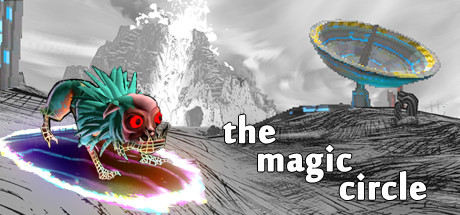
One of the game’s most creative features is its creature-editing mechanic. Players gain the ability to capture enemies and rewrite their behaviors, essentially altering the rules of the game itself. Creatures can be transformed from hostile enemies into loyal allies, abilities can be swapped between different monsters, and entirely new combinations can be created to solve puzzles or bypass obstacles. This system creates an impressive level of freedom because the game rarely limits players to a single intended solution. Instead, experimentation becomes the heart of the experience. Players are constantly encouraged to manipulate systems creatively and exploit the unfinished nature of the world around them.
The puzzle design benefits enormously from this flexibility. Rather than relying on traditional logic puzzles, The Magic Circle encourages players to think like developers and break systems apart from the inside. Many obstacles can be approached in multiple ways depending on how players modify creature abilities or interact with broken mechanics. The feeling of exploiting unfinished systems to progress creates a satisfying sense of rebellion, as though players are actively dismantling the game’s structure while exploring it. This design philosophy gives the gameplay a level of originality rarely found in puzzle-focused adventures.
The writing is easily one of the game’s greatest strengths. Throughout the experience, players overhear constant arguments between the fictional developers responsible for the unfinished game world. These conversations gradually reveal years of creative frustration, ego clashes, missed deadlines, and conflicting artistic visions. The dialogue is sharp, funny, and surprisingly insightful, especially for anyone familiar with the realities of game development or creative industries in general. What begins as satire slowly becomes more emotional as the game explores themes of failure, obsession, compromise, and the fear of disappointing audiences.
The voice acting deserves particular praise because much of the game’s emotional impact depends on the performances. The developers feel like believable people rather than exaggerated caricatures, and their growing frustration becomes increasingly compelling as the story progresses. Their arguments about creativity, commercial pressure, and unfinished ambitions add genuine emotional weight to the narrative, helping the game move beyond simple comedy and become something far more thoughtful.
Visually, The Magic Circle uses its unfinished aesthetic brilliantly. Early environments appear broken and incomplete, filled with placeholder textures, missing geometry, and unfinished concepts abandoned during development. As players progress deeper into the world, different visual styles begin colliding together, creating surreal areas where polished environments exist alongside retro assets and half-finished mechanics. This constantly shifting presentation reinforces the game’s themes perfectly because the world genuinely feels like a project trapped in development chaos. The graphics themselves are not technically impressive, but the artistic direction is incredibly clever and memorable.
The soundtrack and sound design also contribute strongly to the atmosphere. Ambient music creates a strange sense of melancholy and mystery while quieter sections allow the dialogue and environmental storytelling to remain the focus. The unfinished world often feels lonely and unstable, and the audio design reinforces that emotional tone effectively. Combined with the strong voice performances, the game creates an immersive atmosphere despite its intentionally broken environments.
Another major strength is how strongly the game rewards curiosity. Players are encouraged to explore boundaries, search hidden areas, and experiment with mechanics in ways that feel almost unintended. The game constantly expects players to question rules and test limitations rather than simply following objectives blindly. This rebellious spirit becomes one of the most enjoyable aspects of the experience because it transforms exploration into an active process of dismantling the game itself.
However, The Magic Circle is not entirely flawless. While the creature-editing systems are extremely creative, the game occasionally fails to fully explore their potential. Some abilities and combinations feel underused, and certain puzzles are simpler than players may expect given the freedom offered by the mechanics. The relatively short runtime also means some ideas disappear before they are expanded upon fully. At times, the experience can feel more like an exceptionally clever prototype than a completely realized large-scale adventure.
The pacing becomes somewhat uneven during the later portions of the game as well. Certain narrative developments arrive abruptly, and the conclusion may not satisfy everyone given the strong buildup earlier in the experience. Players who are uninterested in metafiction or commentary about the gaming industry may also struggle to connect with the story because those themes are central to nearly every aspect of the experience.
Despite these flaws, The Magic Circle succeeds because of how fearless and original it is. Very few games attempt to turn the process of game development itself into a playable narrative experience, and even fewer manage to integrate those ideas so naturally into the gameplay mechanics. Every broken system, unfinished environment, and rewritten creature contributes directly to the larger themes about artistic control, player agency, and creative failure.
The Magic Circle may not be the longest or most polished indie title available, but its creativity and ambition make it one of the most unique narrative puzzle games on Steam. Its combination of experimental gameplay, intelligent writing, memorable performances, and unconventional storytelling creates an experience that remains fascinating long after completion. While certain mechanics feel underdeveloped and the pacing occasionally falters, the originality and confidence behind the project make it an easy recommendation for players interested in creative game design and narrative experimentation.
Rating: 9/10