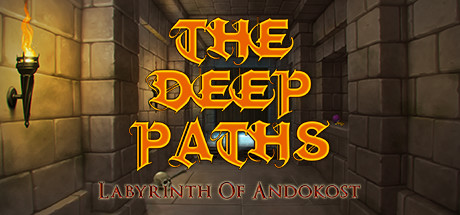
The Deep Paths: Labyrinth Of Andokost is a first-person, dungeon crawling RPG.
Modeled estimate, not a reported figure. How we estimate →
Media

About


Genres
Stats
All-time low is the lowest price we've recorded for this game since we started tracking it.
Languages: English**languages with full audio support
Engagement
Hours played at review time, across 40 reviews with recorded playtime.
Reviews
Themes across 40 recent reviews and how positive each mention is. A keyword signal, not full sentiment analysis.
positive critical· bar length = how often the theme comes up
Reviews
It plays very similarly to Legend of Grimrock; grid-based dungeon crawling with monsters, loot and puzzles & secrets to discover. The graphics are beautiful, and being able to see what you're doing is certainly not a problem; this might be the brightest gridder Tough, old-school combat, and traditional character levelling A great RPG grid based movement to add to any fans of this type of game
Nice little crawler with good puzzles and a very addictive "find all secrets and collectibles" side. BUT there are one thing to keep in mind before starting out: Combat is based on littarly backstab, which means you have to stand sideways to the enemy and wait til they move, and then move yourself behind them. You may like this kind of combat or you might not - it does require a bit of patience and sometimes takes the fluidity of the game. I found it kind of relaxing, and -- if you don't like this kind of combat: The game offers a lot of ways to get rid of enemys via the enviroment (like trapdoors and impalers) and it's actually cool and funny to lure your enemy into a trap and then set if off.
Mods for Legend of Grimrock are better than this. If you don't know what you are doing as a developer don't try to innovate, you'd be better off just copying what other successful games do. Combat is unbearable, complete garbage, deal breaker.
The Deep Paths: Labyrinth Of Andokost is a deliberately old-school first-person role-playing game that wears its inspirations proudly, aiming to recreate the feel and structure of classic dungeon crawlers from the late 1980s and early 1990s. Developed and published by Steve Jarman, the game is clearly designed for players who appreciate methodical exploration, grid-based movement, and a slower, more tactical pace that prioritizes planning and survival over spectacle. Rather than modernizing the genre with streamlined systems or cinematic presentation, it embraces retro conventions almost entirely, making it a niche but sincere tribute to its roots. The game places players in the role of a four-character adventuring party tasked with descending into the sprawling Labyrinth of Andokost, an underground maze tied to the fate of the city above. Movement is strictly tile-based, with players advancing one square at a time and turning in fixed increments, reinforcing a deliberate rhythm that demands attention to positioning and orientation. This approach emphasizes careful navigation and spatial awareness, encouraging players to mentally map corridors, intersections, and dead ends as they progress. Exploration is not about speed but about caution, observation, and learning the labyrinth’s layout through repetition and note-taking. Combat follows a turn-based structure that blends smoothly into exploration, triggering encounters when enemies are met within the dungeon. Battles focus on party composition, positioning, and the effective use of abilities rather than flashy animations or complex systems. Each character archetype fulfills a clear role, with melee fighters absorbing damage, rogues contributing precision attacks, and spellcasters providing offensive magic or support. While the mechanics are relatively simple compared to modern RPGs, they demand thoughtful decision-making, especially when resources such as health and spells become scarce deeper into the dungeon. Character progression is straightforward and functional. As party members gain experience, they grow stronger, unlocking improvements that make later encounters more manageable. Equipment upgrades provide incremental power boosts, and finding better gear becomes an important motivator for exploration. The game does not overwhelm players with build complexity or branching skill trees, instead favoring clarity and familiarity. This simplicity reinforces the retro design philosophy, but it can also feel limiting for players accustomed to deeper customization and mechanical experimentation. Dungeon design is expansive and intentionally maze-like, often prioritizing size and complexity over visual variety. Corridors, rooms, and secret passages form a dense network that can feel oppressive and disorienting, especially without modern conveniences like fully automated mapping. While in-game maps can be found and used, much of the burden of navigation still rests on the player. For genre veterans, this adds to the sense of immersion and accomplishment, but for others it may feel tedious or archaic, particularly during long play sessions where backtracking becomes frequent. Visually, The Deep Paths: Labyrinth Of Andokost adopts a functional 3D presentation that echoes early dungeon crawlers. Textures are simple, environments are sparse, and animations are minimal, but everything is readable and serves its purpose. The atmosphere relies more on imagination and tension than on visual flair, with dim corridors and repetitive stonework reinforcing the sense of being trapped underground. Sound design follows a similar philosophy, using restrained audio cues and understated music to support the dungeon’s mood without drawing attention away from gameplay. Narrative elements exist primarily as background context rather than a driving force. Lore is discovered through exploration, dialogue snippets, and environmental hints, giving players just enough information to understand the stakes without interrupting the dungeon crawl with lengthy exposition. The story functions as a framework for exploration rather than a focal point, aligning with the game’s emphasis on gameplay systems and player-driven discovery. The game’s reception reflects its narrow focus. Players who enjoy classic dungeon crawlers often appreciate its commitment to traditional mechanics, its low price point, and the satisfaction of overcoming challenges through patience and strategy. Others find its lack of polish, limited mechanical depth, and dated interface frustrating, especially when compared to more refined modern tributes to the genre. The interface can feel clunky, inventory management lacks convenience, and some systems feel underdeveloped, which can detract from immersion over time. Ultimately, The Deep Paths: Labyrinth Of Andokost is a game that knows exactly who it is for. It does not attempt to appeal to a broad audience or reinvent its genre, instead offering a faithful, uncompromising dungeon-crawling experience rooted in nostalgia and deliberate pacing. For players who miss grid-based exploration, manual mapping, and straightforward party-based combat, it provides a lengthy and atmospheric descent into a classic-style labyrinth. For those seeking modern comforts, deep customization, or narrative-driven RPG design, it may feel too rigid and dated. As a passion project and homage to a bygone era, however, it stands as a sincere and focused example of retro dungeon crawling done with clear intent. Rating: 5/10
This game has potential for the small cost. For the love of god, fix the movement keys. just moving around, keys are not responsive, need to click them twice often. You are often stuck clicking 10 times to go forward while I am being stabbed in the back. Not sure if the developer wanted some sort of 'not moving' while combat, but since this game is not turn based, then this does not work and fails miserably. Often wondering if the game crashed, and keyboard not responding. -Need to single click and drag items to your inventory. while in inventory you need to double click to take it (to move to character), no consistency anywhere. - While pressing TAB to look closer, you can only grab item if in specific angle sometimes. WTH! -Accessing menus and need to click on close button to exit. Simply enable ESC key to do all this (this is 2022).... - Kinda stupid having 4 guys hitting for 6 pts of damage per round for multiple rounds to kill a single baby rat. just deleted the game....
When you start the game, the first thing you see is some broken HTML and an error message. After a brief party creation step, you enter the game, and are treated to some dialogue between your characters, which is a nice touch. Once you get going, though, you notice the sluggish and unresponsive controls that make just moving around, managing your inventory, and interacting with the environment a chore. Then, a little ways in, you encounter your first opponent: a rat, which you'll fight on a narrow platform with nowhere to go. These rats take upwards of twenty hits to kill (and your attacks can still miss), but they can easily kill one of you in just a few. That's not too out of bounds for Dungeon Master-likes, since you're meant to move around in combat to avoid getting hit - but here, you can't do that. While any of your attacks are on cooldown (which lasts about five seconds), you are rooted to the spot. This means that you don't have much choice but to stand there and trade blows until one of you drops dead. You can deal extra damage from behind, but have fun getting there when input is so choppy and you can't move after striking (if you even have space to maneuver at all). You can try to whittle it down with your weaker ranged attacks, but since, again, you can't move, this only works if you can obstruct its path (and if you have that kind of patience). Maybe you could hit it a few times, wait to be able to move again, and then run away and wait for your health to regenerate, but aren't we getting to the point where we ask why we're doing this? It took me three attempts to kill the first rat without losing someone (KOed characters recover, but they don't get XP, so it still matters). After two more tiresome battles with rats, I decided I'd had enough. The problem of how to most efficiently defeat a rat with 100+ hit points does not interest me enough to solve it, and with basic interaction already posing so much friction, I just didn't want to continue.
A really good "dungeon crawler" with a good balance of exploration, fighting monsters, puzzle and trap solving problems plus a basic character progression system. It also has some interesting gameplay design features, and a basic but decent story. Similar in quality to the Legend of Grimrock 1 in terms of graphics and use interface but not quite as "polished". It takes about half an hour or so of gameplay to figure out the game mechanics as there is not much in the way of a tutorial, and overall it takes a few hours to really "get into the game". There are number of software "features" and / or bugs in the game, but no game breaking ones. However, there is a serious software bug that affects saving your game or where you up or down dungeon levels - which you do a lot of. It takes about 2 or 3 minutes every time you save a game, or go up or down a level which loads the dungeon level. Therefore, you need to be very patient as this happens a lot and it can be annoying! If you are the sort of person who would get frustrated by some of the above issues then the game definitely falls into the Steam category "Not Recommended". (I have fairly powerful Windows 11 system so I do not think it is my computer causing this problem.) Fighting the monsters is quite tactical and semi 'turn based' so you need to use the dungeon environment ie traps, pits etc to your advantage to beat most of the monsters and also kill them from a distance with spells / arrows or backstab them. If you attack the monsters "head on" you will generally get wiped out most times, especially early in the game. Notwithstanding the above, the actual game is really quite good. I would say it is on 'par' with The Legend of Grimrock 1. I really enjoyed the exploration and puzzle solving elements, and the monster fighting was quite good. I am very impressed that this game was made, I think, by a single person. It takes between 15 - 20 hours to finish the game if you do not use Dimeloe's excellent game guide. (I had to use it just once when I was stuck.) I bought the game for about £5. Extremely good value for this price. I hope the developer will make more games like this in the future?
I actually completed the game and thought it was pretty good for the price. There are a lot of complaints about unbalanced combat in the reviews, but you need to understand that this game is not really about combat. There aren't that many enemies in the labyrinth, maybe 4-6 per floor on the early floors, and 8-10 on the later floors, so you don't actually do that much fighting. The game is mostly about navigating the labyrinth, solving puzzles, and figuring out how to unlock the access to the next floor. The enemies are more like puzzles that you need to solve in order to get past them, either by getting behind them and backstabbing (which does double damage) or by luring them into traps. If you play slowly and methodically, and be careful not to take on more than one enemy at a time, the game is really not difficult at all. (Also, someone posted annotated maps of the entire labyrinth in the guide section, which is a big help if you get stuck.)
The Deep Paths est un bon jeu dans le style de Dungeon Master avec en plus un graphisme de qualité. On y retrouve une équipe de 4 héros évoluant dans un univers de souterrains pleins de pièges, passages secrets, leviers... Contrairement à Dungeon Master, il n'y a pas de notion de nourriture, la magie se limite à l'utilisation de quelques baguettes magiques, le bestiaire est restreint à une dizaine de créatures, l'armement est également limité et il faudra se montrer patient lors du repos du groupe qui pourra prendre jusqu'à 5 mn d'attente. Malgré cela, je recommande aux joueurs aimant ce style de jeu à déplacement case par case de partir à l'aventure de ce dongeon !
Just over an hour in and I know this is going to be bad and probably won't be finished. Let's just say it's no Legend of Grimrock. My biggest gripe with this game is with the combat: you can only move after all party attacks have cooled down and your back row can receive damage from frontal attacks. Admittedly they can attack with any weapon, not just spells or long range weapons but the back row offers no protection for mages or weaker characters. Party movement outside of combat is slow, with sluggish, unresponsive controls, where one movement action needs to be fully completed before you can hit a key for the next action, including simply turning. Your party shares one inventory, apart from the clothes they wear and weapons they carry but the inventory screen is also slow and not very user friendly, combat also continues while on this screen, which wouldn't be so bad if it was quick and intuitive. I'll edit my review if the game, story or experience suddenly becomes amazing but for now I don't recommend at all, especially if you're not even a fan of the grid based, real time combat genre.
Related
Related
Trends
Modeled estimate over time, reconstructed from Steam's monthly review histogram.
Momentum
Pace estimated from the game's recent review growth (our daily snapshots) at its own sales-per-review ratio — a momentum signal, not booked sales.
Audience
Estimated from the language of this game's reviews — a proxy for where players are, not official Steam demographics.
Related
| Paranormal place | $18.4K | 76 | 66% | $6.99 |
| Alphabear: Hardcover Edition | $18.4K | 116 | 83% | $9.99 |
| Frontline: World War II | $18.4K | 58 | 86% | $11.99 |
| Among the Heavens | $18.4K | 180 | 88% | $2.99 |
| Bloody Rally Show | $18.4K | 243 | 89% | $2.99 |
| .T.E.S.T: Expected Behaviour — Sci-Fi 3D Puzzle Quest | $18.4K | 91 | 75% | $5.99 |