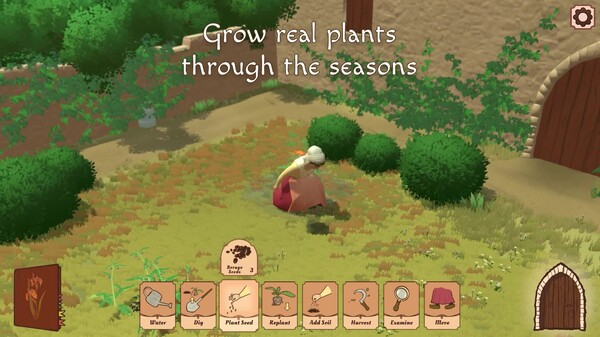
Cozy third-person gardening in 1643 France. As Agnès, restore a forbidden abbey garden, grow and identify real plants through the seasons, uncover a spy plot, help the community, and find queer romance.
Modeled estimate, not a reported figure. How we estimate →

About
Port-Royal-des-Champs is quiet now. But it isn’t empty.
The stones remember. The garden does too.

You are Agnès, a young peasant trusted with a noble task. The Abbess has given you the keys to her personal garden - a place even the mysterious Solitaires living near the abbey are forbidden to enter. What was once majestic has been swallowed by weeds and years.
Take your time. Pull back the wild growth, reveal old paths, and decide what this garden becomes. As the story advances, new areas open up, inviting you deeper into a holy place that’s slowly waking again.
Sometimes restoration is just patience.
Sometimes it’s the first step into something larger.

The garden is alive with real flora, and it behaves like a real ecosystem. Plant seeds, water them, and learn what makes each species thrive. Soil type matters. Moisture matters. Even proximity to other plants matters. There’s no rigid grid here - you’re gardening in a natural, free-form space.
As the seasons turn, discover and identify plants across every stage of their growth. When the moment is right, gather flowers, leaves, and seeds for botany. Your knowledge grows alongside the garden.
Notice what flourishes.
Notice what struggles.
Then gently make it right.

This garden was never only a garden. Hidden objects lie in the overgrowth and ruins, waiting to be found. Each discovery fills out your collections and can trigger new quests and quiet conversations. The abbey holds a long history of wonders - and of things deliberately forgotten.
Among what you uncover is a book written by a deceased spy. Its meaning is dangerous, and the wrong hands are already searching for it. Work with the local community to understand what it says before the British and French royals do.
The dirt hides more than roots.
Keep digging.

Even with court drama and espionage in the background, your days remain peaceful. The Abbess Garden is cozy at heart - a small world where you garden at your own pace, completing gentle quests and tending plants until they’re happy. Progress the story whenever you feel ready, letting it unfold linearly as you restore life to the abbey grounds.
You’ll meet NPCs based on real historical figures and events. You’ll help neighbors. You’ll piece together a quiet conspiracy. And somewhere in all that softness and sunlight, you may find a lover - a romance that grows naturally, like everything else here.
A sanctuary.
A mystery.
A garden that needs you.
Genres
Stats
All-time low is the lowest price we've recorded for this game since we started tracking it.
Languages: English
Engagement
Hours played at review time, across 41 reviews with recorded playtime.
Reviews
Themes across 41 recent reviews and how positive each mention is. A keyword signal, not full sentiment analysis.
positive critical· bar length = how often the theme comes up
Reviews
Alright, so I've been following this game since Edwige began posting on Reddit about it, getting the newsletters, the whole bit. It's great to see the full game released. First, it's a well-researched historical game (though the language can be anachronistic, with characters saying 'Ok'... but then they're French characters speaking English, without knowing English, at a time when English itself would've been quite different, so let's move on). Second, you get to garden! It's similar to some of the mechanics of other gardening/farming games, while also being a bit different. The plants indeed need different amounts of water, different types of soil, some need companion plants or more space... and getting it wrong results in dead plants. So there are consequences for over-watering, under-watering, or incorrect soil usage! Third, there's plot. You don't get to choose dialogue options, you're just along for the ride. There are queer romances, political intrigue, spy drama! Yes, the plot has been made up, but it's based on real life events from mid-17thC France. Overall, I really enjoyed the game. There were some typos, the language was, as I said earlier, anachronistic at times, and I completed it in less than the 6 hours predicted. But I could've spent more time cultivating the garden a bit better and getting the last two achievements, which I missed somehow. It was still a really cool game which felt different from what we usually get here, and I highly recommend it for history and botany nerds.
I played the demo of this and it was cute and the story is interesting. I enjoy planting and watering flowers in the garden. It's a simple game, with a cast of likeable people to gossip with and if you just want to sit back and relax, this is def good for that. :)
It's a point-and-click where clicking is nearly impossible because the graphics are so primitive.
The Abbess Garden is a tranquil historical simulation game developed by MD Studio and published by indie.io that centers on the slow restoration of a neglected monastery garden in seventeenth-century France. Unlike many farming or life-simulation games that emphasize busy routines and constant resource management, this title takes a far more contemplative approach. Players assume the role of Agnès, a young woman tasked with bringing life back to a once-beautiful garden surrounding a religious abbey. Over time, the player clears weeds, plants seeds, nurtures flowers and herbs, and gradually transforms the forgotten land into a flourishing sanctuary. The experience emphasizes patience and careful observation, encouraging players to appreciate the quiet rhythms of gardening rather than rushing toward quick rewards. The narrative framework unfolds gently as the garden slowly reveals traces of its past. While the primary goal is to restore the land, the environment itself acts as a storytelling device. As Agnès works the soil and removes layers of overgrowth, she discovers fragments of letters, hidden objects, and historical remnants tied to the abbey’s previous inhabitants. These discoveries gradually introduce a subtle mystery surrounding a spy who once operated near the monastery and whose secrets may hold political significance. Rather than presenting a dramatic plot filled with constant twists, the story emerges organically through exploration and conversations with nearby villagers. This slow and atmospheric storytelling reinforces the game’s calm tone, allowing players to uncover history piece by piece as they work in the garden. The gardening mechanics form the core of the gameplay, and they attempt to simulate plant growth in a slightly more organic way than traditional farming simulators. Instead of relying strictly on fixed planting grids, plants grow in a more natural environment where factors such as soil condition, watering habits, and proximity to other plants influence their development. Players must experiment with placement and care routines in order to discover which conditions allow certain plants to thrive. Some species flourish in specific soil compositions or require particular spacing from neighboring plants, encouraging players to observe the environment and adapt their gardening strategies. This system adds a thoughtful layer of realism, turning gardening into a process of experimentation rather than simply planting and harvesting crops. Seasonal progression further enriches the gameplay loop. As time passes in the game world, plants develop through their life cycles and new varieties become available to cultivate. Flowers bloom, herbs mature, and seeds eventually produce new growth that can be harvested or replanted. Watching the garden evolve across these cycles creates a sense of continuity and long-term progress. The once-barren ground slowly fills with color and life, rewarding players with a visual transformation that reflects their efforts. Because the game’s pacing is intentionally slow, the process of building a vibrant garden becomes a satisfying long-term project rather than a quick series of tasks. Exploration is another important component of the experience. The garden contains hidden corners, buried artifacts, and forgotten pathways that gradually become accessible as players clear away overgrown vegetation. These discoveries contribute to small quests, collections, or narrative clues that deepen the player’s understanding of the abbey’s past. Interactions with nearby villagers and members of the local community also provide context for the historical setting, revealing personal stories and perspectives connected to the monastery. These interactions help establish the world beyond the garden itself and make the restoration project feel like part of a larger living environment. The historical setting is one of the game’s most distinctive aspects. The garden is located near Port-Royal-des-Champs, a real location associated with religious communities in seventeenth-century France. The developers draw inspiration from this period, incorporating details such as traditional clothing, architecture, and plant species that would have been common during the era. This historical grounding gives the game a sense of authenticity that sets it apart from more fantastical farming simulators. The setting feels grounded in real history, making the quiet act of tending the garden feel like a small but meaningful contribution to preserving the past. Visually, The Abbess Garden adopts a soft and inviting art style that complements its peaceful gameplay. The environment is filled with gentle natural colors and detailed plant models that change over time as the garden grows. Watching empty plots slowly transform into flourishing beds of flowers and herbs provides one of the most satisfying visual elements of the experience. Character designs remain understated but expressive, emphasizing the calm and grounded tone of the story rather than relying on exaggerated stylization. The audio design plays an important role in reinforcing the game’s relaxing atmosphere. Soft instrumental music accompanies the player’s activities, blending seamlessly with ambient sounds such as wind moving through leaves, birds chirping, and distant village noises. These subtle soundscapes help create the impression of a living countryside environment where time moves slowly and naturally. The music rarely demands attention, instead serving as a gentle backdrop that enhances the meditative quality of the gameplay. However, the same slow pacing that defines the game’s charm may also be its greatest limitation for some players. Those who prefer fast-paced gameplay or complex resource management systems may find the experience too gradual or repetitive. The mechanics focus more on observation and experimentation than on difficult strategic decisions, which can make the gameplay feel less challenging compared to other simulation titles. Additionally, the narrative unfolds quietly and may feel understated to players expecting dramatic storytelling or high-stakes conflicts. Despite these limitations, The Abbess Garden succeeds in delivering a distinctive type of simulation experience. Instead of emphasizing productivity and efficiency, it encourages players to slow down, observe their surroundings, and enjoy the gradual process of restoring a living environment. Its blend of historical atmosphere, realistic gardening mechanics, and gentle storytelling creates a game that feels almost meditative in nature. For players who appreciate cozy simulation games that focus on relaxation and immersion rather than constant activity, the experience offers a refreshing alternative to more demanding farming titles. Overall, The Abbess Garden stands out as a thoughtful and atmospheric simulation centered on patience, discovery, and historical charm. Its careful attention to environmental detail and plant growth systems gives the gameplay a unique identity, while its quiet narrative adds depth without overwhelming the peaceful tone of the experience. While it may not appeal to players seeking fast progression or complex systems, it provides a memorable and calming journey for those willing to embrace its slower pace. Rating: 7/10
Just started it but really love the cozy vibe (and the fact it's a real historical place)! Early spring is a great time to try it out too :)
i'm still early in the game but wanted to leave a review because this game is obviously a labor of love <3 the characters and world have a lot of care put into them. the game so far is split into interacting with people around town (the npc art is great) and tending to the garden. as a garden game and actual gardening fan, i really like the gardening section - it is a lot more detailed than most garden games, with real plants and info about them, as well as diff plant stages, water requirements etc. it's a lot more fun with a little complexity (rather than plant > water > harvest as the default in many gardening games). i'm looking forward to planning out a super pretty garden! also the plant graphics are done well and are very accurate to real life. i love how water pools up. the controls take a minute to get used to, i watered some plants more than i meant to and they got sodden and i had to replant them somewhere else lol, but it was kinda fun. music was super chill. anyway if you are a gardening game fan, or a history fan, or both check it out :)
Disclaimer : having only played for a short while so far, this review is only from a first impressions standpoint. And those first impressions are good ! The ambiance is relaxing, the music has so far been very pleasant, and the gameplay itself is straightforward enough to grasp for anyone (at first). Given the detailed information provided when examining the garden, I'm fully expecting there to be a fair amount of juggling soil types, humidity and seeds further down the line. Historical accuracy : I merely dabble when it comes to that period of French history so I am hardly qualified to speak definitively about it, but from what little I know it's admirably documented and researched. A word on phrasing and vocabulary : one can tell at a glance that, while the vocabulary is very good, some phrases come across as stilted and a couple of words seem out of place. This isn't make or break for me, and it may even be a conscious writing choice, but it did make me raise an eyebrow when a distinctly French turn of phrase or two popped up. This is par for the course for a title from a small studio, and I have no doubt that the mood and atmosphere will transport me to the 17th century whenever I need to slow down and clear my mind a little.
The game's setting is nice, a rural village that gets dragged into bigger events as the plot develops, with plenty of charismatic characters along for the ride. Fortunately for me, the gardening gameplay was more forgiving than I expected, so no green thumb required to keep all plants happy. I found the interface to be a bit unintuitive, I often ended up watering the middle of the path or inspect a random bush instead of my intended action - but your mileage may vary. TL;DR: Novel gameplay with a nice story set in an underappreciated time in history, worth it for that alone!
[h1]Une Plongée au Cœur du Recueillement[/h1] En ce moment solennel où je couche ces mots sur le papier (ou plutôt sur cette lucarne de verre), mon voyage au sein de ce jardin s'est achevé. Quatre petites heures seulement m'ont vu errer parmi ses allées ; pourtant, le cœur me presse de louer cet ouvrage afin de lui prêter, selon mes faibles moyens, quelque assistance. Il est des titres dont la noblesse d'âme commande que l'on rompe le silence. Ici, le sage saura pardonner l’[b]étroite mesure du projet[/b], tout comme ces [i]imperfections légères et presque mignonnes[/i] qui n'ôtent rien à la splendeur du trait. On y salue la prouesse d'exécution, la flamme d'une passion sincère et, par-dessus tout, un respect quasi religieux pour la pierre et la fleur. [h2]Ce qui réjouit l'âme :[/h2] [list] [*] [b]L'Atmosphère :[/b] Quelle grâce infuse ce lieu ! La quiétude y est si profonde qu'elle semble suspendre le cours du temps. [*] [b]L'Âme de l'Artisan :[/b] On sent derrière chaque bosquet le dévouement de ceux qui préfèrent la délicatesse du détail au vain fracas des grandes productions. [*] [b]Un Refuge de Paix :[/b] C’est une véritable bénédiction pour l'esprit las des tourmentes de ce siècle. [/list] [h2]Ce que l'on pourrait parfaire :[/h2] [list] [*] [b]La Langue de France :[/b] [i]Mort-Dieu ![/i] C'est là mon unique et plus ardent souhait : que ce jardin puisse un jour nous parler dans les mots de Molière. [*] [b]L'Ultime Polissage :[/b] On notera quelques menues défaillances, tels des cailloux dans un soulier fin, qui demanderaient une main experte pour que l'expérience soit parfaite. [/list] [h1]Verdict : Un Ouvrage de Grande Vertu[/h1] Que chacun s’y arrête un instant ; car pour qui sait goûter la nature et le silence, [b]The Abbess Garden[/b] est une escale nécessaire.
this game is a visual novel with a compelling gardening system added to create a satisfying gameplay loop. I love a historical setting, and the peaceful turning of the seasons combined with the gradual drip of a political intrigue plot really works for me
Related
Related
Trends
Concurrent players on Steam, sampled daily since tracking started.
Audience
Estimated from the language of this game's reviews — a proxy for where players are, not official Steam demographics.
Related
| Zombie Flick | 僵尸快打 | $13.9K | 67 | 46% | $5.99 |
| World Seed Classic | $13.9K | 106 | 92% | $5.99 |
| Synthesis of Corruption | $13.9K | 60 | 87% | $8.99 |
| Voronica Cleans House: a Vore Adventure | $13.9K | 76 | 84% | $12.99 |
| Cat and Ghostly Road | $13.9K | 220 | 93% | $4.99 |
| Boot Hill Heroes | $13.9K | 61 | 87% | $8.99 |