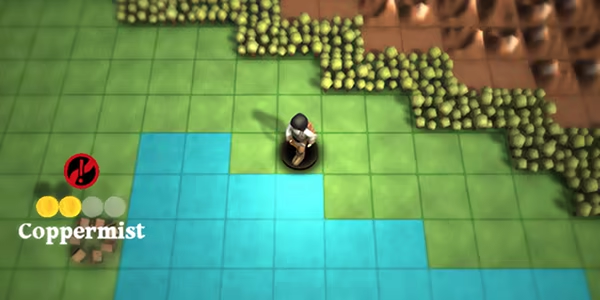
Terra Randoma is a turn-based roguelike RPG in a procedurally generated open world. Travel a world full of curiousity and perilous dungeons. Develop your character however you want with skills, talent stones and randomized items while you discover an ancient secret.
Modeled estimate, not a reported figure. How we estimate →
Media

About


Stats
All-time low is the lowest price we've recorded for this game since we started tracking it.
Languages: English
Engagement
Hours played at review time, across 40 reviews with recorded playtime.
Reviews
Themes across 40 recent reviews and how positive each mention is. A keyword signal, not full sentiment analysis.
positive critical· bar length = how often the theme comes up
Reviews
This is an excellent RPG with a very enjoyable game loop: get quest, stock up on materials, enter dungeon, explore, try not to die, collect loot, return. It's bite-sized instead of hugely sprawling: you can see the entire map on one screen, there are five towns, the dungeons have a fixed maximum size, and you can only do five quests at a time. That makes it easy to work your way through the game, and keeps you playing for just one more quest, one more item upgrade, and so on. It took me about 30 hours for one victory on normal difficulty.
I really wanted to like this game but actually playing it just got to the point where I can play other games that do what this game does, but better. I gave it 5 hours and it wasn't much fun for any of that time. It is overly punishing for no reason at all, for example, anytime you try to pick up loot there is a 20% chance that instead you get a monster (what fun! not...) And I hope you don't use fire spells because if its raining they are completely worthless! (not just reduced damage, you can't even use them at all... so much for magic fire) But the biggest issue is the PAINFULLY slow stamina regeneration. Your stamina regens so slowly that you have to run around the map for 20-30+ turns in between actually attacking or chug TONs of potions that are hard to farm b/c of RNG dependent loot drops. (I played for ~5 hours, went "foraging" about 20+ times and never found one the "common" herbs you need to make stamina potions) You have a stamina pool of maybe 60ish, your starting abilities cost 20ish+ and get more expensive as you level them up, you recover less than 1pt per turn AND that recovery rate goes down as you pick up loot. So I hope you like running around because that's what you're going to be spending most of the game doing. Overall 5/10, but to the games credit the dev does seem to be highly active so hopefully it will get better. But until that time just go play The Doors of Trithius, it is everything this game wants to be only better.
Some nice ideas, but ultimately gets crushed by tedium and a shocking lack of basic QoL. The Tedious: [list] [*]Quest objectives almost always spawn on the far side of the map, and require a return trip to the quest giver to complete. [*]Random encounters are numerous, and despite a supposed variety, seem to mostly be the same five or six scenarios. [*]Difficult terrain, inclement weather, and status effects all slow the real-time movement of your character between squares. It's a turn-based game, there's no reason for this. [*]The dungeons are all the same, and you have to explore every randomly generated room to spawn the boss. [*]Special abilities all use stamina, which regenerates incredibly slowly. But guess what, your basic attacks also use stamina! Health doesn't regen at all. So for every minor battle you end up chugging 2 or 3 potions, and then have to spend your non-questing time just searching vendors to restock. [*]Equipment has durability. But repair kits are so plentiful that there's no real risk of your gear breaking at inopportune times. So it's just another tedious thing to keep an eye on. [*]Crafting skills are borderline useless because one of the two materials for every recipe is inexplicably rare. [/list] The Unquality of Life [list] [*]Remember when I said you have chug potions like a frat boy on Friday night? You can't assign potions to the hotbar, so you're constantly opening your (likely overcrowded) inventory to keep yourself alive. [*]You can't rebind keys. Movement uses the numpad, but 'wait' uses the spacebar; num-5 isn't even an alternate. For chugging potions, you're going be opening your (B)ackpack instead of (I)nventory. [*]Mouse movement is one square at a time. [*]The graphics settings are just 1 through 5, without any explanation or apparent effect beyond making the screen darker. The edges of the playing field have an incredibly distracting blur effect that can't be turned off. [*]Ambient sound effects in town are also terribly annoying and can't be turned off. [*]The game allows you to open just about any screen from any other screen, but then gets confused as to which screen to close when you hit the escape key. (Pro Tip: It should always be the last screen opened.) [/list] The dev appears to be finished with working on the game with the latest 'codex' update, so I wouldn't expect any improvements. All of the "features" I listed have been in the game for years at this point, anyway.
I like it. I played 27 hours of this over xmas vacation this year, and beat it on easy. I find the gameplay loop addictive in a good way. There is always something I want to *do*: go somewhere, explore, get materials, upgrade items, level up skills, improve towns, etc. I don't love the RPG-style random overworld encounters, but I know that's common in games. It's not a big enough turn-off to ruin the fun, and there's actually a skill I can level that lets me avoid 95% of them. Nice.
Hmmm, this one is hard. It has the shell of a great game here, but the magic is just missing somehow? The game basically feels like you're playing inside a world of side quests as if the main story line has already been completed or something, never quite getting off the ground to truly feel compelling, more like a second job or something. It's just slightly lacking in the oomph necessary to really give you an impetus to keep playing, after 10 hours I had a world chock full of rich and loyal towns, but I just couldn't really be bothered continuing to drone around in search of more random infinite side quests whose only rewards I knew by then would be bigger numbers and another round of side quests. The game needs something more that just "ties it all together". The ratio of impact between auto-attack and abilities is also badly off, the abilities and "out of the ordinary" actions besides the standard sort of bump attack just really don't deliver the value necessary to make them feel fun, interesting and worth doing. I think reducing all the item weights by 50%, slightly reducing base power and hugely increasing the power of abilities would improve this game a lot. Additional enemy variation is also needed; while I'm quite sure there were a lot of different types of enemy units, I'd never know either way because they all behave functionally the same. This is a classic case of a game putting too much energy into crafting and oddity systems and not enough into ensuring the core game play and overall narrative were compelling. I'm umming and ahhing between recommend and not recommend here, it's a thumbs up for now but I think really only if you're in need of a time sink. If you've already got other titles you're enjoying it's not really one to make a priority.
It could be fun if you're the type of person who enjoys big-swing RNG and disposable playthroughs. There's a tactical element that's rendered almost meaningless by the massive range on dice rolls, especially as you progress. The lego style art is kind of charming, but ends up highlighting the forgettable plastic feeling of the game and every randomly assembled part of it.
Jumped right into the game without reading anything on web. I do not regret it :)
A small game with big updates, dev is very active.
Terra Randoma is a turn-based roguelike RPG that thrives on unpredictability, player agency, and systems-driven storytelling. Developed and published by Deniz K., the game presents itself modestly at first, with a simple visual style and an unassuming interface, but it quickly reveals a dense web of mechanics and interactions that reward patience and experimentation. Rather than guiding the player through a tightly scripted narrative, Terra Randoma focuses on creating a world where stories emerge naturally through exploration, combat decisions, and the consequences of chance. The foundation of the experience lies in its procedurally generated world. Each new game drops the player onto a freshly created island, complete with its own geography, settlements, dungeons, and points of interest. These worlds can vary significantly in layout and scale, encouraging multiple playthroughs and ensuring that familiarity never turns into predictability. Exploration feels purposeful, as traveling across the map can lead to unexpected discoveries, whether that’s a struggling town in need of help, a dangerous ruin hiding valuable loot, or a random encounter that spirals into a major turning point for your character. The sense that anything could happen at any moment is one of the game’s strongest hooks. Combat is built around classic grid-based, turn-based mechanics that emphasize positioning, stamina management, and tactical foresight. Every action carries weight, and careless decisions can quickly lead to defeat, especially when facing stronger enemies or unfavorable terrain. Instead of traditional classes, Terra Randoma offers a highly flexible character system built around skills and special abilities, allowing players to shape their character freely over time. This openness encourages creative builds, whether you prefer brute-force melee combat, stamina-efficient survivability, or a hybrid approach that adapts to whatever the world throws at you. Abilities play a crucial role in defining combat flow. Special powers, learned through unique systems rather than rigid class trees, can dramatically change how battles unfold. Managing stamina becomes just as important as dealing damage, as overextending yourself can leave your character vulnerable at the worst possible moment. This balance between power and restraint gives combat a thoughtful pace, rewarding careful planning over impulsive aggression. Encounters feel less like puzzles with fixed solutions and more like dynamic problems shaped by terrain, enemy behavior, and available resources. Outside of combat, Terra Randoma leans heavily into survival and world interaction systems. Hunger, weather, time of day, and environmental conditions all influence decision-making, adding texture to exploration. Camping, cooking, and crafting are not side activities but essential tools for long-term success, providing buffs and recovery options that can mean the difference between survival and failure. These mechanics integrate smoothly with the broader gameplay loop, reinforcing the idea that preparation and adaptability are just as important as raw combat skill. Quests and progression are intentionally loose and organic. Rather than following a linear storyline, players pick up tasks from taverns, settlements, or chance encounters, shaping their own path through the world. Some quests resolve quickly, while others branch or evolve based on outcomes, creating a sense of continuity and consequence. Towns can change over time, relationships form through repeated interaction, and reputations subtly influence how the world responds to your presence. This approach allows Terra Randoma to feel more like a living sandbox than a checklist-driven RPG. Visually, the game adopts a minimalist, almost tabletop-inspired aesthetic that prioritizes clarity over spectacle. While it lacks flashy animations or detailed character models, this simplicity helps keep the focus on mechanics and decision-making. The interface presents information efficiently, making it easy to track resources, abilities, and status effects without overwhelming the player. Audio design is understated, serving primarily to support immersion rather than dominate attention, which fits the game’s contemplative and methodical tone. Difficulty and randomness are central to the experience, and they won’t appeal to everyone. Luck can play a significant role in encounters, and unexpected setbacks—including sudden character death—are part of the design philosophy. However, the game offers options that allow players to adjust how punishing the experience is, making it accessible to those who prefer a more forgiving RPG while still satisfying players who enjoy high-stakes roguelike tension. In the end, Terra Randoma is a game that values systems over spectacle and emergent stories over scripted drama. It rewards players who enjoy thinking through consequences, adapting to uncertainty, and learning from failure. While its presentation is modest and its pacing deliberately measured, the depth beneath the surface is substantial. For fans of turn-based tactical RPGs and roguelikes who appreciate freedom, replayability, and worlds shaped as much by chance as by choice, Terra Randoma offers a rich and quietly compelling adventure that grows more engaging the longer you spend with it. Rating: 8/10
I've been looking into and trying plenty of strategy games as of late, and almost all of them have been disappointing. I took a chance on Terra Randoma, and I'm glad I did. Sure, there's tweaks that could be made to attributes, skills, talents, and quests to improve viability, balancing, and variety. But with that said, there's plenty of variety and replayability in the randomness of the maps, encounters, dungeons, quests, drops, equipment, and items. Terra Randoma isn't a showy game, but if you like strategy games, I think it's worth your time.
Related
Related
Trends
Modeled estimate over time, reconstructed from Steam's monthly review histogram.
Momentum
Pace estimated from the game's recent review growth (our daily snapshots) at its own sales-per-review ratio — a momentum signal, not booked sales.
Audience
Estimated from the language of this game's reviews — a proxy for where players are, not official Steam demographics.
Related
| DIMENSIONS | $53.9K | 117 | 50% | $19.99 |
| Operation Wolf Returns: First Mission | $53.9K | 104 | 67% | $24.99 |
| Pocket Stables | $53.9K | 205 | 92% | $8.99 |
| Drums Hero | $53.9K | 80 | 72% | $19.99 |
| Wunderling DX | $53.9K | 192 | 94% | $14.99 |
| Inescapable: No Rules, No Rescue | $53.9K | 63 | 40% | $49.99 |