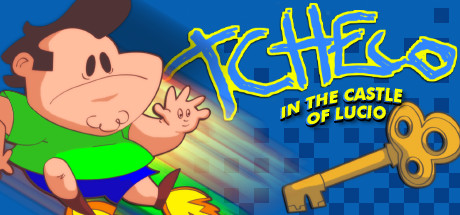
Tcheco in the Castle of Lucio is an exciting, fast-paced action game.Help Tcheco the Adventure Boy to leave a mysterious castle full of deadly creatures! Be ready for a big challenge, full of nonsense humor and retro goodness.
Modeled estimate, not a reported figure. How we estimate →
Media

About
Genres
Stats
All-time low is the lowest price we've recorded for this game since we started tracking it.
Languages: English, Portuguese - Brazil**languages with full audio support
Engagement
Hours played at review time, across 40 reviews with recorded playtime.
Reviews
Themes across 40 recent reviews and how positive each mention is. A keyword signal, not full sentiment analysis.
positive critical· bar length = how often the theme comes up
Reviews
PEPITO!! MAICON!!
Obscure, ultra-challenging 8-bit cult classic platformer, perfectly blending nostalgia with brutal difficulty
A simple and quick platformer that is delightfully fun, incredibly satisfying, filled with eventful action, and packed with personality. Positive: - The 8-bit approach to the design and to the creative aesthetics is adeptly authentic, making use of retro sprites and sounds expertly. Even the implementation of digitized voices is artfully produced, adding a nice touch to the accompanying chiptune melodies. - Each screen is its own independent level, having its own unique objectives, maintaining the platforming mechanics as one progresses, while also introducing new ways to interact with obstacles and hazards. This unconventional level layout is refreshing and provides the player with gratifying bite-sized stages that are amusing, brief, and promptly progressive. - References to Brazilian popular culture are spread through several screens around the game, with acknowledgments of entertainers, famous video games, and allusions to the country's political past. These implicit connections come in visual and in aural forms, adding an exceedingly charming layer to the already charismatic original characters and cleverly imaginative world. Neutral: - It can be occasionally difficult to realize what part of the screens' background can be climbed on or not, without experimentation. Platforms blend too easily with decorative visual features, causing the playable character to fall or to take damage inadvertently. - Platforming allows no improvisation whatsoever, as the player must traverse each screen precisely as the developer designed them, without any room for experimentation or ingenuity. Approaching environmental hazards or avoiding enemies only involves learning what the developer accommodates. - There is no checkpoint or savepoint system in place. One must complete the game in one sitting, without any way to save or to load their progress. Having said that, a successful attempt to beat the game takes about fifteen minutes to complete, so the aforementioned lack of the ability to save is not a major drawback. - Settings, options, and controls are not available in any fashion. The game runs in the fixed traditional aspect ratio of 4:3, and there is no way to adjust volume or to remap buttons or keys. Aside from this, the game runs at around 65 frames per second at all times, without drops. Negative: - Crashes associated with Visual C++ errors happen, and there does not seem to be anything that could be done about the problem. Updating the associated redistributables is not helpful. - Hit detection is inconsistent and erratic, causing the player to lose health points unfairly. Sometimes, the playable character seems to have a wide berth from an obstacle and still receives damage, while at other times, sprites seem to touch but cause no damage. - Some screens require precision platforming in order to advance, yet the engine that the game was developed under does not provide the necessary accuracy of controls for clean movement and jumping. This problem makes some screens clumsy and awkward. Overall rating: 3.5/5.0
It really takes you back to the old days.
有卡 没中文 没成就 切科在卢西奥城堡 《切科在卢西奥城堡》是一款节奏明快、刺激的动作游戏。 帮助冒险少年切科逃离这座充满致命生物的神秘城堡! 准备好迎接一场充满无厘头幽默与复古情怀的大挑战。 游戏特色 2D 平台跳跃游戏,经典红白机(Famicom/NES)爱好者的不二之选! 画面与音效充满 8-bit 美学风格。 支持 Xbox 手柄与键盘操作。 65 个难度循序渐进的房间。 上手简单,玩法轻松。
Tcheco in the Castle of Lucio is a deliberately old-school platformer developed and published by Marcelo Barbosa that fully embraces the design philosophy of early console-era games, particularly those from the 8-bit generation. From the moment it begins, the game makes it clear that it is less concerned with hand-holding or modern conveniences and far more focused on precision, repetition, and player perseverance. Narrative context is kept minimal, serving mostly as a framing device to justify the journey through a sprawling, trap-filled castle, and this stripped-down approach reinforces the title’s commitment to gameplay above all else. At its core, the experience revolves around navigating a large collection of individual rooms, each functioning like a compact challenge or obstacle course. Movement is simple and intentionally rigid, emphasizing tight jumps, careful timing, and memorization of enemy patterns. Every room introduces a new hazard, mechanic, or twist that demands the player’s full attention, and mistakes are punished swiftly. The game’s structure leans heavily on trial and error, where death is not only expected but essential to learning how each room functions. In its classic mode, losing all lives results in restarting from the beginning, a design choice that mirrors the harsh difficulty curves of early platformers and will immediately appeal to players who enjoy mastering systems through repetition rather than gradual progression. What keeps this punishing loop from becoming exhausting is the game’s playful unpredictability. Levels often surprise the player with absurd or humorous elements, ranging from unconventional obstacles to unexpected interactions that feel deliberately mischievous. This sense of humor gives the castle a strange personality, making each room feel less like a sterile challenge and more like a chaotic experiment designed to test reflexes and patience. While the mechanics themselves remain simple, the variety in room design ensures that the player is constantly adapting, even if the overall structure remains familiar throughout the game. Visually, Tcheco in the Castle of Lucio fully commits to its retro identity. The pixel art is bold and colorful, evoking the limitations and charm of classic 8-bit graphics without attempting to modernize or embellish them. Environments are distinct enough to prevent the castle from feeling monotonous, even if they remain visually simple. Character sprites and enemies are intentionally blocky and exaggerated, adding to the game’s playful tone. Complementing this is a chiptune-inspired soundtrack that reinforces the nostalgic atmosphere, providing energetic loops that suit the game’s frantic pace, though extended sessions may reveal a lack of musical variety. The game also offers alternative modes that slightly soften its otherwise unforgiving nature. These modes allow players to retry rooms without fully restarting, making the experience more accessible to those who enjoy the gameplay but find the classic structure too punishing. While these options don’t fundamentally change how the game plays, they do broaden its appeal and make it easier for less experienced players to engage with its level design without becoming overly frustrated. Despite its strengths, the game’s rigid adherence to old-school design can be divisive. The lack of checkpoints, limited lives, and reliance on memorization may feel dated or unnecessarily punishing to players accustomed to modern platformers that prioritize flow and accessibility. Progress can feel slow, especially when late-game mistakes force significant repetition, and the absence of deeper systems or progression beyond clearing rooms means replay value is largely tied to personal mastery rather than evolving gameplay. Once the final room is conquered, there is little incentive to return unless the player wishes to challenge themselves again. Ultimately, Tcheco in the Castle of Lucio succeeds because it knows exactly what it wants to be. It is a focused homage to a bygone era of game design, built around precision platforming, unforgiving difficulty, and a playful sense of absurdity. While it may not resonate with players seeking narrative depth or modern conveniences, it offers a satisfying and authentic experience for fans of retro platformers who enjoy overcoming steep challenges through patience and skill. For those willing to embrace its harsh lessons and persistent restarts, the journey through Lucio’s castle becomes a memorable test of endurance and timing that feels both frustrating and rewarding in equal measure. Rating: 8/10
Кем надо быть чтобы задержатся в этой игре хотя бы на 5 минут
Game muito top, lembra muito jogos de NES
JOGAO
Fez meu ódio crescer a cada novo cenário, amei!
Related
Related
Trends
Modeled estimate over time, reconstructed from Steam's monthly review histogram.
Momentum
Pace estimated from the game's recent review growth (our daily snapshots) at its own sales-per-review ratio — a momentum signal, not booked sales.
Audience
Estimated from the language of this game's reviews — a proxy for where players are, not official Steam demographics.
Related
| Hazard Levels | $16.6K | 76 | 68% | $7.99 |
| Smash Cars | $16.6K | 63 | 76% | $9.99 |
| Deep Desktop | $16.6K | 134 | 77% | $5.99 |
| The Hidden Art of Innkeeping | $16.6K | 64 | 100% | $7.99 |
| Shards of Azuria | $16.6K | 101 | 60% | $7.99 |
| The Plane Effect | $16.6K | 79 | 62% | $14.99 |