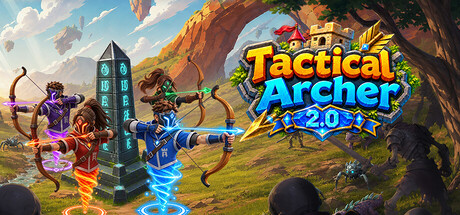
Mysterious island portals unleash plague monsters targeting "Guardian Monuments"—their destruction dooms the island. As defender, use a bow (break armor/hit weak points) and a magic sandtable: place towers, real ones rise to block. Game has VR/desktop versions and map editing for custom levels.
Modeled estimate, not a reported figure. How we estimate →
Media

About
An inexplicable portal has appeared, devouring the surrounding plants and trees. Countless infected skeletons and monsters pour out of the portal, their target being the "Guardian Stone Tablet" on the island. Once the stone tablet is destroyed, the entire island will be completely shrouded in plague.
So far, the plague has eroded several islands and is continuing to spread outward. At this moment, a distress signal comes from a border village: the plague portal has opened, and infected creatures may invade at any time. The Guardian Stone Tablet in the village needs your protection.
You will play the role of a magic tower defender on the island, using a bow and arrow as well as a magical sand table to fend off enemy invasions.
Take control of a mysterious strategic sand table. Every layout and deduction you make here can be mapped in real time and affect the in-game world ahead, as if you possess the magic to manipulate reality. Players can place defense towers on the magical sand table, which corresponds to the in-game map on a 1:1 scale. At the same time, identical defense towers will rise in the real-world scene corresponding to the sand table, and you can use various defense towers to block the enemy's attack.
You not only need to make overall plans and carefully arrange various arrow towers and fortifications; you can also personally draw the bow and shoot arrows, resolving crises with precise shots, and enjoying the dual fun of strategic layout and action operations.
From editing the map with every blade of grass and every tree to designing the level events wave by wave, powerful creation tools are in your hands. Create a unique battlefield and invite friends to challenge your masterpiece. The desktop version of the game allows players to customize maps and levels, letting you build a battlefield of your own.
The game supports two gameplay modes: traditional PC desktop and VR. This allows you to either make strategies in a comfortable setting or step into the battlefield as if you were really there, fully experiencing the thrill of defending and drawing the bow to shoot arrows.
5. Free Shooting Range: Do as You Wish
The shooting range is not only a training camp for honing your archery skills and testing new weapons, but also a safe space where you can move freely, explore, and discover surprises—providing a place to relax amid the intense battles.
This is your strategic core! Here, you can not only configure and upgrade equipment and weapons, and purchase scarce resources, but also move freely. The achievement trophies unlocked in the game will be displayed here, recording your gaming career.
Genres
Stats
All-time low is the lowest price we've recorded for this game since we started tracking it.
Languages: English, Simplified Chinese
Reviews
Pretty bad experience, Barely made it past level 2 because of game breaking glitches. Big armoured guy heals when towers shoot him and so does the boss slime. Slimes zooms at crazy speeds and gets stuck or pass through stuff.
塔防游戏中能玩家主动参与进攻的游戏不少,这个的特色是你在塔楼的棋盘上布置炮塔,然后可以随时切换到棋盘外变成第一人称视角,并在棋盘塔楼上拉弓射箭参与进攻。你走不出塔楼,视觉里外2层,有点像是梦中梦的感觉。 但是攻击判定非常迷惑,总是看到明明射中了,但是不造成伤害判定。我建议极大增加判定区域。 按空格键可以开关阴影效果。 过关的三星显示看不出是亮灯还是没亮灯,缺少动画表现。 普通困难黑夜,黑夜模式没办法直观理解到底是什么难度。 有中文 没成就 可VR 585MB
Tactical Archer is an indie strategy-action hybrid developed and published by Dejevis that attempts to merge several gameplay concepts—tower defense, archery combat, and tactical planning—into a single experience. Rather than focusing entirely on passive defenses like many games in the genre, it places the player directly into the battlefield as an active participant armed with a bow. The game’s premise revolves around defending mystical islands from waves of corrupted creatures emerging from dangerous portals. At the center of each battlefield lies a sacred monument that must be protected at all costs, and the player’s responsibility is to design defensive structures, prepare tactical layouts, and personally engage the invading enemies before they can destroy the island’s core. This structure gives the game a mixture of strategic oversight and hands-on action that distinguishes it from more traditional tower defense titles. The most distinctive element of the game is its magical “sand table” system, which acts as a planning interface that mirrors the battlefield. Before combat begins, players use this tabletop-like environment to position defensive towers, obstacles, and various structures. The interesting twist is that the miniature layout corresponds directly to the actual battlefield, meaning every structure placed on the table appears in the world at a one-to-one scale. This approach creates the feeling of commanding a miniature war map while still remaining connected to the actual terrain where battles unfold. It allows experimentation with defensive layouts and choke points, encouraging players to think carefully about enemy movement paths, tower placements, and how their own archery support will complement automated defenses. Once enemy waves begin, the perspective shifts from pure planning to active combat. The player must pick up a bow and engage enemies directly while the towers perform their automated roles. The archery mechanics are simple but functional, requiring the player to aim carefully, time shots, and focus on high-priority targets that slip through defensive lines. Stronger enemies may require more attention from the player’s bow, forcing quick decisions between maintaining defensive structures and personally eliminating threats. This dual-layer system—strategic preparation followed by reactive combat—creates a rhythm where success depends on both intelligent planning and the player’s ability to intervene during critical moments. Enemy encounters unfold through wave-based assaults originating from portals scattered around the map. These monsters gradually advance toward the Guardian Stone Tablet, the central objective that must be protected. If the tablet is destroyed, the mission fails. Over time, waves grow stronger and introduce tougher adversaries that test the durability of defenses and the player’s combat skill. The tension created by this escalation is one of the game’s more enjoyable aspects, especially when a carefully planned defense holds together under pressure while the player provides precision support with the bow. Another notable feature is the inclusion of both traditional desktop gameplay and virtual reality support. In standard PC mode, the player controls the bow using conventional inputs, giving the game the feel of a tactical shooter blended with strategy mechanics. In VR, however, the experience becomes significantly more immersive. Players physically draw the bowstring, aim arrows with natural hand movement, and interact with the battlefield in a more tangible way. The VR option helps the game stand out within the strategy genre, offering a more physical interpretation of the player’s role as a defender rather than simply controlling units from afar. The game also provides a few supplementary systems intended to extend its replay value. A shooting range allows players to practice their archery skills and experiment with different equipment in a low-pressure environment. There is also a command room where players can manage equipment, upgrade certain elements, and display progress through trophies and achievements. These spaces function as hubs between missions and give the experience a sense of structure, though the progression systems themselves remain relatively light. Customization and creative tools add another dimension to the experience. Players can design their own battlefields, experiment with defensive layouts, and create unique scenarios using the available level editing features. While the editing tools are somewhat basic compared to full modding platforms, they still provide room for experimentation and can extend the game’s lifespan for players who enjoy crafting strategic challenges. Designing a map, testing defensive layouts, and watching them play out in real time can be surprisingly engaging for those interested in the tactical side of the game. Visually, Tactical Archer adopts a simple 3D style that emphasizes clarity over visual spectacle. The environments are relatively straightforward, featuring stylized islands, defensive structures, and enemy creatures that are easy to distinguish during chaotic battles. While the art direction lacks the polish of larger studio productions, the clear visual presentation helps maintain readability during combat, which is important for a game where positioning and quick reactions play a major role. Despite its creative ideas, the game does have limitations. The scope of content is modest, and the number of enemy types, maps, and progression elements can feel somewhat limited after extended play sessions. The mechanics themselves are enjoyable but not especially deep, meaning that once players discover effective defensive strategies, the challenge curve can flatten. These shortcomings make the experience feel somewhat experimental, as though it is exploring an interesting concept rather than fully realizing its potential. Even so, Tactical Archer deserves credit for attempting something different within the crowded strategy genre. Its blend of tabletop-style planning and active archery combat offers a refreshing twist on tower defense gameplay, particularly for players interested in VR interactions. While it may not have the scale, polish, or content variety of larger titles, it still delivers moments of satisfying tactical experimentation and creative battlefield design. For players who enjoy indie experiments, strategy hybrids, or VR-enabled combat experiences, Tactical Archer can be an intriguing niche title worth exploring. It may not redefine the genre, but its unique mix of planning and hands-on defense provides a distinctive flavor that sets it apart from more conventional tower defense games. Rating: 6/10
not even worth it on sale. badly optimized with buggy interface.
Related
Related
Trends
Concurrent players on Steam, sampled daily since tracking started.
Momentum
Pace estimated from the game's recent review growth (our daily snapshots) at its own sales-per-review ratio — a momentum signal, not booked sales.
Related
| My Bike | $3K | 55 | 73% | $1.99 |
| The Seven Deadly Seas | $3K | 55 | 69% | $1.99 |
| Apocalypse Island | $3K | 67 | 40% | $1.99 |
| PIXEL DRIFT | $3K | 79 | 43% | $1.99 |
| SKUF BACKROOMS | $3K | 99 | 58% | $0.99 |
| Drunkn Bar Fight on Halloween | $3K | 67 | 73% | $2.99 |
Related
| Cities: Skylines | $203.5M | 290.9K | 93% | $29.99 |
| Factorio | $140.7M | 232.6K | 98% | $35.00 |
| Cities: Skylines II | $112.7M | 91K | 55% | $49.99 |
| Planet Coaster | $109.4M | 72.1K | 91% | $44.99 |
| Planet Zoo | $107.6M | 97K | 91% | $44.99 |
| Jurassic World Evolution | $74.6M | 55.2K | 87% | $44.99 |