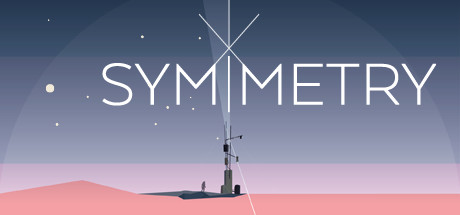
SYMMETRY is a stark, pressure-driven survival experience developed by Sleepless Clinic and published by IMGN.PRO that places players in an unforgiving science-fiction scenario defined by scarcity, isolation, and constant loss of control. The premise is simple but bleak: a research ship has crash-landed on a frozen alien world, and a small group of crew members must survive long enough to repair the vessel and escape. What distinguishes SYMMETRY from more conventional survival sims is its refusal to provide comfort, safety nets, or steady power growth. Instead, it presents survival as a fragile balance that can collapse at any moment, reinforcing the idea that endurance—not dominance—is the true goal.
The core of the game revolves around managing a handful of survivors, each with individual skills, limits, and physical needs. Every day becomes a puzzle of prioritization: who gathers food, who chops wood for heat, who repairs damaged systems, and who must rest before exhaustion becomes fatal. Time is always working against you, as cold temperatures drain stamina and hunger steadily erodes health. Even basic decisions feel heavy, because assigning someone to one task inevitably leaves another critical need unmet. This constant trade-off creates a persistent sense of anxiety, making progress feel tentative rather than triumphant.
Resource management in SYMMETRY is intentionally harsh. Supplies are limited, gathering is slow, and equipment frequently breaks down, forcing players to divert attention away from long-term goals just to keep the base functional. Food shortages and fuel scarcity often dictate strategy more than any overarching plan, and a single mistake can cascade into multiple failures. The game resists the power fantasy common in many survival titles; instead of building toward stability, players are often just trying to delay collapse long enough to inch closer to escape.
Crew wellbeing extends beyond simple hunger and warmth. Survivors can become exhausted, injured, or mentally strained, reducing their effectiveness and forcing players to rotate responsibilities carefully. Skill development exists, but it is born from necessity rather than choice, with crew members adapting to roles they are forced into by circumstance. This system reinforces the game’s tone of desperation, as specialization feels less like growth and more like a reluctant adjustment to worsening conditions.
Narrative elements are woven subtly into the experience rather than delivered through explicit storytelling. The world itself feels hostile and unknowable, and hints of strange phenomena and unsettling discoveries suggest that the planet may be more than just a frozen wasteland. These moments add a layer of unease without shifting the game into overt horror, allowing the atmosphere to remain quietly oppressive. The story never dominates the mechanics, but it provides enough context to make the struggle feel purposeful rather than abstract.
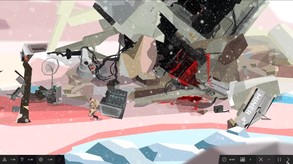
Visually, SYMMETRY adopts a minimalist, retro-futuristic vector art style that sets it apart from more realistic survival games. Characters, environments, and interfaces are rendered in sharp, geometric forms and muted colors, emphasizing clarity and mood over detail. This aesthetic reinforces the sense of alienation, making the planet feel cold, empty, and indifferent to human suffering. Paired with subdued sound design and ambient music, the presentation successfully sustains a tone of isolation and quiet dread throughout the experience.
The game’s pacing and difficulty are among its most divisive aspects. Progress is slow, and failure is frequent, often sending players back to the beginning after hours of careful planning undone by a chain of unfortunate events. Randomized weather shifts and unexpected breakdowns can undermine even well-considered strategies, which some players view as an authentic representation of survival under extreme conditions. Others find this randomness frustrating, as it can make outcomes feel less like the result of decision-making and more like inevitability.
There is little in the way of traditional variety. Environments remain largely consistent, and the core loop changes only in intensity rather than structure. Over time, the repetition of daily survival routines can set in, especially for players who struggle to break past early stages. SYMMETRY does not attempt to soften this repetition with cosmetic rewards or dramatic milestones, instead committing fully to its vision of endurance as the primary challenge.
Ultimately, SYMMETRY is a game that succeeds most strongly as an atmosphere-driven survival simulation rather than a broadly accessible management experience. Its strength lies in how convincingly it conveys vulnerability, making every success feel temporary and every loss deeply consequential. For players who enjoy survival games that emphasize tension, scarcity, and emotional weight over empowerment, SYMMETRY offers a memorable and often punishing journey. For those seeking steady progression, variety, or forgiving systems, its uncompromising design may feel exhausting. It is a game that asks players not how to win, but how long they can endure—and that question defines both its appeal and its limitations.
Rating: 5/10