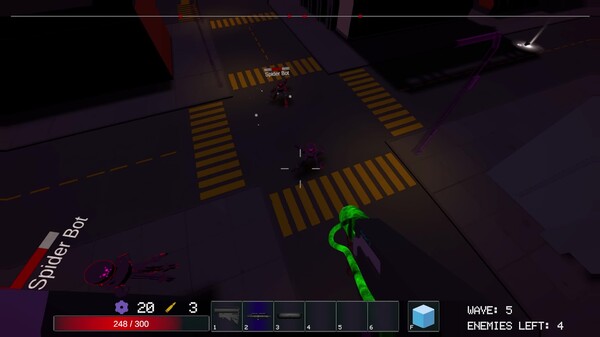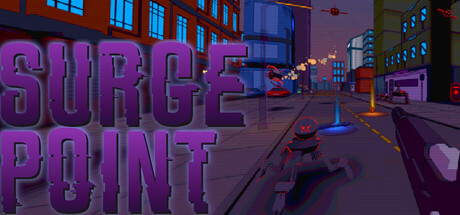
Craft weapons mid-run, strafe through chaos, chain recoil jumps, spawn platforms out of thin air. Pick cards. Break runs. Repeat.
Modeled estimate, not a reported figure. How we estimate →
Media

About
SURGEPOINT is a roguelike boomer shooter inspired by Risk of Rain and Quake. Craft your arsenal from scratch, master movement that rewards creativity, and survive as long as you can in a corporate death game.
You're a prisoner of SurgePoint Industries, a megacorp that throws inmates into combat simulations to stress-test experimental weapon technology. Every run, you're dropped into the arena to fight waves of combat bots. Your job? Find the perfect weapon combination before you die. Again.
There's no escape. There's no winning. There's only lasting longer than last time.
There are no pre-made guns in SurgePoint. Just parts. Find barrels, bodies, mags, grips, and sights during your run and snap them together to create something deadly.
Combine a Splitting Barrel with a Shotgun Body and Explosive Mag to spray explosive projectiles across the room. Or load Bouncy Ammo into a Ripper Body and turn tight corridors into a bullet hell. Ricochets fly off every wall until nothing's left standing.
The battlefield never stays the same. Swap components on the fly to adapt or die trying.
Combat isn't won by raw firepower alone. It's about speed, positioning, and style.
Run, jump, and strafe through procedurally-assembled arenas. Your gun kicks. Hard. Master the recoil to dodge incoming fire, reposition mid-fight, or launch yourself skyward. High-recoil builds hit like trucks but send you flying. Low-recoil builds keep you grounded but won't save you from a swarm.
Your enemies don't fight fair. Neither should you. Deploy Holocubes to create temporary platforms. Block choke points to buy yourself time, reflect bouncy rounds into enemies behind cover, or climb to rooftops and hidden areas the bots can't reach.
Genres
Stats
All-time low is the lowest price we've recorded for this game since we started tracking it.
Languages: English
Reviews
Really fun fast-paced roguelike with a unique gun-building twist. I'm writing this after my first run, which hooked me in and lasted almost 2 hours. Definitely worth the price, even in early access. I'm excited to see what else gets added!
First impressions, to update as it gets updated over time. Fun concept! The Gun building mechanic works really well, and the gun parts do make each build feel distinct and different. Reminds me of Tower of Guns in a good way with the gun kickback letting you really fly around and out maneuver the bots. The cards system is also cool, giving you the option between permanent slight upgrades/mechanical change or single wave boost. Still feels verrryyy early. Movement physics isn't very tight yet and only one map means it's difficult to use your movement to the extent you need. Models are also pretty basic and lack personality, although the physics based movement of the enemies is fun to watch, like the jerky leg movements of the spider bots. Worth checking out atm for a few bucks. Hopefully the movement gets tightened up, some 'juice' is added to make the gunplay feel a bit better, and some more variety/modes is added. The bones are here and pretty solid, Good job so far and good luck with the rest of development!
Related
Related
Trends
Modeled estimate over time, reconstructed from Steam's monthly review histogram.
SurgePoint is a fast-paced roguelike shooter that combines old-school arena combat, extreme player mobility, and an impressively flexible weapon crafting system into one chaotic sci-fi action experience. Developed and published by The Blue, the game feels like a deliberate fusion of classic boomer shooters and modern roguelike design. It takes the speed and aggression of games like Quake and Unreal Tournament while layering randomized progression, modular weapon construction, and procedural combat arenas on top. Even in its current Early Access state, SurgePoint already demonstrates a strong gameplay identity built around experimentation, movement mastery, and nonstop momentum-driven combat. The premise is intentionally minimal but effective. Players take the role of prisoners trapped inside violent simulations controlled by the massive SurgePoint Industries corporation. These arenas are designed to test experimental weapon technology under increasingly deadly conditions, forcing players to survive endless waves of robotic enemies while scavenging weapon components and upgrades. The narrative remains mostly in the background because the game understands that its real focus is gameplay freedom and mechanical creativity rather than cinematic storytelling. The corporate simulation setting mainly exists to justify the constant chaos and endless experimentation taking place during each run. One of the game’s most impressive features is its weapon customization system. Instead of simply collecting predefined firearms, players build weapons dynamically using interchangeable parts found during gameplay. Barrels, magazines, ammunition types, grips, firing mechanisms, and elemental modifications can all be combined in different ways to create wildly unpredictable guns. Some combinations produce explosive shotguns capable of launching enemies across arenas, while others create rapid-fire ricochet weapons or recoil-heavy launchers that double as movement tools. This system becomes the heart of the entire experience because every run encourages players to experiment with strange combinations and discover absurdly powerful setups. The flexibility of weapon building creates enormous replay value. Players are constantly adapting their strategies depending on which parts appear during a run, and some combinations completely transform how combat feels. One run might focus on precise long-range weapons, while another becomes a chaotic explosion-filled sprint through enemy waves using unstable projectile launchers. The excitement comes from discovering synergies between weapon parts and movement mechanics rather than simply memorizing enemy patterns. Combat itself feels heavily inspired by classic arena shooters. Movement is extremely fast, and survival depends more on speed and aggression than defensive play. Strafing, bunny hopping, aerial movement, recoil jumps, and momentum management are all essential parts of gameplay. The game actively rewards players who stay mobile and aggressive instead of hiding behind cover. Certain weapons generate enough recoil to physically launch the player through the air, turning gunfire into both an offensive weapon and a movement system simultaneously. This creates a combat flow where players are constantly flying through arenas while firing explosive weapons at swarms of robotic enemies. One of the most creative mechanics is the Holocube system. Players can generate temporary platforms and structures during combat to block enemies, create new pathways, or reach elevated positions. This feature adds an additional tactical layer beyond simple shooting because players are constantly manipulating arena layouts while fighting. Combined with recoil-based movement, the Holocube mechanic gives the game a unique identity that separates it from more straightforward roguelike shooters. Arenas become highly interactive spaces where movement and positioning matter just as much as firepower. The roguelike structure works extremely well within this framework. Every run introduces randomized enemy waves, procedural maps, upgrade cards, and weapon combinations that force players to adapt continuously. Upgrade cards allow players to shape builds in dramatically different directions, emphasizing mobility, explosions, elemental effects, ricochets, or raw firepower depending on preference. This unpredictability keeps gameplay fresh because no two runs unfold exactly the same way. The game constantly encourages experimentation rather than relying purely on mechanical mastery. Visually, SurgePoint embraces a retro-inspired sci-fi style that prioritizes speed and readability over excessive detail. The environments are filled with neon lighting, industrial architecture, and cyberpunk-inspired design elements that reinforce the corporate simulation setting effectively. Bright projectile effects, explosions, and movement trails help make combat visually satisfying without overwhelming the player during chaotic encounters. The art direction succeeds because it complements the fast gameplay rather than distracting from it. The soundtrack and sound design also contribute heavily to the game’s energy. Electronic music and aggressive combat effects maintain momentum throughout every run, helping firefights feel intense even during smaller encounters. Weapons sound powerful and impactful, especially when combined with explosive or ricochet-heavy builds that fill arenas with destruction. The audio design constantly reinforces the game’s chaotic pace and aggressive combat philosophy. One of the strongest aspects of SurgePoint is how much freedom it gives players. The game rarely forces a specific strategy or preferred playstyle. Instead, it constantly encourages experimentation through weapon crafting and randomized upgrades. Players who enjoy discovering overpowered combinations and creating chaotic builds will likely find the gameplay loop highly addictive. The game captures the same rewarding experimentation found in strong roguelikes where every run becomes an opportunity to discover something unexpected. However, the Early Access state is still noticeable. While the core mechanics are already strong, the overall amount of content remains somewhat limited. Enemy variety, environmental diversity, and long-term progression systems could all use further expansion. After many runs, players may begin noticing repeated enemy behaviors and familiar arena structures. The current version feels more like the foundation of a potentially excellent game rather than a fully complete experience. Certain balancing issues also appear occasionally, especially when particularly powerful weapon combinations trivialize encounters too easily. Some enemy AI behaviors feel simplistic compared to the complexity of the player’s movement and weapon systems. Technical polish is generally solid for an indie project, though some animations and environmental assets still reveal the limitations of the smaller development scale. Despite these shortcomings, SurgePoint already succeeds at creating one of the more mechanically creative indie shooters currently in development. The combination of modular weapon construction, movement-focused combat, and roguelike progression creates an experience where improvisation and experimentation feel just as important as aiming skill. Every successful run feels chaotic and personal because players are constantly building weapons and movement strategies unique to their own playstyle. For fans of boomer shooters, roguelikes, and movement-heavy FPS games, SurgePoint offers a highly promising and deeply enjoyable experience filled with creativity, speed, and chaotic experimentation. If future updates continue expanding the content variety and refining the existing systems, the game has the potential to become one of the most distinctive indie shooters in the modern roguelike FPS genre. Rating: 8/10
I didn't play too much but for being an early access the game is overall quite good there's content and the idea is really nice. Also I don't have any performance issues
Momentum
Pace estimated from the game's recent review growth (our daily snapshots) at its own sales-per-review ratio — a momentum signal, not booked sales.
Related
| Mount & Blade II: Bannerlord | $309.8M | 294.2K | 88% | $49.99 |
| Palworld | $279.6M | 452.3K | 94% | $29.99 |
| The Forest | $254.8M | 678.8K | 96% | $19.99 |
| Schedule I | $144.4M | 309K | 98% | $19.99 |
| Raft | $144M | 376K | 93% | $19.99 |
| Phasmophobia | $121.9M | 835.2K | 94% | $13.99 |
Related
| Robo Do It | $1.4K | 60 | 70% | $0.79 |
| Psycho | $1.4K | 99 | 58% | $1.99 |
| Just skill shooter 2 | $1.4K | 55 | 38% | $0.79 |
| Comit the Astrodian | $1.4K | 60 | 82% | $0.99 |
| 单身狗的最后机会 | $1.4K | 54 | 85% | $0.99 |
| Black Jack Story | $1.4K | 90 | 69% | $0.99 |