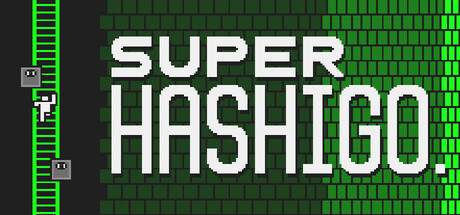
The controls used during the game are a simple operation with only two keys: "Forward" and "Backward." However, it offers a highly challenging experience. Dodge various gimmicks and aim for the top of "HASHIGO"!
Modeled estimate, not a reported figure. How we estimate →
Media

About
The game uses only two keys during gameplay: "Forward" and "Backward" — an extremely simple control scheme.
Yet it delivers a challenging high-difficulty experience that truly tests your skills.
Avoid a wide variety of gimmicks and traps as you aim for the top of "HASHIGO," a tower consisting of over 200 floors!
※This game was created with RPG Maker MV
・Streaming is allowed
There are no restrictions on live streaming, uploading play videos, or monetization.
・Controls during the main game
↑ or D-pad Up --- Move forward (climb the ladder)
↓ or D-pad Down --- Move backward (descend the ladder)
F5 key or L1+R1 triggers (pressed simultaneously) --- Reset (return to title screen)
F4 key --- Toggle fullscreen / windowed mode
・Stage structure
A total of 5 stages, each consisting of dozens of floors
Over 200 floors in total — a true test of endurance
※The current floor number is displayed in the top-right corner
※You can save your game each time you clear a stage
・Mistakes
If the player character touches an enemy or gimmick, they will fall (miss)
There is no traditional Game Over,
but when you miss, you restart from a few floors back.
How many floors you are sent back is random — sometimes you may have to redo dozens of floors.
If your spirit breaks, that’s the real Game Over.
Stats
All-time low is the lowest price we've recorded for this game since we started tracking it.
Languages: English, Japanese
Reviews
SUPER_HASHIGO is an unforgiving arcade climbing game that turns an incredibly simple control scheme into a demanding test of reflexes, concentration, and persistence. Developed by CAPT.G, the game revolves around ascending a massive trap-filled tower while using only two directional inputs. On the surface, the concept sounds almost absurdly minimalistic, but the game quickly reveals itself as a brutally precise challenge built around timing, pattern recognition, and repeated mastery through failure. It feels heavily inspired by old-school arcade design philosophy where success is earned entirely through skill and patience rather than progression systems or accessibility mechanics. The central gameplay loop focuses entirely on climbing upward through hundreds of increasingly dangerous floors packed with moving traps, collapsing hazards, and unpredictable obstacle combinations. Players move using only forward and backward controls, which creates an unusual form of tension because every movement becomes extremely deliberate. The stripped-down mechanics force players to focus completely on timing and positioning rather than complicated inputs or layered systems. What initially seems simplistic gradually becomes surprisingly intense once the tower begins introducing more aggressive hazards and increasingly punishing sequences. One of the game’s biggest strengths is how effectively it creates tension using such limited mechanics. SUPER_HASHIGO does not rely on cinematic storytelling, elaborate upgrades, or visual spectacle to hold attention. Instead, the challenge itself becomes the entire experience. Every floor climbed feels meaningful because failure can happen instantly if concentration slips for even a moment. The game constantly introduces new environmental gimmicks and trap patterns that require players to adapt quickly while maintaining careful control over movement. This constant evolution helps the gameplay remain engaging despite the intentionally minimal structure. The difficulty is absolutely relentless and will likely become the defining feature for most players. SUPER_HASHIGO clearly targets players who enjoy punishing skill-based games where improvement only comes through repeated attempts and memorization. Certain sections demand extremely precise timing and near-perfect execution, especially during later floors where hazards begin overlapping in more chaotic ways. However, the challenge rarely feels unfair because mistakes are usually the result of player error rather than random design. Each failure teaches something useful, and eventually overcoming sections that once seemed impossible creates a very satisfying sense of accomplishment. The pacing is another surprisingly effective aspect of the experience. The game constantly alternates between slower moments requiring patience and sudden bursts of danger demanding immediate reactions. Players may spend several seconds carefully analyzing one obstacle only to encounter fast-moving hazards immediately afterward that force rapid decision-making. This balance between calm concentration and sudden panic keeps the climb consistently tense and prevents the gameplay from feeling too predictable. Visually, SUPER_HASHIGO embraces a clean retro-inspired presentation that fits the arcade gameplay perfectly. The graphics are intentionally minimal, prioritizing readability and obstacle clarity over detailed environments or flashy effects. This works extremely well because split-second reactions are often required, and the clean visual design ensures players can always understand what is happening on screen. The abstract tower environments carry a strange and almost dreamlike atmosphere despite their simplicity, giving the game a unique visual identity without relying on technical complexity. Sound design also contributes significantly to the experience. Audio cues help players anticipate hazards and maintain rhythm during difficult sections, which becomes increasingly important as the tower grows more chaotic. The soundtrack remains subtle for much of the game, allowing concentration and tension to remain the primary focus. Combined with the minimalist visuals, the restrained audio presentation creates a surprisingly immersive arcade atmosphere centered entirely around survival and progression. One of the most addictive aspects of SUPER_HASHIGO is the constant feeling that success is always just barely achievable. Even after repeated failures, players are usually tempted to immediately attempt another run because progress feels tied directly to improving personal skill rather than grinding or unlocking upgrades. Reaching a new floor after struggling through difficult sections creates genuine excitement because every small victory feels fully earned. At the same time, the game’s extreme difficulty will naturally make it inaccessible for many players. SUPER_HASHIGO offers almost no forgiveness and expects players to tolerate repeated failure while slowly learning obstacle patterns through trial and error. Players who dislike harsh punishment, precision platforming, or arcade-style repetition may quickly become frustrated by the demanding structure. The game makes very few concessions toward accessibility or easing players into its challenge curve. The minimalist nature of the experience can also become repetitive during longer play sessions. While the game introduces enough trap variety to maintain tension for a while, the overall structure never evolves beyond climbing and avoiding hazards. Players looking for narrative progression, meaningful world-building, or major gameplay changes may eventually feel limited by the simplicity of the concept. Despite those limitations, SUPER_HASHIGO succeeds because it commits completely to being a pure skill-based arcade experience. It strips away unnecessary systems and focuses entirely on movement precision, timing, and challenge. That focused design gives the game a refreshing sense of clarity compared to many modern titles overloaded with progression mechanics and distractions. For players who enjoy hardcore arcade games, punishing platformers, and experiences centered entirely around mastery and perseverance, SUPER_HASHIGO offers a tense and highly rewarding challenge. Its minimalist controls and brutal difficulty will not appeal to everyone, but players willing to embrace the frustration and persistence required will find an addictive climbing experience built around pure skill and determination. Rating: 6/10
本編までクリアしたレビューです。 上下に動いて障害物を避けつつはしごを登るゲーム。 障害物がかなり癖があり、謎解き要素的なやつだったり初見殺しだったりと様々。 一見無理だと思われるような配置でもちょっと待ったり、後ろに下がるのが正解だったりとかなりよく考えられたステージ構成だと感じました。 ミスると1画面下に、何回かミスするとランダムに大きく落とされるので根気は要ります。 タイミングゲー、パターン構築、操作精度に自信がある方は是非。
Related
Related
Trends
Concurrent players on Steam, sampled daily since tracking started.
Related
| Glasses and Girls | $315.6 | 51 | 82% | $0.99 |
| Bongo Quest | $315.6 | 51 | 45% | $0.49 |
| Food and Girls | $315.6 | 51 | 86% | $0.99 |
| Dances and Girls | $322 | 52 | 83% | $0.99 |
| Anime Sunset Ride | $334.4 | 54 | 67% | $0.49 |
| Cosmic Journey PC Live Wallpaper | $336.3 | 52 | 71% | $0.49 |