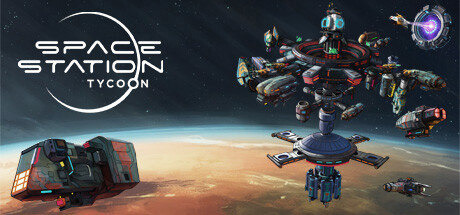
Space Station Tycoon, developed and published by Lunheim Studios, is an ambitious blend of space simulation, base management, and economic strategy that places the player in charge of building and maintaining a thriving orbital hub. It begins with a simple concept—constructing a small station to service travelers, traders, and miners—but quickly expands into a sprawling web of interconnected systems involving energy management, logistics, trade routes, and defense. The game’s appeal lies in its ability to merge classic tycoon-style mechanics with science fiction themes, allowing players to design and operate a fully functional space station that caters to an ever-growing clientele of ships and visitors. It’s a compelling premise, and in its best moments, Space Station Tycoon captures the creative freedom and emergent storytelling that make management sims so addictive.
At the heart of the experience is a familiar but well-executed gameplay loop. Players begin with limited funds and a small framework in orbit, gradually expanding by adding modules such as docking bays, power generators, living quarters, entertainment facilities, and research labs. Each addition brings new needs and opportunities: larger ships require bigger docking ports, more residents demand increased life support capacity, and higher-tier clients expect luxury amenities like casinos or observation decks. Balancing all these demands forms the core of the game’s strategy. The economic model encourages efficiency—everything costs maintenance, and an unprofitable module can drag down your entire operation. This creates a natural tension between expansion and sustainability. The game rewards thoughtful planning, where careful placement of modules and intelligent use of limited resources determine whether your station becomes a bustling hub or a floating wreck.
What distinguishes Space Station Tycoon from other management titles is the layer of external challenges that influence your operations. The station exists in a living galaxy where events occur dynamically. Players must contend with space pirates raiding supply routes, asteroid storms damaging infrastructure, and radiation waves threatening station stability. These hazards force investment in defensive systems, shields, and repair drones. It’s not enough to build; you must also protect. This interplay between creation and destruction keeps the gameplay from feeling static. The galaxy map system, which allows you to expand your influence by connecting to nearby planets via jump gates, introduces another level of strategy. Expanding your network means more traffic and trade opportunities, but it also increases exposure to danger and logistical strain. This balance between growth and risk gives the game a sense of scale and consequence rarely seen in indie management sims.
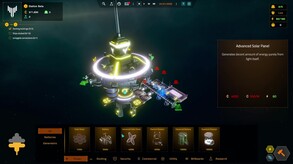
Visually, Space Station Tycoon adopts a clean and functional aesthetic. Its art direction favors clarity over spectacle, using sharp interfaces and modular designs to ensure that every part of the station is easily identifiable at a glance. The top-down view and flexible camera controls make managing the layout intuitive, and the interface, while initially overwhelming, becomes more readable with experience. The environments are filled with small details—ships docking and departing, service bots scurrying about, lights flickering as power surges—giving the illusion of a living, breathing ecosystem. The audio design supports this atmosphere well, with a mixture of ambient sci-fi hums and subdued electronic music that reinforces the sensation of managing a fragile outpost deep in space. While the visual presentation lacks the polish of high-budget titles, its minimalist approach complements the game’s focus on systems and functionality.
That said, Space Station Tycoon suffers from many of the issues common to ambitious indie simulations. The complexity of its systems is both a strength and a weakness, as the game often struggles to explain itself. The tutorial covers only the basics, leaving players to discover the deeper mechanics through trial and error. Many have noted that the interface, though serviceable, can feel cluttered or unclear when managing large stations. Some icons lack proper tooltips, and certain mechanics—such as staff efficiency or resource distribution—aren’t fully transparent. Technical performance is another concern. As stations grow in size, framerate drops and system slowdowns can become noticeable. This undermines the fluidity of play, especially when managing multiple crises simultaneously. Occasional bugs, such as unresponsive AI workers or misplaced ships, further disrupt the experience. These problems don’t ruin the game, but they reveal its unfinished edges and the limits of a small development team’s reach.
In terms of pacing, Space Station Tycoon starts strong but eventually loses momentum once a station reaches a certain level of stability. The early hours are filled with meaningful decisions—every new module feels like a risk, every upgrade a victory—but after reaching self-sufficiency, the game settles into a predictable rhythm. The research tree, while extensive at first glance, flattens out over time, and the late game lacks escalating challenges or meaningful end goals. The absence of a deeper political or narrative layer leaves expansion feeling somewhat hollow after a while. For players who enjoy pure sandbox play, this may not be an issue, but those looking for long-term strategic depth may find the experience tapering off prematurely. Still, the foundation is strong enough that with additional content and balancing, the potential for deeper gameplay is clearly present.
Despite these shortcomings, Space Station Tycoon remains a charming and thoughtful entry into the management genre. Its combination of construction, economics, and light strategy provides plenty of satisfying moments, especially for players who enjoy experimenting with layouts and optimizing efficiency. Watching a station evolve from a few connected modules into a sprawling commercial hub is immensely gratifying, and the constant interplay between profit, logistics, and survival keeps you invested. The game’s imperfections—occasional bugs, repetitive progression, and uneven pacing—are the kind of issues that can be improved with continued development, and Lunheim Studios has shown an ongoing commitment to refining its systems. For fans of simulation and space management titles, Space Station Tycoon offers a unique experience that is both creative and challenging. It may not yet rival the depth of genre giants, but it has the heart, ambition, and solid framework of a project destined to grow into something special.
Rating: 6/10