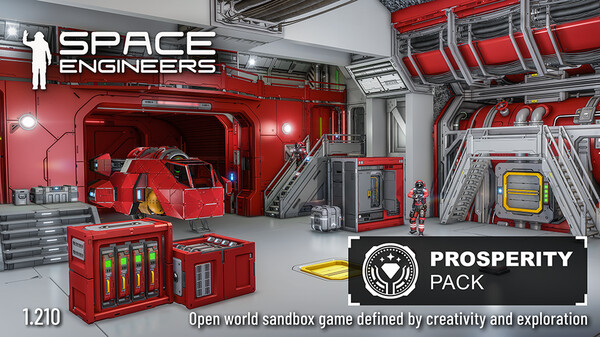
Space Engineers is a sandbox engineering game where you design and build ships, stations, and planetary bases in a fully destructible environment. Explore planets and space, mine resources, survive hazards, and engage in combat alone or with friends in Creative or Survival modes.
Modeled estimate, not a reported figure. How we estimate →
Prices
Each in the currency that store quoted — not converted: the gap between two rows is the publisher's pricing, not an exchange rate.
Discounts
Every price cut of more than 20% we have observed, in each market that quoted one, with this game's chart position on either side of it. These are episodes, not a model: a sale is one event, and one event cannot tell you what the next one will do.
Reviews, worldwide (the counter carries no country): 5.71/day in the week to Sep 14 → 6.17/day in the week after.
About
Space Engineers is an open world sandbox game about designing, building and testing your own space machines. Construct ships, stations and planetary bases in a fully destructible environment, then explore planets and space, mine resources, survive hazards and engage in combat alone or with friends in Creative or Survival modes.
Play solo or in multiplayer, from small co-op outposts to huge community servers. Start with a simple lander, grow into a mining and industrial empire, or focus on warships and planetary fortresses – the game gives you the tools and physics, you decide what to build.
Space Engineers uses a volumetric physics engine: every block and voxel has mass, inertia and damage. Ships break apart, stations crumble and terrain can be drilled, carved and reshaped, so your engineering choices really matter.
Space Engineers is grounded in real engineering and hard science fiction, driven by realism and plausible near-future technology. Think modern space programs extrapolated into the future: realistic ships, stations, tools and systems where everything is built and simulated block by block. It’s about the machinery you build, not about magic or scripted set-pieces.
10+ years of active development with many free updates every year – and still ongoing
Huge Steam Workshop with thousands of ships, bases, mods, scripts and scenarios
Stable, feature-rich sandbox ideal for long-term saves and big community servers
All DLC is cosmetic-only – everyone plays with the same gameplay
Active player base, dedicated servers and modding community
Design and pilot small and large ships, asteroid stations and planetary bases
Over 200 functional blocks: thrusters, rotors, pistons, turrets, conveyors, production blocks and more
First- and third-person building, symmetry tools and blueprints for fast large-scale construction
Manual building in Survival: weld to assemble blocks, grind to disassemble and reuse components
Voxel planets, moons and asteroids with atmospheres, gravity and climate zones
Drill, cut and blast terrain; carve tunnels, craters and underground bases
Ships and structures take block-by-block damage and can break into pieces
Deformable and destructible objects with real mass, storage capacity and integrity
Creative – unlimited resources, instant building, no death
Survival – manual assembly, resource and power management, death/respawn
Singleplayer or multiplayer (co-op or competitive) with privacy settings and dedicated servers
Scenarios, Workshop worlds and custom worlds so you can start in exactly the kind of universe you want
Super-large worlds with procedural asteroids and exploration encounters
Exploration systems that add ships and stations to discover, capture and conquer
Visual Script Editor to create your own missions, game modes and campaigns
Cargo ships, factions and AI-controlled threats to interact with – or defend against
Deep Steam Workshop integration for worlds, blueprints, mods and scripts
Modding API in C# to change game behaviour and add new systems
Programmable block for in-game automation and custom logic
Support for custom textures, models and many other mod types
Electricity, power grids and generators powering your entire base or ship
Oxygen and hydrogen for life support and thrusters
Weapons and combat blocks for ship-to-ship battles and base defense
GPS, remote control, voxel hands, controller support and more quality-of-life tools
Extensive language support with official and community localizations
Add-ons
Each DLC is estimated with the same model as a game, then summed — a modeled figure, not reported DLC sales.
Sums Steam only; Xbox, PlayStation publish no volume signal, so the true total is higher by an unknown amount.
| Store | Price | Audience | Score | Chart | Est. revenue |
|---|---|---|---|---|---|
SteamYou are here | $9.99−50% | 134.5Kreviews | 89% | — | $29.3M |
| $19.99 | 4Kratings | 70% | — | not modelled | |
Updates
Build ids and update times come straight from Steam's PICS — the same source SteamDB reads. Patch history grows as we record new builds.
Engagement
Reviews
Themes across 1153 recent reviews and how positive each mention is. A keyword signal, not full sentiment analysis.
Reviews
Ultimate Sandbox where you get a planetary system to play with and build whatever you can dream up. Also nice Survival Mode or Creative Mode options to try out your contraptions. From making a random Catapult from Hinges and Rotors to building the greatest Starship there will be things to try out and a System of planets to visit. With Trader Bases and stations both planetside and in space along with pirates that will try to get their hands on your hard earned creations. There is also the Steam Workshop where you can download blueprints of ships from other players to mess around with in your own worlds, and even upload your own masterworks and compete in making the most complex machines work. There will be explosions from both weapons and from machinery that just want to be let free from existance, or for the greater glory of Clang. You will undoubted get irritated at times when things just don't work and at times feel excited from seeing things work as intended or over expectations.
Media

Related
Related
Price dynamics, follower growth, revenue and sales trajectories with interactive tooltips
This and every other Pro feature is free until October 20, 2026. A free account is all it takes.
Every market we collect.
Reviews, worldwide (the counter carries no country): 12.86/day in the week to Jul 30 → 9.71/day in the week after.
For scale, across Steam · Top Sellers · Brazil over the last 30 days: the 23 chart moves that followed a price cut of more than 20% went a median of 14 places towards #1, and the 2,515 moves with no price cut behind them went 2 away. One store, one chart, one country — it is the only place we have enough observations to say even that.
Prices outside the United States have been collected since 6 August 2026 and chart positions since 19 July 2026, so a cut older than that has no market to compare and a market that joined later has no history yet. Nothing here is converted between currencies.
Genres
Stats
All-time low is the lowest price we've recorded for this game since we started tracking it.
Languages: English, German, Spanish - Spain, Czech, Danish, Dutch, Polish, French, Italian, Finnish, Hungarian, Norwegian +4 more
| $19.99 |
| 2.9Kratings |
| 69% |
| — |
| not modelled |
Matched by title — a reused name can pair the wrong games. * is a critic aggregate. Prices and positions are each store's United States storefront; Epic charts worldwide. Audience and Score too, except Steam's, which is worldwide.
Hours played at review time, across 1.2K reviews with recorded playtime.
positive critical· bar length = how often the theme comes up
Pretty neat
highly addictive
Lots of value, highly recommend it
We Had a Cunning Plan… Recommended: Absolutely. But keep an eye on your wheels. Four weeks ago I landed on a planet in vanilla Survival driving a rover and picking berries like a technologically ambitious monkey. Space Engineers has a steep learning curve. At first I thought the objective was to learn how to play the game correctly. I was wrong. The real objective, at least for me, turned out to be repeatedly asking: “I wonder what would happen if…?” I started in vanilla Survival, where every component mattered, fuel mattered, resources mattered, and mistakes had consequences. It was a brilliant introduction because it gave everything value. Building something that actually worked felt like an achievement. But eventually I realised the learning curve was slowing down my ability to experiment. So rather than grind through every unknown mechanic, I switched to Creative and treated it as an R&D laboratory. That transformed the game. Creative hasn't spoiled Survival for me; quite the opposite. It has allowed me to learn systems rapidly, experiment without worrying about resources, deliberately break things, understand why they broke, and blueprint successful designs ready for another day. When I eventually return to Survival, I'll be returning with knowledge rather than shortcuts. And then there is my slightly unusual co-engineer: ChatGPT. I play alone, but I haven't felt as though I've been learning alone. Having an AI alongside me to bounce ideas off, calculate things, explain mechanics, research solutions and—most importantly—help connect one discovery with another has completely changed the pace at which I've learned. I encounter something strange in the game, tell my AI partner what I'm seeing, and we work through it together. I test the idea in-game, report what actually happened, and that becomes evidence for the next idea. It's an extraordinary feedback loop: Try → observe → laugh → understand → adapt → try again. And there has been a lot of laughing. We recovered a wrecked shuttle and learned how projectors and blueprints worked. When I finally spawned the reconstructed ship, it immediately opened fire on the nearby Pirate Stronghold until its guns were empty. We naturally concluded that the pirates must have been responsible for its original demise. There is absolutely no evidence supporting this conclusion. We remain satisfied with it. While cleaning up the entity list one day, I also discovered page after page of mysterious one-block grids labelled Wheel. Obviously debris. Delete. Delete. Delete. Delete. Some time later I zoomed out over the Stronghold and thought: “Where the f*** have all my wheels gone?” It turns out Space Engineers treats wheels as separate little grids. Twenty-two wheels should have existed. Twelve survived only as memories. The pirates were immediately blamed. That disaster then created a need to lift our crippled vehicles so we could repair them, which gave us an idea for a recovery pod for our heavy-lift platform, including an underslung operator's seat so I could actually see what I was picking up. Necessity is the mother of invention. Administrative incompetence is apparently the father. Then came Grasshopper, our experimental small-grid Prototech jump craft. It wasn't remotely finished when I accidentally deleted the construction platform underneath it. So Grasshopper's carefully planned maiden flight became: “Can you hover five metres while I put the bloody floor back?” It could. Beautifully. And suddenly another accident had given us useful flight-test data and the beginnings of an idea for a standard small-grid pod chassis. This has become our philosophy. There are no useless failures if you stop and ask what they taught you. Space Engineers is full of snakes and ladders. Our approach has increasingly become: When you encounter a snake, ask whether you can turn the bastard into a ladder. Blueprints were perhaps our biggest ladder. They solved preservation, experimentation and PCU pressure simultaneously. We could save discoveries, dismantle physical grids and reproduce useful designs later. We started calling BPs Balloon Parts: ideas we've inflated through experimentation and tied down so they can't float away. Then we discovered the Steam Workshop. I went looking for one useful small-grid printer blueprint. Through what can only be described as divine intervention by Clang, I somehow ended up with roughly 55,700 blueprints in my F10 menu. So now we have the Balloon Dimension. And that has introduced another lesson: don't reinvent every wheel—particularly after you've deleted twelve of them. Other players have already spent enormous amounts of time solving problems. Their blueprints are compressed engineering experience. Spawn them in Creative, operate them, reverse-engineer them, understand why they work, then take that knowledge back into your own creations. It feels like climbing a steep mountain and gradually noticing the worn footholds and pitons left by thousands of climbers who passed this way before you. My AI partner adds something resembling a jetpack. If the wall becomes impossible, sometimes the useful question isn't “How do we climb this?” It's: “Why are we still climbing the bloody wall?” And that's probably the greatest compliment I can give Space Engineers. The game is what it is, but it's also whatever you decide to make of it. You can survive. Mine. Engineer. Fight. Explore. Build beautiful ships. Build hideous ships that inexplicably work. Reverse-engineer other people's creations. Invent your own mythology. Start an imaginary engineering company. Blame pirates for your mistakes. Worship Clang. Spend an evening recovering twelve wheels you personally deleted. And if you're a solo player wondering whether there's enough here for you: absolutely. In fact, playing alone gives you enormous freedom to follow curiosity wherever it leads. Add the Workshop, Creative experimentation and—if it appeals to you—an AI collaborator to help research and reason through what you're discovering, and “solo” doesn't have to mean figuring out everything unsupported. Four weeks ago I was picking berries beside a rover. Now we've got a Pirate Stronghold, recovered ships, Prototech equipment, experimental jump craft, Thunderbird-inspired heavy lift, modular pod ideas, projectors, blueprints and access to tens of thousands of community creations. Do I know where we're going next? Absolutely not. That's rather the point. We know where we've been. At the end of each day we can look backwards and draw the map. Tomorrow we deliberately step beyond its edge and ask: “I wonder what would happen if…?” Sometimes you get a spacecraft. Sometimes you get knowledge. Sometimes you delete twelve wheels. All three have been worth it. 10/10 — would accidentally de-pixel my own vehicle fleet again. Laybak & Luvit Engineering: Have a cunning plan. Try it. Laugh. Learn. Blueprint whatever survives.
крутая игра
Im honestly addicted there is so much to do in this game and I haven't even downloaded a single mod yet and the community has gone wild with their builds. Highly recommend if you love space, combat, trial and error, and exploration
I've barely scratched the surface flying thru space, building, fighting , surviving, relaxing
An Incredible experience. A cosmic unforgettable world
I hope Klang will take less sacrifices from me for giving a review... I love this game with all my heart. It is challenging on levels, I could've never have imagined when I started playing some 10 years ago, and it still is. Still the most fun I've had in any game of my life. Takes an enormous amount of creativity, knowledge and engineering to achieve something beautiful. You can just wing it and hope stuff works, or you can calculate a lot of stuff. Once you start playing you will have an understanding of thrust to weight ratios, separating production processes, automation, binary programming, all the fun stuff. I could never recommend this game enough for anybody. Just beware of Klang and sometimes sacrifice something to keep it satisfied enough to not take stuff from you whenever it wants.
Active players
Estimated daily and monthly active players (DAU/MAU) modeled from peak concurrency.
Players by region
Where this game's players are, estimated from review languages.
Players also reviewed
The games this title's players most often review too — audience affinity.
Related
| Game | Estimated lifetime revenue | Reviews | Review score | Price |
|---|---|---|---|---|
| $22.3M | 29.2K | 79% | $19.99 | |
| — | 0 | — | — | |
| $6.3M | 5.6K | 75% | $23.99 | |
| — | 4.2K | 55% | — | |
| $221.9K | 382 | 61% | $14.99 | |
| $8.9K | 25 | 76% | $9.99 |
Related
| Game | Estimated lifetime revenue | Reviews | Review score | Price |
|---|---|---|---|---|
| $29.3M | 26.9K | 66% | $39.99 | |
| $29.3M | 30.6K | 73% | $49.99 | |
| $29.1M | 104.4K | 84% | $17.99 | |
| $29.1M | 27.3K | 84% | $29.99 | |
| $29M | 35K | 92% | $29.99 | |
| $29M | 19.6K | 86% | $39.99 |