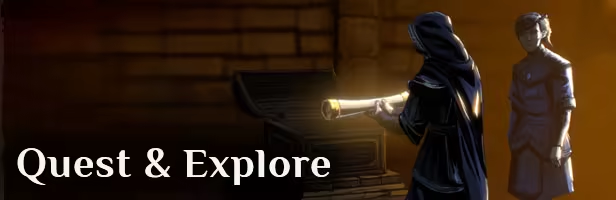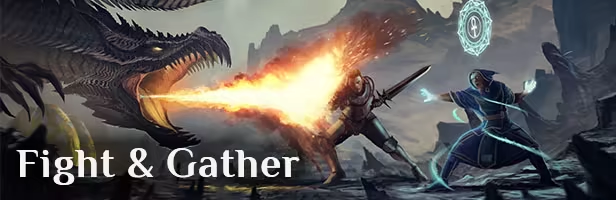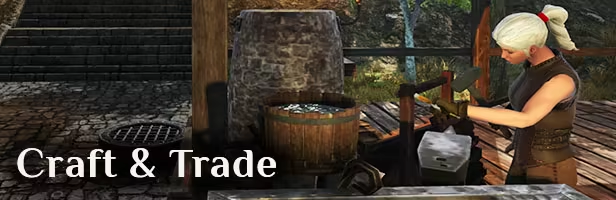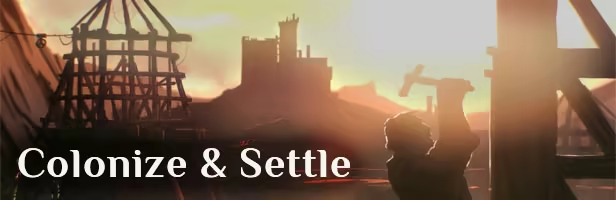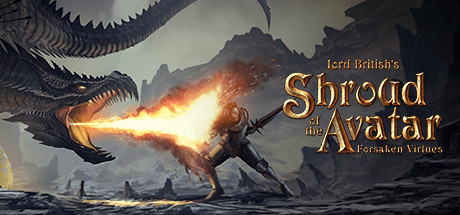
SHROUD OF THE AVATAR: FORSAKEN VIRTUES is a multiplayer fantasy RPG that sets the player on a path filled with peril and tough choices as they explore a persistent realm that can be shared with other Avatars. It is the spiritual successor to Richard Garriott’s Ultima games.
Revenue comes from in-game items and microtransactions, which our price-based model doesn't estimate. The player count below is how many people own it, not what they spent.
About


Genres
Stats
Engagement
Reviews
Themes across 62 recent reviews and how positive each mention is. A keyword signal, not full sentiment analysis.
Reviews
[h1]Grind of the Avatar: Forsaken Wallets[/h1] Shroud of the Avatar is what happens when you sell people a spiritual successor to Ultima and then deliver a confused, buggy, cash-shop-driven MMO-ish sandbox where the most developed system is the part that asks for more money. The pitch was nostalgia, deep roleplay, player freedom, meaningful community, maybe even a little of that old Lord British magic. What you actually get is a dead-feeling world, clunky combat, ancient UI, weak quests, bad performance, endless loading, half-finished systems, and enough grind to make Korean MMOs look like casual phone games. The game cannot decide what it wants to be. Single-player RPG? Not really. MMO? Barely. Sandbox? Technically, in the same way an empty parking lot is an open world. The zones feel disconnected, the NPCs feel like placeholder furniture, the story feels like someone lost the design document in 2014, and the combat has all the weight and grace of clicking Excel cells during a fever. And then there is the monetization. Dear god, the monetization. Housing, deeds, towns, decorations, premium currency, subscriptions, store junk, "limited" offers, digital real estate - the whole thing feels less like a fantasy world and more like a retirement home for whales. The actual game is starving in the corner while the cash shop gets another hat, another house, another shiny thing for the last twelve people still financially trapped in Novia. People will say "but it is free to play now". Yeah, and a casino bathroom is also free to enter. That does not make it a good vacation. The saddest part is that some people clearly wanted this to work. A lot of backers were Ultima fans. They wanted a living world, not a land deed simulator with broken quests attached. They gave feedback, waited for years, came back again and again, and got the usual early-access museum experience: "it has potential" slowly turning into "why is this still like this?" Even the community side sounds like a warning label. Tiny population, defensive veterans, criticism treated like heresy, support stories that make the whole thing feel less like customer service and more like asking a landlord cult for permission to leave. So no, I cannot recommend this. Not as an Ultima successor. Not as an MMO. Not as a sandbox. Not even as a free curiosity unless you specifically enjoy studying failed Kickstarter archaeology. If you want an RPG, play an RPG. If you want an MMO, play an MMO. If you want to watch nostalgia get milked until only dust comes out, then sure, welcome to Shroud of the Avatar. [b]Everyone else: stay away.[/b]
Media

Related
Related
Price dynamics, follower growth, revenue and sales trajectories with interactive tooltips
This and every other Pro feature is free until October 20, 2026. A free account is all it takes.
Languages: English**languages with full audio support
Hours played at review time, across 62 reviews with recorded playtime.
positive critical· bar length = how often the theme comes up
I really wish I could like this game, the idea of building your character how ever you want with different skills is really appealing. But, the game is filled with ♥♥♥♥ tons of abandoned Player House and Player Towns that just add to the annoying stuttering and lag the game already seem to be plagued with and no matter how low I put the graphics, its still happening, so... yeah. Also, the game has achievements that don't seem like they're working.
More playable than it used to be from what it looks like. Though, the community seems non-existent?
Feels like a 3rd Person Perspective 3D UO ("You are what you do"). Runs in Linux OK!
Shroud of the Avatar: Forsaken Virtues is a fantasy role-playing game developed and published by Catnip Games that seeks to preserve many of the principles that defined classic computer RPGs while integrating elements of modern online worlds. Inspired by the legacy of the Ultima series, the game focuses heavily on player freedom, meaningful choices, character customization, and community interaction. Rather than guiding players through a rigid sequence of quests and predetermined classes, it presents an expansive world where personal decisions shape both character development and the overall adventure. The game takes place in the realm of New Britannia, a land built around the philosophical ideals of Truth, Love, and Courage. These virtues serve as more than narrative themes; they form the foundation of the world itself. Throughout the journey, players are repeatedly confronted with decisions that test their values and influence how they are perceived within the story. This emphasis on morality recalls the design philosophy of older role-playing games, where actions often carried consequences beyond simple reputation meters or alignment systems. One of the most distinctive aspects of Shroud of the Avatar is its approach to character progression. Instead of forcing players into traditional classes such as warrior, mage, or rogue, the game uses a flexible skill-based system that allows characters to evolve naturally according to player preferences. Combat abilities, magical disciplines, crafting talents, and support skills can all be developed simultaneously, creating countless opportunities for unique builds. This freedom encourages experimentation and allows players to create heroes that reflect their own playstyle rather than conforming to predefined archetypes. Exploration is a major component of the experience. New Britannia is filled with forests, villages, ancient ruins, hidden dungeons, and mysterious landmarks waiting to be discovered. The world often rewards curiosity, encouraging players to leave established paths in search of secrets, resources, and optional quests. Rather than relying entirely on objective markers and guided progression, the game frequently allows players to uncover content through observation and investigation, creating a stronger sense of immersion. Combat combines real-time action with an unconventional deck-based ability system. Players customize skill decks that determine which abilities become available during encounters, creating a balance between planning and adaptability. The system offers considerable depth for those willing to learn its mechanics and allows a high degree of personalization. Different combinations of skills can dramatically alter combat effectiveness, making experimentation an important part of character growth. Crafting receives an equally impressive level of attention. Gathering resources, refining materials, and creating equipment are not simply side activities but integral parts of the game's economy and progression systems. Dedicated craftsmen can spend countless hours mastering their professions and producing valuable goods. The crafting mechanics support a player-driven economy where equipment and resources retain meaningful value, helping create a world that feels active and interconnected. Housing is another feature that distinguishes Shroud of the Avatar from many other online role-playing games. Players can acquire homes, customize interiors, display trophies, establish vendors, and participate in player-run communities. Entire towns can be shaped by their inhabitants, creating a strong sense of ownership and social interaction. These systems contribute significantly to the game's sandbox nature and encourage long-term investment in the world. One of the game's most ambitious ideas is its flexible approach to multiplayer. Players can experience the world in various ways depending on their preferences. Those who prefer a more solitary adventure can focus on the story and exploration aspects, while others can participate in the larger online community. Cooperative play, social events, player markets, and community-driven activities all contribute to a living world that evolves through the actions of its inhabitants. The narrative itself is filled with lore, political conflicts, and philosophical themes that reward players who enjoy reading and engaging with the world. Conversations often contain important information, and quests frequently require more thought than simply defeating enemies or collecting items. The storytelling reflects the game's old-school inspirations by emphasizing world-building and player engagement over cinematic presentation. Visually, the game prioritizes scale and functionality over cutting-edge graphical technology. While some aspects of the presentation reveal the game's age, the world remains rich with detail and personality. Diverse environments, elaborate player housing, and numerous towns help create a believable fantasy setting. Continuous updates and community support have also helped expand the world over time, ensuring that it continues to evolve long after its initial release. The game's greatest strength is also its biggest challenge. Its commitment to classic RPG design results in a steeper learning curve than many modern online games. New players may initially feel overwhelmed by the numerous systems, complex progression mechanics, and lack of extensive hand-holding. However, those willing to invest the time often discover a depth rarely found in more streamlined MMORPGs. Shroud of the Avatar: Forsaken Virtues succeeds because it prioritizes freedom above all else. Character development, exploration, crafting, housing, and social interaction are all designed to allow players to create their own stories rather than simply follow predetermined paths. While it may not appeal to everyone, particularly those seeking a highly polished modern MMORPG experience, it offers a rich and rewarding world for players who appreciate classic role-playing values and extensive customization. Rating: 6/10
my butthole still hasn't recovered
Why does this game have choppy 2003 graphics if it was released in 2018? If the graphics are from 2003 that isn't a deal-breaker but if they are that outdated it could at least run smooth...
amazing modern day uo love it
Controversy aside Best MMO I've played. Worthy successor to UO,
its great for what it offers
Players by region
Where this game's players are, estimated from review languages.
Players also reviewed
The games this title's players most often review too — audience affinity.
Related
| Game | Estimated lifetime revenue | Reviews | Review score | Price |
|---|---|---|---|---|
| $0 | 577 | 31% | Free | |
| $0 | 93.9K | 78% | Free | |
| $0 | 39.7K | 77% | Free | |
| $6.7M | 11.8K | 52% | $17.99 | |
| $2.1M | 3.1K | 72% | $29.99 | |
| — | 2 | 50% | — |