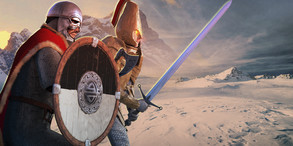
Shieldwall Chronicles: Swords of the North is a gripping, tactical RPG that lets you build a powerful band of adventurers and partake in a grand adventure.
Modeled estimate, not a reported figure. How we estimate →
Media
About
Stats
All-time low is the lowest price we've recorded for this game since we started tracking it.
Languages: English**languages with full audio support
Engagement
Hours played at review time, across 40 reviews with recorded playtime.
Reviews
Soft Yes. Campaign needs more "story". Animations or cut scenes would be nice. Total game is around 15 hours long, a bit short. Tactical play is interesting and there is some replay value in mixing up different combinations of team members. Buy this if it's on sale, as in 10 bucks of less.
I'm a fan of turn based tactical games. I found this game very unappealing. I would not recommend.
Shieldwall Chronicles: Swords of the North is a tactical role-playing game that draws heavily from classic grid-based strategy traditions while carving out its own identity through flexible combat systems and a focus on party-driven decision making. Developed and published by Wave Light Games Inc., the game places players in command of a mercenary company venturing into the harsh northern lands of a grim fantasy world. From the outset, it establishes an atmosphere of danger and uncertainty, where survival depends not on individual heroics but on coordination, positioning, and long-term planning. The core of the experience lies in its turn-based tactical combat, which rewards thoughtful play and punishes careless decisions. Battles unfold on grid-based maps where terrain, line of sight, weapon range, and enemy behavior all matter. Charging forward recklessly can expose vulnerable units, while overly defensive tactics may allow enemies to surround or overwhelm the party. Each encounter feels like a small tactical puzzle, asking players to assess threats, manage spacing, and decide when to commit to offense or retreat. The pacing of combat encourages patience, making victories feel earned rather than automatic. Party composition and character progression play a major role in shaping how battles unfold. The game offers a wide selection of distinct classes, each filling a clear tactical role. Frontline fighters excel at absorbing damage and controlling enemy movement, while ranged units and spellcasters provide offensive pressure at the cost of survivability. Support-oriented characters add another layer of strategy by enhancing allies or weakening enemies. Building an effective party requires understanding how these roles interact, and success often depends on exploiting synergies rather than relying on raw strength alone. One of the game’s more notable design choices is its flexible action system. Players can choose between simplified and more complex action point mechanics, allowing them to tailor the experience to their preferred level of depth. The simpler mode streamlines turns and lowers the barrier to entry, making the game more accessible to newcomers. The more advanced mode, on the other hand, tightly integrates movement and abilities into a shared action economy, offering greater control and tactical nuance for players who enjoy micromanagement and careful optimization. The campaign is structured around a traditional high-fantasy conflict set in the northern realms, where undead, monstrous creatures, and rival factions threaten stability. While the narrative does not aim for deep moral complexity, it provides enough context to give meaning to the battles and progression. Story events and branching decisions occasionally shape how the campaign unfolds, adding replay value and reinforcing the sense that the player’s choices matter, even if the storytelling remains straightforward and functional rather than emotionally driven. Visually, Shieldwall Chronicles favors clarity and atmosphere over spectacle. The art style emphasizes readability in combat, ensuring that unit positions, attack ranges, and environmental features are easy to interpret at a glance. Character models and environments convey a rugged, cold-world aesthetic that fits the northern setting, even if they lack the polish of larger-budget titles. The user interface is clean and informative, providing essential tactical information without cluttering the screen, which is crucial in a game where informed decisions determine success. Difficulty options and adjustable systems make the game approachable across a wide range of skill levels. New players can ease into the mechanics without being overwhelmed, while experienced strategy fans can push themselves with tougher settings that demand near-perfect execution. This scalability helps the game appeal to a broader audience, allowing players to engage with the tactical depth at their own pace rather than being forced into a single difficulty curve. That said, the game is not without its limitations. The narrative and character interactions, while serviceable, lack the depth and emotional weight found in some genre standouts. Some encounters can feel familiar over time, and balance quirks occasionally emerge, particularly as party compositions become more specialized. These issues rarely undermine the core experience, but they do remind players that the game’s strength lies more in mechanics than storytelling. Overall, Shieldwall Chronicles: Swords of the North is a solid and rewarding tactical RPG that emphasizes strategy, party management, and deliberate combat over flash or narrative ambition. It does not seek to reinvent the genre, but instead refines familiar systems into a cohesive and satisfying experience. For players who enjoy turn-based tactics, careful positioning, and the challenge of guiding a small group through a hostile world, it offers a compelling journey that rewards planning, experimentation, and mastery. Rating: 7/10
I love this game and the play style. I would have liked to see more campaigns added.
very fun
How not to make a good first impression: "ambiant" (ambient), "at any times" (time), "remainging" (remaining), "quiting" (quitting), "grants" (grant). That's from the options screen and the initial tutorial text. How not to make a good second impression: have a tutorial that explains what's on the screen, pointing occasionally to blank space instead of a UI element, but doesn't actually tell you how to move units or attack. This would be less of an issue if the mouse cursor changed to reflect which action would be performed when you click, e.g. most games change the cursor to a sword or an arrow when clicking results in a melee or ranged attack. I've played enough games like this to be able to guess what to do, but the tutorial told me about a bunch of things that aren't yet relevant (command points, complex game mode) instead of telling me how to play. (If somebody asks to do the tutorial, assume they need it.) Rounding third: when the tutorial tells you that there's a "quit" button in the pause menu, but it's not actually there during the tutorial. (That one's actually just sort of funny.) Bringing it on home: right-click to bring up info on a unit and get a poorly-formatted info dump that feels like debugger output. The only way I found to determine the range of the basic attack of my units is to pop that open and scan down the unevenly-spaced lines to find the number. Then I get to count hexes. Again, changing the mouse cursor could help with some of that. (I'm guessing this was a straight port from a mobile platform.) There are other weird things. I was mouse-hovering over the skill buttons to see what they did, and moved the camera position (WASD). The mouse cursor vanished and then reappeared in the middle of the screen. Every time I shift the camera I have to find the mouse again afterward. Sometimes when I click on one of my units it doesn't change focus. The game selection screen presents a collection of 24 buttons that say "in use" or "empty" with no other information (and they're all the same color, so in-use and empty sort of blend together visually); you have to click on them to get more information. Throughout the UI, the color and framing for buttons and panel headers is nearly identical, so I found myself trying to click on things that weren't actually buttons. Part of my problem here may be that I just finished playing King Arthur: Knight's Tale. It's not a AAA game or a contender for GotY, but the controls and UI presentation are so much cleaner than this. I played through the tutorial and tried the first couple of missions. The UI issues annoyed me enough that I gave up on it. I may come back to it someday, but I would recommend against it unless you have a high tolerance for poorly-executed UI.
its a solid RPG turn based game, simple and fun to play. I wish there was a little more to it. But for what it is. Its really not bad. So i am happy i purchased it.
This is a great one! Some notable QoL improvements over the Demon's Rise games, and much better visuals as well. It makes me excited to play future Wave Light creations, as this studio's games just keep getting better and better. [h1] General Thoughts [/h1] [list] [*]Great combat and interesting story. Most level objectives are "defeat all enemies", which suits me just fine [*]Satisfying progression, between what's awarded through levels/stats, gear, and being able to access stronger abilities [*]Diverse array of gear to equip (would be cool to see visual changes on my heroes though) [*]Nice variety of heroes to try out, plus the ability to swap them mid campaign makes the initial heroe selection less paralyzing :D [*]No stat points or abilities to allocate at level up means no fear of unoptimized builds [/list] [h1] Suggestions for Future Games [/h1] [list] [*]Gamepad/controller support [*]Cloud Saves [*]FPS limiter - I have had intense coil whine from all the Wave Light games I've played. Limiting my GPU to 100 FPS solves this [*]Maybe have filter categories (melee, ranged, healer, etc) for each of the possible heroes? I love the number of options available, just find it a bit daunting at first to make a choice [*]There were no items to increase the numbers of attacks in this game (that I found), which was one of my main strategies in the Demon's Rise games, but TONS that gave counterattacks. Some of my characters had ~30 counterattacks by the end of the game, but would rarely use more than 10 [/list] [h1] Bugs [/h1] Nothing game breaking, but a few I encountered include: [list] [*]Encountered the known issue where a few characters didn't gain experience for several missions. They were all of a similar level at the end of the game, so it didn't seem to matter much [*]Mounted units were really cool to see, but when the enemy turn was sped up 2x they would move in a strange way- they would move to the target hex, but then the unit would keep going in a straight line several hexes further until the attack animation started, which would return them to the target hex. I did have a 100 FPS limit in place, so that might've caused this, and it didn't happen when I reduced the enemy turn speed [/list]
I much prefered Demon's Rise - War for the Deep, one of the previous games of the developer. That one had literally twice as many classes (no, making a male and female declination with minor stats differences for each of the 15 classes does not count as making 30 classes total) and it let you go ham with your characters, with every single stat able to be increased through equipment. Shieldwall, probably in an balancing attempt, removed the ability to increase your number of attacks, your ability points and AP regen, and your movement range with equipment. I can understand the logic, but the end result is a really constrained-feeling character management where all I can do is make minor incremental upgrades to my stats to make my mediocre characters slightly less mediocre. The early game is incredibly tedious, because your characters' accuracy range from mediocre to pathetic, so you are constantly missing again and again. Also, hit chance cap at 95%, so even if you stack up accuracy increasing equipement, you can never guarantee a hit (it can also never go lower than 5%, so even speccing in defense doesn't mean you're safe from all harm). Really, it's just a slog. And once you get through that and finally manage to get your team to a somewhat-competent level... Well, you're left with a mediocre story and repetitive battles. No thank you.
sure is nice not to have to repair gear. fun game
Related
Related
Trends
Concurrent players on Steam, sampled daily since tracking started.
Momentum
Pace estimated from the game's recent review growth (our daily snapshots) at its own sales-per-review ratio — a momentum signal, not booked sales.
Audience
Estimated from the language of this game's reviews — a proxy for where players are, not official Steam demographics.
Related
| ViewTracker | $71.5K | 271 | 76% | $14.99 |
| SHE WAS 98 | $71.5K | 464 | 85% | $7.99 |
| Trinity Trigger | $71.5K | 115 | 65% | $29.99 |
| Pixel Ripped 1995 | $71.5K | 191 | 95% | $19.99 |
| Foretales | $71.5K | 1.2K | 85% | $2.99 |
| Wizorb | $71.5K | 1K | 70% | $2.99 |