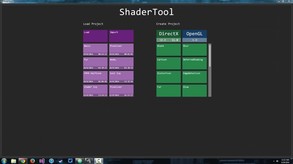
Finally a modern shader IDE for programmers and FX artists. Write HLSL and GLSL shaders and view results instantly. Create complex shaders with an easy-to-use node-based render pipeline. Import model, texture and other resources per drag'n drop to create awesome effects. Create any kind of shaders and share them with the community.
Modeled estimate, not a reported figure. How we estimate →
Media

About
Genres
Stats
All-time low is the lowest price we've recorded for this game since we started tracking it.
Languages: English
Engagement
Hours played at review time, across 36 reviews with recorded playtime.
Reviews
Good, but not maintained, tool for understanding how shaders work.
Update: The software is still rather buggy, but the developers seem to care, and things are getting fixed quite fast. No one should rely on this software for anything quite yet. There are still mountain piles of bugs. This early access is mostly early and not a lot of access. The concept is very good and the node-based UI design makes a whole lot of sense, so this software has a lot of potential. The developers simply have a rather poor testing plan, which probably involves closing eyes and just pressing the release button. EDIT: Latest update makes steam loop in "Preparing to launch shadertool" forever. Changing to negative review until this is fixed.
Top-notch.
ShaderTool is a specialized creative and technical application that occupies a unique space on Steam, positioned less as a traditional game and more as a hands-on development environment for real-time graphics. Developed by Stefan Kraus and Timo Armbruster and published by BiteTheBytes GmbH, it is designed specifically for shader authors, graphics programmers, and technically inclined artists who want a focused workspace to experiment with GPU shaders without the overhead of a full game engine. Rather than aiming for mass accessibility, ShaderTool commits itself to depth, immediacy, and precision, making it a niche but valuable tool for those serious about visual effects and rendering technology. At the core of ShaderTool is its real-time feedback loop, which tightly integrates a code editor with a live rendering preview. This design philosophy allows users to see the results of their shader changes instantly, encouraging experimentation and rapid iteration. Writing HLSL or GLSL code becomes a far more intuitive process when every adjustment to lighting equations, color blending, or vertex transformations can be evaluated visually within seconds. This immediacy significantly reduces the friction often associated with shader development, where small mistakes or miscalculations can otherwise require lengthy compile-test cycles in external engines. One of ShaderTool’s most distinctive features is its node-based render pipeline, which complements traditional text-based coding rather than replacing it. Users can construct rendering workflows visually by connecting modular components, defining how data flows between shader stages and rendering passes. This hybrid approach makes the tool flexible: experienced programmers can dive deep into custom shader code, while users who prefer a more visual workflow can assemble effects through nodes and then refine them further with code. This dual system also makes ShaderTool a strong platform for prototyping complex visual effects that involve multiple passes, layered materials, or post-processing stages. Asset integration further strengthens ShaderTool’s practical appeal. Models, textures, and other resources can be imported directly into the workspace, allowing shaders to be tested on real geometry rather than abstract primitives. This context is critical for meaningful shader development, as lighting behavior, surface detail, and scale can dramatically affect the final result. Being able to preview shaders on actual assets makes the tool feel grounded in real production scenarios rather than isolated experimentation, and it helps bridge the gap between concept and implementation. ShaderTool is unapologetically technical, and its learning curve reflects the inherent complexity of shader programming. Users without prior experience in GPU concepts, rendering pipelines, or shader languages may find the initial experience daunting. The interface assumes a baseline understanding of how shaders work, and while the live preview helps demystify cause and effect, ShaderTool is not designed as a step-by-step tutorial platform. Instead, it rewards users who are willing to learn through experimentation, documentation, and external study, making it particularly well suited for students, hobbyists, and professionals who already have some grounding in graphics programming. From a usability standpoint, the application strikes a balance between functionality and focus. The interface is dense but purposeful, prioritizing tools relevant to shader creation rather than overwhelming users with unrelated features. Syntax highlighting, error reporting, and structured project organization help maintain clarity as shader complexity grows. Performance is generally solid, and the tool runs comfortably on modest hardware as long as the system supports modern graphics APIs, which makes it accessible to a wide range of developers without requiring high-end workstations. Where ShaderTool shows its limitations is in scope rather than execution. It does not attempt to replace full-featured game engines, nor does it provide extensive scene management, physics, or scripting systems. Certain advanced rendering techniques can be more cumbersome to implement compared to engine-level solutions, and users seeking an all-in-one production environment may find the tool too focused. However, this narrow focus is also its strength: ShaderTool excels precisely because it avoids unnecessary complexity and concentrates on shader development as a standalone discipline. Community reception reflects this specialized identity. Users who approach ShaderTool with clear expectations tend to appreciate its responsiveness, flexibility, and the creative freedom it offers. Criticism generally comes from those expecting a more beginner-friendly or engine-like experience, highlighting that ShaderTool is best understood as a professional or enthusiast-grade utility rather than a casual creative app. Its relatively small but dedicated user base reinforces its role as a tool for a specific audience rather than a broadly marketed product. Overall, ShaderTool is a thoughtfully designed shader development environment that emphasizes experimentation, clarity, and real-time visual feedback. It fills a niche that sits between raw shader coding and full engine development, offering a streamlined space to explore, prototype, and refine GPU effects. For anyone deeply interested in real-time graphics, shader programming, or visual effects creation, it provides a focused and rewarding platform that respects both the artistic and mathematical sides of shader work. Rating: 7/10
It is a nice tool for study and prototyping.
I bought the app to study it, and I'm very impressed so far.
Related
Related
Trends
Modeled estimate over time, reconstructed from Steam's monthly review histogram.
Momentum
Pace estimated from the game's recent review growth (our daily snapshots) at its own sales-per-review ratio — a momentum signal, not booked sales.
Audience
Estimated from the language of this game's reviews — a proxy for where players are, not official Steam demographics.
Related
| Wallpaper Engine | $42.3M | 1M | 98% | $4.99 |
| 3DMark | $11M | 20.7K | 93% | $29.99 |
| Aseprite | $8.2M | 26.3K | 99% | $19.99 |
| Crosshair X | $8.2M | 44.1K | 93% | $9.99 |
| Soundpad | $5.3M | 102.9K | 96% | $4.99 |
| Action! - Gameplay Recording and Streaming | $5M | 7.5K | 85% | $29.99 |
Related
| The Mystery of the Druids | $11.4K | 142 | 51% | $4.99 |
| The Electrifying Incident: A Monster Mini-Expedition | $11.4K | 205 | 94% | $3.24 |
| Skigill | $11.4K | 147 | 78% | $3.34 |
| House of 1000 Doors: Serpent Flame | $11.4K | 112 | 91% | $6.99 |
| Heart of the House | $11.4K | 77 | 90% | $6.99 |
| Luxor 2 | $11.4K | 54 | 43% | $9.99 |