The terrible "rat fights" (Rattenkrieg) fought out in the urban area of Stalingrad end of 1942, on a battalion scale and two days per turn scales. Relive one of the fiercest and deadliest battles in history, a ‘Hell in a Small Place’.
Modeled estimate, not a reported figure. How we estimate →
Media

About


Genres
Stats
All-time low is the lowest price we've recorded for this game since we started tracking it.
Languages: English, French, German, Russian, Spanish - Spain, Simplified Chinese, Korean, Japanese
Engagement
Hours played at review time, across 40 reviews with recorded playtime.
Reviews
Themes across 40 recent reviews and how positive each mention is. A keyword signal, not full sentiment analysis.
positive critical· bar length = how often the theme comes up
Reviews
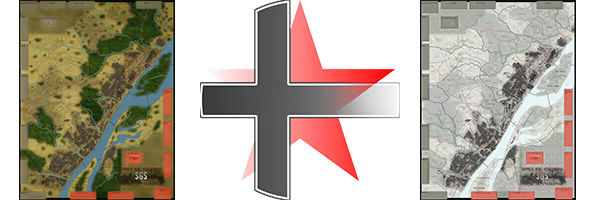
I can’t recommend this game because the time and map scales just don’t do justice to the Battle of Stalingrad. Despite using the term “Rattenkrieg” in the description, having the correct order of battle, and having Dzerzhinsky Tractor Works and other place names on the map, it isn’t the Battle of Stalingrad that you're presiding over as the player. A more general issue I have is with the engine developed (specifically, IGoUGo instead of WeGo system of turns) for the franchise and many of the game mechanics. Overall, the game is too complex and cumbersome to be a "beer and pretzels" wargame, but misses too many opportunities to be a serious (or even intermediate) one. In many ways, a nearly 30-year-old eponymous treatment of Stalingrad by Atomic/Avalon Hill’s World at War series is much better, including with ease of play. That said, there are a few inclusions that I was happy to see that do elevate this game above some of its competitors. These include: -Unit activation: you can’t generally conduct offensive operations with every unit every turn, which reflects very real supply and command issues. It creates a nice nuance in that you need to plan ahead what stacks you will be moving in the future and coordinate your replacements, etc., in advance to prepare them for successful battles. HOWEVER, I think it would be better to activate units at the division level rather than stacks. It makes more sense in military command and logistics terms to do it that way. It would also be helpful to use limited movement for non-activated units to make minor shifts in your lines. -Army support is a good way to indicate that Army HQ has prioritized certain units. -Fever/Winter Effects: Axis units can suffer losses due to harsh winter or sickness. HOWEVER, rather than permanently losing strength (and facing elimination), I’d prefer to see a temporary lowering of morale and/or immobilization or some other temporary impact. -German units recalled/redeployed out of the game. HOWEVER, with the advance warning you’re given, you can send them on suicide missions. Would be a good addition to include a VP penalty/incentive for sending them off in a best order as possible. -Garrisons in structures: a good feature that simulates taking over an area but you still have holdouts in a fortified building. -Many Soviet units enter the game a partial strength, reflecting casualties along the way or the fact that many units were sent into Stalingrad without receiving their full allotment of units or equipment. HOWEVER, German units begin at full strength despite having just fought/marched all the way from Kharkiv. The Germans arrived thirsty, dusty, and tired–not fresh. This should likewise be reflected. The positives are not enough to overcome many areas for improvement in the game. These include: -Map scale: there are only 70-odd tiles–and fewer than half of those the City of Stalingrad–on the west bank of the Volga. These measure a few square KM each (1-2 KM per side). This is far too big for urban combat and allow you to dump an entire division or more into one tile to face a similar number of opposing troops. The map should use a smaller scale and limit stacking to a couple of battalions or maybe a regiment. -Time scale: turns are two days, but it would be better to have day/night turns (2 turns per day) or even more. Antony Beevor’s “Stalingrad” notes the use of night attacks by the Soviets to avoid the Luftwaffe, which wore down the Germans. Including a fatigue model and allowing specific night attacks (not simply the infrequent card played) would better simulate the approach of the Soviets. -Rattenkrieg versus Operation Uranus: it’s ironic that the designers used an engine built for large-scale operational-level combat and focused on urban close combat while purposefully ignoring one of the great mobile encirclements of WWII. I’d suggest adding that for several reasons. First, it far better fits the game engine and would make a more enjoyable game. Second, ignoring this part of the battle misses what was the first large-scale, combined-arms success of the USSR in WWII and one that showed that poor strategic planning/hubris could be a fault of the Germans, too. It was a catastrophe that Hitler brought upon the Wehrmacht and a story that needs to be remembered. Note that the World at War: Stalingrad game used 400 m hexes with smaller units for urban combat and then 1 km or 3 km for the encirclement battles. It was a good solution. The game engine generally has several issues that would keep me from getting any of the other games in the series, at least for WWII and later games: -IGoUGo versus WeGo: at this point, I think wargamers should expect in all but the lightest wargames a WeGo system of more or less simultaneous movement. The World at War series used this 30 years ago. -Limited artillery and air mission choices: the employment of artillery and air assets is overly focused on direct support of combat missions. There is no option for counterbattery fire (unless you identify and specifically target opposing artillery), harassing fire/strafing to slow movement through crucial crossroads, etc. Defensive fire is quite unrealistic: divisional artillery should be available to support the units in that division if attacked–not just if you’re lucky enough to guess a tile that might be attacked. The plotting of artillery missions over the map also wastes game time for no gameplay return–it should be just select and assign. -Reconnaissance model could be improved through use of probing attacks, air reconnaissance missions, and sustained contact with opposing units. Over time, in general, your understanding of opposing stacks should increase and you should be able to review them unless some/all units move in/out. The card system is not a good way to approximate intel on your enemy. -Many cards seem out of place: some are redundant to assets you already have in the battle; for example why have a Stuka card when you have Stuka units in the battle or flamethrower card when you have engineers? It’s a better approach to stick to Army support counters or other assets. In summary, for me the game has limited replayability because it does little to move wargaming ahead; in fact overall it’s a step backwards over where we were 30 years ago. It does not accomplish its goal of simulating urban combat in Stalingrad.
I wanted to like this game. The first challenge was figuring out movement; it is not intuitive. Watched the tutorial several times, but in game, I couldn't understand why the game didn't work the same as the video. I finally just moved individual units, which accomplished the movement, just takes a little longer. Now for the battles. If there is some tactical considerations for movement, I don't see them. Either, you can stack a ton of guys onto a space, or not. The game feels like the only battles worth fighting are those; tons of guys. Otherwise, you can't win. So, rather than some tactical consideration, just see which spaces you can move a lots of guys. If you can, do...then fight (you might succeed). If you can't get a lot of guys, then don't, you'll lose. So, that's the game...move lots of guys, or not. How the unit strength's affect combat is not clear; other than more is better. I was hoping there would be nuanced tactics with enough units to encircle, affect multiple attacks/breakthroughs, etc. Theoretically, you can encircle a building, by controlling the surrounding area, but the areas are so large that working toward and encirclement is not really something you strive for, though it might happen by accident. Another barrier to tactics is the combat method described above....just move as many guys as you can into a space you want to take. This mechanic doesn't really allow for breaking groups of units up to maneuver. If you try this and have a small stack, it will be decimated. This also forces you to keep units together. On top of the unit issue is the combat resolution. There are not really any choices to combat, just click to roll dice. Why the results happen, I don't know. Guys get reduced, then you can decide to retreat, but that's it. I was hoping you could choose between different attack methods, such as infiltrate, frontal attack, assault movement, etc. Other than being stronger, Pioneers/Engineers are just units. How about giving them special attacks? Anyway, lack of choices combined with no clear picture of why things are happening the way they are, makes the combat unexciting. In the end, I guess this is an area control game kind of like Risk. Whoever has the biggest stack wins the space. Unlike Risk, I wasn't sure why my guys die or don't die. I wanted to like this game..but it is missing those things that make a combat game feel like combat; choices, tense conflict, clear understanding of why you're making choices, but being limited by your resources. Can't recommend to war gamers.
Now that the smaller scenarios have been added I can recommend these games. The smaller scenarios help newcomers learn the basic rules and the step by step turn structure. The artwork and combat detail are amazing. With more titles arriving regularly this is a great game system to learn. The basic system works from game to game but each title also adds an incredible amount of specific detail that customizes each game. For this game start with Mamaiev Kurgan a 5T scenario as The Germans. Small unit count and small usable map area can be a great learning experience and introduction to the game system. In discussions under thread small scenario I added some specific advice. Thank you Avalon Digital for bringing these to the PC. Can't wait for Arnhem.
I saw this being played on youtube and thought it looked really complicated/niche, but I decided to give the game a chance. Besides some typos in the cards, (Movement in the army support cards is misspelled as movemement) so far I think the game is really fun. I decided to get the Afrika Korps game from the same devs because of this and I'm enjoying them both. I think I'll get more in the future. I hope the developer continues to make games and fine-tune them, because they have something really fun here. Edit: I've played the game for some additional time and I gotta say, this is some addicting stuff. This needs to be more popular. I'm ranting and raving to my friends about it.
At this moment the game gives lots of trouble playing smoothly. The game hangs frequently during moving troops or assigning arty or air support. Clearly some problems need looking into before I would recommend this game.
相当好玩也很有策略性的战棋游戏 和介绍不同的是德方相当困难,从难头到尾的那种, 你必须在早期就决定发起攻势的方向并集结充足的兵力 苏军及时的补充会让你时刻都有可能在河岸迎面撞上优势敌军,你的支援不可能比苏军来得更快, 很容易陷入因集结兵力而存在空闲地块,让苏军趁虚而入,你又不得不调兵过去围剿然后导致无法集结兵力进攻河岸地块 苏军可以利用大量的固定炮台和工事来填补不让德军快速机动,又可以利用河岸的铁路和渡船快速调动兵力 实际上苏军最简单也最有效的战术是防守,用行动点数将前期有限的兵力后撤,留下一大堆工事迟滞德军是苏军开局的要点, 即不要在非必要地块浪费兵力,利用快速调动使德军无法保持局部优势兵力,使用火炮轰击德军集结地块,这就是苏军的胜利法则,表示玩苏军的时候一大堆卡片用不出来只能丢掉(笑)
Easy to learn, hard to master type of game. Some are complaining the the UI/mechanics are not intuitive, but I would earnestly disagree - this game is played by well defined and presented phases, just follow the flow. That said, it is not a typical grognard game, but I would still recommend the game to such players for these reasons: 1) The historical context is nicely presented, and the rules' relevance to them is explained 2) It's a classic old school tabletop wargame - if you have a soft spot for tabletops, you might like it 3) At the very least, it's a fun game for your coffee break The only negative for me personally is the upbeat/propaganda music, which is, yes, historical, but overshadows the drama of the Stalingrad battle. I would prefer ambient war horror background sounds (you can always turn the in-game music off, of course) P.S. I bought it on sale, but I still consider the full price fair - it's a niche game, the dev has to survive somehow :)
I've installed and bounced off this game multiple times. At this point, the UI is my worst enemy. Game does explain things, but I still run into roadblocks. Example: Drag artillery "gunfire" counters to place them on regions to bombard. Seems simple. Except that when i drag the "off map" artillery, the line will change to red and then seem to change its origin to whatever region i am on. When I move it around it gets confused and does little "routes" through various regions as though it was an actual unit moving around. It just seems like there's always some issue like this. Don't get me started on right click to select units and left click to move, or maybe click and drag. I've watched multiple video tutorials and I feel like this game and others in the series could use major improvements to the intuitiveness of the UI and UX. I'll change my review if I can ever figure out how to get through a full turn without being unsure how to take a basic action.
[h1]SGS Battle For: Stalingrad[/h1] [i]Addictive gameplay mechanics with lots of variables ( cards to be played ) and tactical decisions ( for ex : will you spend 3 VP to bring romanians in to the fight at Rostov - 9 battalions )...i alwais play the grand campaign in turn based games and discard small scenarios but thats up to the player preference ![/i]
This game is highly recommended. Once you figure out the interface, you will be treated to the joy of an intense battle. All the elements you would expect at Stalingrad are included by the use of cards and other mechanics. If you are unfamiliar with the system or want to play this game or games in the series better, I would suggest going to Zilla Blitz on YouTube to get a better idea how to play and even approach this game. He uses a friendly and unassuming method to put across in just a few turns how to proceed. This system has received concerns from players the system has a learning curve. Well in fact, it does. That said little worth doing isn't achieved without a modicum of sweat. Here to that applies. In the end I firmly believe that the payoff will more than make up for the effort. Great graphics, gameplay and depth are here. It's calling you and you know you really want to master this.... Come on down, you hear?
Related
Related
Trends
Concurrent players on Steam, sampled daily since tracking started.
Audience
Estimated from the language of this game's reviews — a proxy for where players are, not official Steam demographics.
Related
| Dungeon Mori | $21.3K | 70 | 96% | $11.99 |
| Blueblood Arena | $21.3K | 92 | 97% | $8.99 |
| Sitting Ducks | $21.3K | 70 | 83% | $7.99 |
| Geo Mythica | $21.3K | 56 | 100% | $14.99 |
| 花园魔三国2 -The Sacrificial Girl of the Fantasy 3 Kingdoms 2- | $21.3K | 79 | 89% | $12.99 |
| BASEBALL STARS 2 | $21.3K | 117 | 76% | $7.99 |