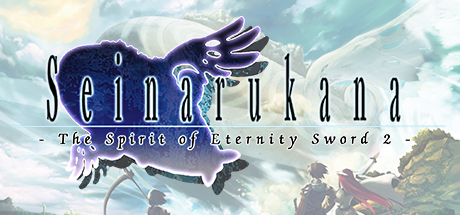
Seinarukana – The Spirit of Eternity Sword 2, developed by Xuse and published by JAST, is an expansive and deeply ambitious fusion of visual novel storytelling and tactical role-playing gameplay. Acting as a spiritual successor to Aselia the Eternal, it builds upon the same universe of gods, souls, and eternal swords while introducing a new cast, new worlds, and a refined battle system. What distinguishes Seinarukana from most visual novels is its sheer scale. It’s not just a story about friendship and destiny; it’s a saga that stretches across dimensions, interweaving personal emotion with epic metaphysics. The game unfolds as a hybrid of dramatic narrative and strategic combat, with an emphasis on choices that shape both relationships and outcomes over an extensive campaign that can span well beyond sixty hours.
The story begins in a seemingly ordinary setting, with protagonist Nozomu Setoki living a typical high school life alongside his friends. However, the tranquility shatters when a supernatural event transports them to a parallel world governed by mana, gods, and warring nations. From there, the game transforms from a slice-of-life prologue into a grand adventure about survival, love, and the burden of cosmic power. Nozomu’s journey, along with those of his female companions, is both a physical and spiritual odyssey, as each character confronts their inner conflicts while adapting to this alien realm. The writing gradually escalates from moments of levity and human warmth to philosophical and tragic reflections on fate and the endless cycle of life and death. The tone occasionally shifts from lighthearted to somber, but these tonal changes reinforce the sense of growth and loss that pervades the narrative. Each heroine—whether it’s the steadfast Satsuki, the gentle Narukana, or the fiery Katima—represents a thematic thread that deepens the exploration of destiny and free will.
What makes Seinarukana remarkable is the way it balances storytelling and gameplay. While the bulk of the experience takes the form of lengthy visual novel segments with branching choices and multiple romance routes, it is also structured around a fully realized tactical combat system. Players command teams of three characters per unit—assigned to attack, defend, or support roles—and move them across interconnected maps to conquer strongholds and outmaneuver enemy forces. The system combines turn-based strategy with real-time elements, as unit initiative and skill cooldowns determine the flow of battle. Each fight becomes a calculated test of resource management, where mana, formation, and elemental affinities dictate victory. Unlike typical RPGs that allow grinding to overcome difficulty spikes, Seinarukana demands careful planning and an understanding of mechanics. The late-game battles, in particular, grow intensely challenging, forcing players to master synergy between units and utilize every advantage available. This design rewards tactical precision while also emphasizing the narrative stakes behind each encounter.
The visual and audio presentation complement the game’s ambitious storytelling. The character designs are expressive, leaning toward the classic anime aesthetic with vibrant color palettes and distinctive costumes that reflect each world’s cultural tone. While the graphics are not cutting-edge, the 2D art and interface exude a nostalgic charm reminiscent of early 2000s Japanese PC games. Every major character is voiced in Japanese—except for Nozomu, whose silence allows players to project their own perspective—giving emotional depth to the dialogue. The music deserves particular praise, ranging from energetic battle themes and ethereal choral pieces to melancholic piano tracks that underscore the story’s emotional moments. Together, these elements create a world that feels alive, immersive, and steeped in mythic weight, even when the technical limitations show through.
Yet for all its strengths, Seinarukana is not without its flaws. The pacing is uneven, especially during the early hours, where long stretches of dialogue can feel sluggish before the story truly unfolds. The combat, while rewarding, can become repetitive due to the limited variety of mission objectives—many of which boil down to capturing every enemy base or defeating a boss under time constraints. Similarly, while the game offers multiple endings and romantic paths, much of the content overlaps between routes, with significant divergence occurring only toward the final chapters. Some players might find the story’s metaphysical concepts dense or convoluted, especially as it delves into abstract ideas about the nature of eternity and divine hierarchy. Still, these criticisms are more reflective of the game’s ambition than its execution; Seinarukana strives for thematic complexity even at the risk of occasional confusion.
From a broader perspective, Seinarukana stands as a rare example of a visual novel that succeeds in merging emotional storytelling with strategic depth. It challenges players to think both narratively and tactically, rewarding those who invest time in understanding its systems and lore. The branching routes and multiple endings provide substantial replay value, while the romance elements lend a human counterbalance to the cosmic stakes. It’s a game that demands patience, but it repays that investment with a uniquely immersive experience—one that feels personal and grand at the same time. For fans of story-driven RPGs like Utawarerumono or Eien no Aselia, this title offers an equally rich tapestry of characters and themes. Despite its occasional pacing issues and dated visuals, Seinarukana’s emotional resonance and strategic depth make it a standout within both the visual novel and tactical RPG genres. It’s an odyssey that invites reflection long after the credits roll, a meditation on destiny, love, and the eternal will that binds worlds together.
Rating: 6/10