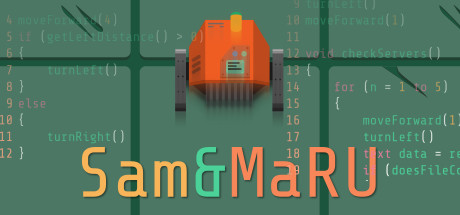
Program robots to solve issues around Singularity Corporation’s factory. Make sure to keep your head down and eyes focused on your work tasks that take the form of puzzles. Don’t worry, Singularity has everyone’s best interest at heart and would never be planning something sinister...
Modeled estimate, not a reported figure. How we estimate →
Media

About
Genres
Stats
All-time low is the lowest price we've recorded for this game since we started tracking it.
Languages: English**languages with full audio support
Reviews
A charming little game where you program your worker-bot to complete mundane tasks - uncover a sinister plot - and get in over your head engaging in corporate espionage! The levels lacked any leaderboards - so there's less of an incentive to optimise everything like you often get in this genre - so not a huge amount of replay value; but I was a big fan of the easter eggs, with extra scraps of story hidden off the main track. It's also good at teaching you the mechanics; introducing them slowly - so by the end combining them into a complex program becomes second nature... I mean very good at that; someone has obviously put a lot of thought into doing that. I did run into a few bugs... perhaps not surprising for an ambitious programming game by a solo developer, but nothing major. There's also a few quality of life things which similar games sometimes have and I missed... things like pausing code/ fast forwarding code mid-execution (debugging got a bit tedious on the longer levels); and being able to copy and paste code snippets from the help files... Regardless - I had fun with it; you might too.
This is one of the best coding games out there for beginners. While Zactronics is the best for pro devs, this game is the best third or fourth game to play if you have zero coding experience. Sam & MarRU is on par with Apple Swift Playgrounds in quality and coverage of coding concepts. If you want to learn how to code, this has to be on your playlist. ----- Update: I finished the game and created a walkthrough guide. The difficulty curve is skewed right--sharp incline from start then peaks near mid game, at "Hack Employee Database" and then finally long tail drops.
[b]The premise:[/b] It's a Zach-Like programming puzzle game where you write code to move robots around a 2D grid and perform tasks. If that sounds like your thing (and it certainly sounded like mine!), you'll probably like this one. The most well-known and obvious game to compare it to is [i]7 Billion Humans[/i], but to me it feels much more heavily influenced (in both gameplay and story, and art style for that matter) by [i]Marvellous, Inc.[/i]. It is different enough from both of those to qualify as its own thing, though. [b]The Gameplay:[/b] Like with most games in the "2D grid" sub-sub-genre of Zach-Likes, the puzzles are (usually) less about the code syntax and more about navigation, and specifically about what (and how much) information your program is able to gather about the space it's traversing. The programming in this game is much more flexible than in most games like it. The aforementioned commands about navigation and information gathering are powerful, and the programming language itself is much closer to BASIC than to assembly code (you can declare and call as many variables as you want, do multiple math operations in-line, and joint conditionals and loops are built right into the syntax). This could have been a double-edged sword, in that it's easier for the player to use but harder for the devs to build challenges around (as much as I get frustrated with determining the distance to an obstacle in [i]7 Billion Humans[/i], it's those very limitations of the game's syntax that lead to some of the most rewarding puzzles in the game!), and indeed, I found [i]Sam & MaRU[/i] quite a bit easier than most. But what it lacks in pure challenge it makes up for with variety and spectacle. [i]Sam & MaRU[/i] regularly introduces one-off mechanics that only appear in a couple of puzzles, which gives a lot of the levels their own sense of personality and keeps things feeling fresh. The mid-game levels in this game are a lot more memorable than the mid-game levels of most games of this type. Granted, some of those one-off gimmicks are better executed than others, and this is compounded by the fact that the instructions when they're introduced are sometimes a bit too vague as to what they actually do (the level where you [spoiler]use the "hackMainframe()" command[/spoiler] crossed fully into "Trying to read the developer's mind" territory, IMO), but at least the lesser ones don't wear out their welcome. [b]The Story (and The Aesthetics In General):[/b] The story is fairly simple, but it's well-executed enough, and is integrated into the gameplay well via clever use of the aforementioned level-specific mechanics, and also provides some bonus challenges in seeking out the lore hints hidden in some of the puzzles (also, as a tech-history geek, I loved [spoiler]the eventual-deuteragonist having the surname "Lovelace"[/spoiler]). The art style is simple as well, but it's clear, and it communicates the layout well while still providing a sense of place. The music, on the other hand... well, let me put it this way: the only music in the entire game, which plays over every puzzle, is a five-second loop of elevator muzak. Thank goodness for the volume settings. [b]QOL[/b] I do have a couple of miscellaneous QOL complaints: [list] [*] The tank controls. Ye gods, the tank controls. Even with the autocomplete, I still got tired of putting "turnRight()"/"turnLeft()" on every other line. There was no reason to make turning a separate command. [*] No option to speed up (or pause) the code execution when testing, which makes debugging your solutions a much lengthier process than necessary, especially later on when the boards get massive and your MaRU takes its sweet time rolling across the floor. [*] Sometimes the level informs me that my bot performed "better than expected," so I'm guessing this game has bonus optimization targets? But I couldn't find any mention of what the targets are or even what stats they're measuring (I mean, I go back and optimize anyway just for fun, but still, it'd be nice to have some sense of how far I am from the goal). [*] On a related note, I do miss having the ability to save multiple solutions for the same puzzle at once (I mean in-game, not just in a text document). [/list] [b]How Much Bang For Your Buck[/b]: The main campaign took me just over 5 hours (and I've played more of these games than is probably healthy), there's a couple of hidden bonus challenges to stumble upon, and of course there's the obligatory postgame "Go back and optimize your earlier solutions with the tricks you've learned in the later levels" thing (or is it only me who does that?). For $10 US, I'd say that's a decent amount of content? [b]The Teal Deer:[/b] If you like programming games, you'll probably like this one. Some QOL issues hold it back from being a genre classic, but for $10 it's good.
The best way to summarize this is a Zachtronics game without the polish. It's still worth your money though.
Sehr gutes programmier Spiel, absolut geeignet für Programmierer und die die es noch werde wollen. Kurzgesagt: 8/10 Über einen zweiten Teil bzw. ein DLC würde ich mich sehr freuen.
Related
Related
Trends
Modeled estimate over time, reconstructed from Steam's monthly review histogram.
Momentum
Pace estimated from the game's recent review growth (our daily snapshots) at its own sales-per-review ratio — a momentum signal, not booked sales.
Related
| CENTRALIA | $702.1 | 51 | 20% | $0.99 |
| Psi Cards | $698.5 | 94 | 30% | $0.49 |
| Kamikaze Cube | $698.5 | 94 | 34% | $0.49 |
| Primal Pursuit | $704.3 | 61 | 80% | $0.65 |
| Milky Way Map | $705.2 | 61 | 84% | $0.49 |
| Alien X | $705.8 | 57 | 60% | $0.49 |