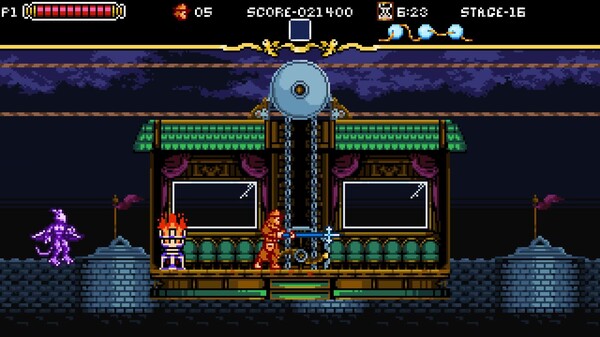
Saint Slayer is an NES-style 2D action game, featuring loads of stages, enemies, and gore set against the backdrop of late-17th century Europe. Play as the ex-soldier Rudiger and wield the Spear of Sacrilege as you save the Holy Roman Empire from the corrupt Catholic priest Father Pacer.
Modeled estimate, not a reported figure. How we estimate →
Media

About
The year is 1698. A mysterious figure named Father Pacer has shattered the peace negotiated after the War of the Grand Alliance, obsessively and violently stealing Catholic relics throughout the Holy Roman Empire. Can the ex-soldier-turned-farmer Rudiger protect his people from a power-mad priest and his horde of monsters and minions? Can he become Saint Slayer?
A robust, 21-stage single player campaign...
...that can be played entirely in two-player co-op!
Stunning, gory, and atmospheric NES-era pixel art
Killer 8-bit chiptune soundtrack
Seven intense boss fights
Find and befriend animal familiars
Unlockable upgrades and bonuses galore
Player choice: Help or hurt those in your path!
Rewards multiple playthroughs with challenges, achievements, and passwords
Stats
All-time low is the lowest price we've recorded for this game since we started tracking it.
Languages: English
Engagement
Hours played at review time, across 40 reviews with recorded playtime.
Reviews
Themes across 40 recent reviews and how positive each mention is. A keyword signal, not full sentiment analysis.
positive critical· bar length = how often the theme comes up
Reviews
Saint Slayer is a fan project at its core, and while there are PLENTY of Metroidvanias these days (almost as common as rogue likes, which isn't a bad thing for the record) When making something in a "crowded" genre so to speak. You really have to bring something interesting to the table to make it stand out. Thankfully, this game does that very nicely Very rarely do I compare one indie game to another, but Saint Slayer is an exception. And I'll be addressing an elephant in the room kind of approach But beforehand, what is Saint Slayer you ask, to me, it's a good example of a modern retro fan project that is a love letter to Castlevania and a multitude of supernatural pop culture media while also using religion, specifically Christianity, as a story telling device with some Biblical elements thrown in, without going into preachy territory or mockery/attacking religion territory either. Mind you I'm Christian myself, but I digress You play as Rudiger, a former crusader who is now a farmer but has found out that a Catholic Priest from the Roman Empire has fallen from grace and turned traitor, that man being Father Pacer. It's up to you to recover the Spear of Destiny, aka the Holy Spear or Spear of Longinus (Which according to the Bible was the spear used when Jesus was crucified) from the corrupt priest who plans to use it for grim purposes. To me, this is like you took the cult classic film of Constantine (From the 2000s ) and applied it to Castlevania style story, as I instantly saw similarities here. Gameplay wise the title feels like a hybrid between Castlevania one on NES and Castlevania Arcade-AKA Haunted Castle. There's also bits of what I feel like could be tidbits of Ghosts and Goblins, as you have to be weary of respawning monsters, there are different paths for each level, and a variety of monsters, ghouls and ghosts (yes that was intentional) to be weary of as you do your best to make pixel perfect platforming and attacks In short? This has the original Castlevania's stage designs and movements, but it also has the enemy variety, varying paths, and a similar difficulty to Ghosts n Goblins. Now I will say outright it is NOT AS brutal or unforgiving as GNG, but the difficulty is close enough to feel like if GNG was more balanced and less a quarter eater However, the biggest thing I could compare this game to, and quite frankly, this made me VERY happy as a fan of both titles, is Infernax Now HEAR ME OUT Saint Slayer is essentially put into a Saints Row vs GTA type of situation, by that I mean both games are EXTREMELY SIMILAR, but its the little things in the designs that make them more akin to kindred spirits rather than rip offs. And, if you really want to get technical, you could consider this game a "good clone" of Infernax in some ways, but this does NOT dock down Saint Slayer at all, it's similar in themes, premise and some design choices, but different in execution and scale Let me put it like this for an abridged take on it Both Infernax and Saint Slayer share the following 1-Both are Metroidvania/Castlevania style homage Games 2-Both have heavy religious themes rooted around Christianity as a focus, with Infernax more having it as a background element with Saint Slayer actually refrencing Biblical elements, both games also take place during the crusades 3-Both have a very "Dark Ages" type of tone and vibes/design 4-Both have multiple endings, a lot of gore, and a form of morality, as you can choose to help or harm the many civilians and people around you, so there are good or bad endings based on what you do The major difference? Infernax is more structured like a Metroidvania RPG and it's morality system is more complex and on a bigger scale. It also is a much slower paced and a longer game, but that kind of pacing isn't always for everyone, even in the world of Metroidvania style games Saint Slayer on the other hand takes what Infernax did and brings it's own story and makes a game that almost feels like a successor, but it's more bite sized, arcade like, and faster paced In short and to put it humorously, If Alcedor's adventure in Infernax was the long big trek that took you a few months to beat fully when borrowing the game from a friend, then to compare, Rutidger's adventure in Saint Slayer is like you took Infernax and condensed it into one of those hidden gem NES games that you'd beat on a weekend rental back in the late 80s/early 90s and re-rent it a few times over to find all the secrets and different routes I can't say this enough, so I'll put this in big text to emphasize a point THIS GAME IS NOT A RIP OFF OF INFERNAX OR BETTER OR WORSE THAN IT AND VICE VERSA, BOTH GAMES ARE JUST VERY SIMILAR WITH DESIGN AND STORY BUT DIFFERENT EXECUTION OVERALL This game also almost feels like a hybrid between an arcade game and an NES game, it has the replayability and difficulty of an arcade title (tough and a PINCH of "Nintendo Hard" but not relentless. Whilst the password system and shops feel like a nod to Castlevania 2 and Zelda 2 just a tad What you get is no award winner, but you have a fun game that isn't necessarily unique in it's concept, but the uniqueness lies in it's gameplay execution, pacing, visuals, and story. The replayability and multiple routes in levels further adds to this It's a kindred spirit to fans of both Castlevania, Infernax, or really any gothic supernatural type of retro video game. And with that said, this is why I absolutely can recommend this game both for fans of the genre and for people who want something that's unique overall. The only warning I can give is go into the game not expecting the most grandiose title or the most in depth or the biggest length. Which is furthermore why I feel this game is fairly priced nicely Here's to Rutidger taking down evil, and perhaps if we're lucky, Simon Belmont, Alcedor, and Rutidger will all visit a tavern for some stew and mead, perhaps they'll all cross over and kick ass together in a pixelated gory monster mash
The hero of the game is Rudiger, an old soldier who once fought to protect the Holy Roman Empire and is now enjoying a quiet life in his village. Of course, peace never lasts long. Trouble arrives in the form of a priest wielding dark magic, determined to get his hands on sacred Christian relics. The gameplay is simple and easy to pick up. You can move left and right, jump, and attack. At first, Rudiger fights with a knife, which is later replaced by a spear. Pressing down lets you crouch, and once you unlock the ability, you can also slide, which is especially useful for hitting enemies close to the ground. Pressing up while attacking allows you to throw your weapon, but only a limited number of times. The number of available throws is shown by orbs in the bar at the top of the screen. The spear can stick into walls, creating some platforming challenges. Thankfully, these sections always provide orb refills, so you can never get stuck. Outside of those moments, throwing your weapon again usually means breaking destructible objects and hoping for an orb refill drop. Throwable weapons can also be upgraded with power-ups, such as explosive attacks or the ability to fire in both directions at once. These upgrades are hidden in destructible objects too, but they disappear as soon as you use your last orb. Stages are played in a linear order, with a mix of enemy encounters and platforming challenges. Enemies die quickly and drop rewards like points and money. They also respawn immediately if you walk far enough away and come back. Since they only reward points and money, and never healing items or other useful upgrades, there is little reason to waste time farming them. And time is always a factor. You are given a limited amount of time to clear a set of stages and defeat each chapter boss. Once the boss is defeated, the timer resets and starts counting down again for the next chapter. Fortunately, the game saves at the start of every new stage, and autosave also triggers after each death or whenever you collect an important item. The stages themselves are well designed and clearly built to challenge you. A common situation is making a difficult jump while a ranged enemy fires projectiles just to knock you back, often straight into an instant-death hazard. Most other damage simply drains your health bar, which can only be restored through fairly rare food pickups. If you explore carefully, some stages also hide permanent upgrades to your maximum health and orb capacity, giving you a welcome advantage. With its old-school visuals and gameplay also comes old-school difficulty. Thankfully, Normal mode feels fair and balanced. Those looking for a bigger challenge can choose Classic mode, which removes revives and shops, while Easy mode disables the frustrating knockback effect that any retro platformer fan will immediately recognize. Difficulty settings also affect health, lives, orb count, and enemy numbers. Shops appear in certain stages and offer a rotating selection of items, but purchases require special coins rather than the more common money bags. These coins can be found in hidden walls or, more rarely, dropped by enemies, and they also count as collectibles. This creates an odd exploit in stage 11, where a hidden coin sits behind a wall right at the beginning. Since the game saves whenever you collect it, you can simply grab the coin, return to the main menu, load your save, and repeat the process as many times as you like. Much of the shop inventory is not essential since many items can already be found in regular stages. The more useful purchases include health and orb upgrades, extra lives, and a shield that revives you once with full health. To counter the coin trick from above, purchases are not saved, so if you buy an upgrade and then quit, your coins will be gone and you’ll have nothing. Another shop items are hints that help locate treasure. Nearly every stage contains one treasure, often visible but locked behind some kind of trick. Collected treasures can be viewed from the main menu, alongside a bestiary featuring every enemy you have encountered. Each treasure also rewards you with a password that can be entered from the password menu to unlock special gameplay modifiers. The game does at least keep track of all discovered passwords, so you do not need to memorize or manually re-enter them every time. Still, the effects are not explained clearly, leaving you to guess based only on the password name. The biggest downside is how the password system interacts with saves. Starting a run with a password creates a new playthrough and overwrites your current normal save if you have not finished it yet. While passwords let you revisit any unlocked stage, doing so resets nearly everything, including points, lives, and even your permanent health and orb upgrades. The only thing that carries over is your total number of shop coins. If you add passwords and different ways to play the game, more playthrough are welcome, especially with a several endings.
An absolutely wonderful indie game that is made by a team who clearly understands what made the classic Castlevania series great. This game will kick your ass at first, but it is not hard to learn the patterns of each level - Levels are short, restarting is quick, and there are multiple difficulty levels. If you're not a fan of 8-bit or challenging platformers, this probably isn't for you, but it could be a decent introduction to the genre if you have an open mind. If you like all kinds of games, this is probably a 7 or 8/10 for you, but if you're coming to the game as a fan of the titles it pays tribute to, it is an easy 9/10 as it is hard to imagine them doing much more to mirror the classic series while still giving it a twist of its own. Highly recommended!
Saint Slayer: Spear of Sacrilege is a love letter to old school NES style games. This feels like a game I could've played at an arcade cabinet in a pizza shop growing up. The audio and visual components to this game are a masterclass. The story is deep without overstaying it's welcome. The gameplay feels stiff in the way that classic games do when it's been a few years since you played and you realize how rusty you are. That's not to say, however, that the movement feels bad. It simply demands that you practice and learn how to finesse it. There's a really substantial amount of content here to play with all the passwords, collectibles, achievements, alternate endings, and little secrets sprinkled throughout. For $10, you get a true modern classic.
I've played and finished one run of this game on hard, so take it with a grain of salt because that might not be the most universal experience, but I feel obligated to post a negative review, because the other ones I've seen are just people saying how the game didn't resonate with them because it feels outdated or stiff, and to me the problem doesn't begin or end here. Of course my take is also a matter of personal tastes, but I'm a hard-arse Castlevania fan and since this game try to emulate the first period of this saga, I feel my review will speak more to people like me. Sorry for the long intro, anyway First off I have to say I love a lot of things about this game, the graphics while a bit inconsistent (some bosses like Heureux or Pacer look weird compared to our game protag, the palette is at fault here) put an emphasis on clarity and I really have to salute that, and the gore and animations give you an idea of much work was put inside this little game. The story isn't really clear up until the end but works for what it is, and the music is great, it's not as iconic as Castlevania (I'll be comparing this game a lot to Castlevania because that's what it is I'm sorry) but there are some really great tunes in there that works well as a whole. The game is also charming and doesn't take itself too seriously although I wished it was darker and more serious, but that's just me. Now comes the gameplay... I don't have anything to say about the core movement of this game, I feel it works like a charm and only people who don't know what they're getting into and/or already hate the old Castlevania will find it off putting. But there's a few things that really rub me the wrong way that are too big to ignore in my opinion: -Weapon Variety : With Rudiger you can throw your spear to damage the enemies from afar. Cool, and then you can pick up variants of the spear to upgrade it. In Castlevania your subweapons are knives that go straight, an axe you can throw in an arc to cover things over your head, a cross that works as a boomerang etc. In Saint Slayer you got a spear that goes through, a spear that explodes, a spear that separates into other little spears, etc etc. All going into a straight line in front of you (except the one that also goes behind you) It feels super lackluster in terms of utility and wished they did more with this. Also you can only use 3 of them (in hard mode at least) at the beginning of your run which feels wrong but I assume it was for balancing reasons (you can use more of them as you find beads during the levels but I'll come back to this later.) -Useless Gimmicks : there are a few concepts introduced in the game that are really not that useful and quickly forgotten. You can plant your spear by throwing it on a wall and use it as a platform. Apart from the moment this thing was introduced, I found no use for it in the rest of the game whatsoever, and you don't even have to use it even once to progress into the game after then, to the point where I even forgot it existed. You also get an upgrade to your spear at some point that gives you the ability to charge up a super attack. It's powerful and kills some enemies in one shot, but it's so long to charge I barely ever used it. (also to the point that when I came across the next metal boxes that you can only destroy this way, I also forgot it existed) -Shop System : there's a shop (in any mode other than classic) that you can enter at some points in the stage where you can get life, upgrades, hints etc. I never felt like having to buy refills because they are plenty in this game, and the upgrades I never really had interest in because of my next point I'm going into. -Save System: You can continue your run from the menu as long as you live, but when you get a game over you're transported back to the main menu and have to enter a password to get back to the stage you previously died on. On top of being obnoxious (having to type a password everytime you want to resume) it happened to me twice that I was looking away in frustration and missed the ♥♥♥♥♥♥♥ password I had to retain in order to come back. Also, all the upgrades you bought or found during your run are all gone, but you keep your money somehow, this leads to a system that pushes you to keep your money and never buy anything, which feels wrong to me. Not cool bro. -The Pacing : The game being inspired by Castlevania, it is divided by multiple stages, upon which completing between 3 and 5 of them will lead you to a boss. However contrary to Castlevania where a few stages makes an entire level before leading to the boss, those stages is all you get as separations. What I mean by that is that however short or long a stage is, if you die during it, you will be revived at the beginning of it, instead of just getting back to the last screen you died on like Castlevania. And since the knockback in this game is super scary and falling into a pit kills you instantly, it can make for an incredibly frustrating experience to have to redo an entire section this long like that only because some damn crab sent you a fork at a bad time. -The Bosses : I can get past everything I just said until now I guess, but the bosses are really the thing that don't make wanna pick up that game again. The level design in this game is fine, it's even great most of the time (even if it doesn't know what to do sometimes between bloating the screen with enemies or give you absolutely nothing) which begs the question of why the bosses are such a train-wreck. They are lukewarm at best, and incredibly pathetic at worst. If you don't count the initial surprise of discovering the bosses for the first time, you shouldn't die to any of them on your second encounter. Their pattern are so simple to guess and so nonthreatening, you have absolutely no reason to get hit, they pose no challenge whatsoever and especially the final boss which is a big shame. I think that might have been the easiest final boss in any game I've played whatsoever and that's saying something. I could have also talked about how you can pick up an item that make you puke so you lose 1 bar of health and that you can get combo'd during it or that you can destroy the items you can pick up or whatever, I understand it wants to have this old game design philosophy with those shenanigans and whatever, and I really don't wanna make it like I absolutely hate this game. I think it's a fine game, heck better than what most AAA try these days, I'm a sucker for these kinda games. BUT at the same time, it is just a homage to older castlevania games with a less appealing universe and visual identity, no real twist to the formula, and if all those problems I evoked don't seem like a big deal individually, put together they make for a mediocre experience. In a world where games like Castlevania: Bloodlines and Curse of the Moon 1 & 2 exists, I really don't have any reasons to pick up that game again if I'm being perfectly honest. It may sound a little harsh, but it brings me nothing more these games don't already have. At the end of the day if a sequel is in motion, I just hope the devs will take into account these issues and try to address them and I'll be looking forward to it. Until then, I don't think I'll be playing it again, I might come back later to see if I missed something or if my opinion changed with time, but for now that will be it.
Great Game!!!!!
as good as Concord
Difficulty balance is a little odd in places but I had my fun. Hard/classic modes especially made me feel the castlevania experience, really had to start thinking about how I approach these levels, and by the end I had it all down to a science. Music is nice too.
Great retro-inspired game that really nails its identity. The presentation is colorful, layered with religious themes, and set against a strong gothic backdrop that gives it a distinct atmosphere right away. The music especially stood out—moody, immersive, and perfectly capturing that classic gothic chiptune vibe. That said, this is definitely a game built for players who appreciate old-school challenge. It leans hard into that NES-era “learn by failing” style of gameplay—expect to play, die, and repeat until you master each level. Playing as Rudiger feels solid and responsive, but be ready for that classic Castlevania-style knockback, which can be punishing if you're not prepared. The gore is another highlight—over-the-top in a fun way, with enemies bursting into guts and adding to the game’s gritty charm. The spear mechanics and power-ups are well-designed, giving a real sense of progression as you defeat bosses and grow stronger. Speaking of bosses, they’re a standout feature. Each fight feels unique, almost like a puzzle, where success depends on learning patterns and finding the right moment to strike. Taking on Pacer and his legion was a blast and really brought back that “good old days” feeling from the games that inspired it. Overall, a great pick for anyone craving a challenging, nostalgic experience with a strong gothic flair.
Solid, but difficult game. Lots of cool levels. Quick but good
Related
Related
Trends
Modeled estimate over time, reconstructed from Steam's monthly review histogram.
Audience
Estimated from the language of this game's reviews — a proxy for where players are, not official Steam demographics.
Related
| BrebeMan | $30.9K | 113 | 100% | $9.99 |
| Out of Sight VR | $30.9K | 65 | 98% | $24.99 |
| Vampire: The Masquerade - Justice | $30.9K | 238 | 65% | $5.99 |
| Thy Creature | $30.9K | 142 | 82% | $13.99 |
| Slave Princess Sarah | $30.9K | 110 | 82% | $14.99 |
| Men against Lizards | $30.9K | 179 | 93% | $9.99 |