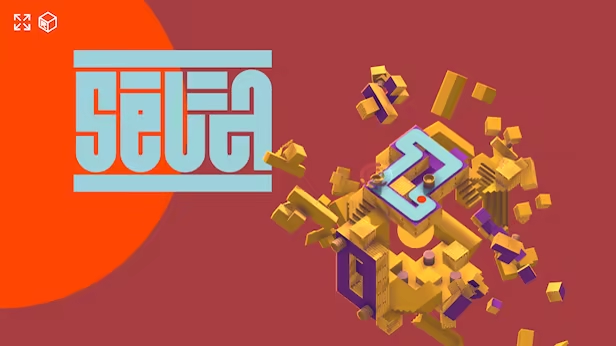
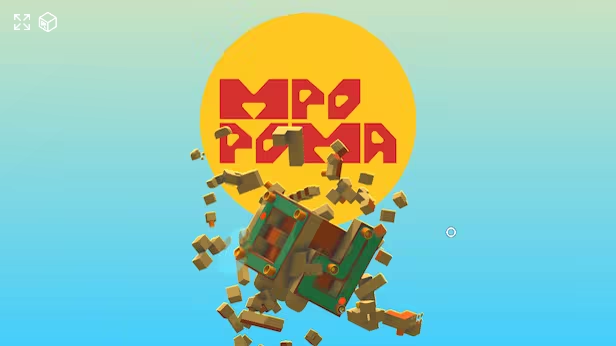
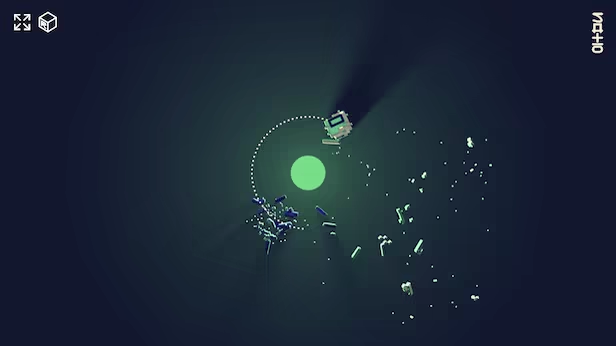
#3 Best game of the year 2023 in Eurogamer! A relaxing puzzle game where you create music by solving mazes. Travel from planet to planet and discover new music. Finalist Apple design awards 2024 in interaction
Modeled estimate, not a reported figure. How we estimate →
Discounts
Every price cut of more than 20% we have observed, in each market that quoted one, with this game's chart position on either side of it. These are episodes, not a model: a sale is one event, and one event cannot tell you what the next one will do.
Reviews, worldwide (the counter carries no country): 0/day in the week to Aug 7 → 0/day in the week after.
For scale, across Steam · Top Sellers · Brazil over the last 30 days: the 26 chart moves that followed a price cut of more than 20% went a median of 7 places towards #1, and the 2,400 moves with no price cut behind them went 2 away. One store, one chart, one country — it is the only place we have enough observations to say even that.
Prices outside the United States have been collected since 6 August 2026 and chart positions since 19 July 2026, so a cut older than that has no market to compare and a market that joined later has no history yet. Nothing here is converted between currencies.
About


Sums Steam only; App Store, Epic, Nintendo publish no volume signal, so the true total is higher by an unknown amount.
| Store | Price | Audience | Score | Chart | Est. revenue |
|---|---|---|---|---|---|
SteamYou are here | $14.99 | 96reviews | 81% | — | $23.2K |
| Free | 62ratings | 73% | — | not modelled | |
Engagement
Reviews
Themes across 47 recent reviews and how positive each mention is. A keyword signal, not full sentiment analysis.
Reviews
This game is very short, and the puzzles are very simple (took me 1.5h to beat) so I don't recommend it if you're looking for a lot of playtime or a challenge. Not even if you're looking for something to chill out to, since even then its capabilities are limited. But I fully recommend it if you're curious about music and would like to learn about some lesser known instruments, genres, and music history. Every level set has a short summary of the instrument/style, and if it sounds interesting (figuratively or literally) then you can follow their link to get much more information, either on the history with further sources, or links to performance for further listening. Part of me hopes that down the line this game will expand with larger levels using all the mechanics to their full potential. There is definitely a lot of unexplored territory with how mechanics might interact, and puzzles simplicity is largely due to how small the planets are, meaning you can accidentally stumble your way into a solution most of the time. In short, ok game, great education tool.
When certain friends have visited me in my studio recently, among some other things, I tended to suggest playing the game Rytmos and almost without exception the first reaction has often been: "Oh I'm really bad at rhythm games or I don't like rhythm games that much" It's fascinating what a name can trigger in us and what we associate with it, in this case of course it's not a big deal but as I said just interesting to observe. In Rytmos music plays first fiddle and so we travel to cube-shaped planets to solve small puzzles and connect dots to create sound loops, while doing this you'll receive background/historical information on the respective musical instruments and you even get the opportunity to record your own little loops with those instruments you have unlocked or received. The game's controls are intuitive and easy to learn, but everything is also explained to you in one of the 16 possible languages. Rytmos is an entertaining and cozy puzzle game and also a little love letter to the world of music and sound. You can finish the game in about 3 hours if you rush through it, but you can also take your time with it, which as you can see works pretty well for me.
Media

Related
Related
Price dynamics, follower growth, revenue and sales trajectories with interactive tooltips
This and every other Pro feature is free until October 20, 2026. A free account is all it takes.
Genres
Stats
All-time low is the lowest price we've recorded for this game since we started tracking it.
Languages: English, French, Italian, German, Spanish - Spain, Danish, Dutch, Japanese, Korean, Portuguese - Brazil, Simplified Chinese, Traditional Chinese +4 more
| $14.99 |
| — |
| 81%* |
| — |
| not modelled |
| $15.00 | — | — | — | not modelled |
Matched by title — a reused name can pair the wrong games. * is a critic aggregate. Prices and positions are each store's United States storefront; Epic charts worldwide. Audience and Score too, except Steam's, which is worldwide.
Hours played at review time, across 47 reviews with recorded playtime.
positive critical· bar length = how often the theme comes up
Overall fun puzzle game, with each level nicely making a short midi style track. The puzzles are not difficult with most not having many branching (or unconstrained) routes, but this makes the game more about a chill puzzling experience while listening to interesting music, than strict puzzles.
To be honest, I liked Rytmos less than I thought I might (based on what Rock Paper Shotgun and Eurogamer had written about it). It's kinda buggy on PC (I don't know to what extent the problem is my controller, though it's a bog standard XBOX controller); the puzzle concepts are clever but the puzzles themselves are hit and miss and can mostly be solved by trial and error, you get some difficult one followed by others where you can sleepwalk into the solution; and for me as someone with a background in percussion the connection between my puzzle solutions and the resulting music is frustratingly indirect. And yet: if the game resonates with you, you're likely to love it. It's a stylish trip through various styles of music across a range of eras and countries, and if you're looking for something that's more of a playful exploration of music and rhythm rather than a tautly designed puzzle with a flair for music, this might be for you.
21082023 Rytmos Videogame that shows off developers musical preferences rather than a game with meaningful musical impact on its gameplay. Some stages (such as german electronic) I turned the sound off because beeps and boops I found increasingly annoying and distracting, and solved puzzles (read: played the game) much more easily. I tried to tie music to gameplay, thinking perhaps rhythm is tied to the gameplay elements and you could maybe predict the pathing by listening, or based on the lenght of the complete line, but no. Movement of the Dot and it's path is cosmetic and finished level show its speed adjusted to visually hit bars. Another problem is progression. After finishing the first stage I decided to go to Sato. And managed to complete first two levels, after which the game stated that I need to finish Kaelo system. Okay, I finished it, and Sato then stated completely different requirement - finish Das System. You can guess what happened next. I finished it, and it then presented me with a different requirement. It's absurd because the game doesn't have level grading, and presents them as though you are allowed you to choose the system you want to play. That's why I chose to play Sato as my stage 2, and it allowed me to play it's first two levels, but absurd to then halt my progress until I fufill ever changing requirements. Should either allow players to choose, or make the game straightforward with 1-1 stage/level gradation and onward, for example. Mobile phone design. Good for mobile, because it takes nothing to move your finger around your screen. On desktop with big screen, it means you have to move your cursor quite far to reach option buttons. You can play the whole game with only mouse, using left-click, however undo function, which would perfectly fit the right-click, is located in top-right of the screen, and it is annoying that such essential feature that would be used alot is not in a more comfortable spot. No tutorial or context for new gameplay elements. Both that exist within the field, and that control the field. I appreciate game deciding to be abstract and minimise direct interaction with the player. However it should not come at a cost of obfuscating gameplay elements. The most egregious example is at system Eradan, second level. The first puzzle introduced is impossible to complete with elements presented on the field (which was the previous level all about). Until you notice an out of field construct that apparently needs to be touched, that in no obvious way connected or related to the field. Which at a later stage made me question whether I was wrong or game now has another "off-field" element that I need to look for. I don't understand this lack of transparency. If you decide to not have any tutorials for new gameplay elements, you are expected to guide player in some other way. If 1994 year title Kirby Dream Course managed to solve this conundrum (by showcasing new abilities during stage select, just as an example), you have no excuse. Difficulty is too low, only exeption to this is Sato (due to its sheer size). Most solutions are under ten moves. Last stage was somehow the easiest stage in the game, because you can find correct pathing to follow in the first couple moves, or immediately, which leaves a sour feeling finishing the game. And I will say, the game has quite a few interesting mechanics to vary solutions, but they are as quickly discarded as they are introduced. The motivator, the reward for playing are some niche (with the few exeptions) instrument samplers that you can hear and read short history about. The instruments, and stages themselves however are a bizzare collection of musical genres of different times, that are random, and that I can only imagine were chosen to the devs liking. I bring this up because there is no "mainstream" music featured, no rock for example, or any music that is considired classical, or their associated instruments. It is funny to me that the selection feels both personal and estranged simultaneously. Overall, the game lacks any substance or cohesion. The musical element is completely detached from the gameplay, and you can even complete the game with sound turned off. The promised "music creation" is you completing levels and collecting missing beats that makes up a composition (unless you want to count rudimentary instument sampler as such). "Mind bending" puzzles will boggle your mind as if the game was aimed at small children, and easily beaten in ~3 hours. Ultimately game lack both engaging gameplay or interesting instrument selection, and unable to bring its chosen topics together in a meaningful way.
打通的时候忘了写测评了,很不错的puzzle小游戏 [h2] 就是没有成就系统 [/h2] (如果是成就党很难受 音乐与puzzle结合的小游戏,做的还不错,美术风格也不错 还能学习一些音乐知识,各国各种音乐发展历史,乐器知识 每解锁一个星球就可以弹奏一种乐器,甚至还有实验音乐 总体就是打折的时候推荐购买来玩玩 谜题也不是特别简单 需要动动脑子玩的
I like puzzle games, but this one doesn't really require thinking. I didn't enjoy it and had to push myself through it to finish it. The music playlists that the developer provides on their website are much more interesting and I recommend checking those if the music is what caught your eye about this game.
游戏还是蛮不错的,一个关卡有三个节点全部打通通关后会有相关的乐器奖励和简单的科普知识背景音乐也是非常多样化,涵盖了各种音乐风格,包括流行音乐、摇滚乐、古典音乐、爵士乐等 将谜题与音乐结合在一起还是蛮有创意的、甚至可以学习地球上一些罕见的音乐、像津巴布韦卡林巴琴、埃塞俄比亚爵士乐、70 年代德国电子乐、印度尼西亚甘美兰、日本氛围音乐等流派启发的音乐知识与历史
This is a stylistic game. Less of a game, it feels more like an interactive experience. Discovering unique genres with information about them is interesting. The puzzles are more like an environment to listen to the music. I found this experience to be enjoyable and I feel interested in discovering more genres of music.
[h1]What I liked[/h1] - [b]All the Beeps and Boops:[/b] Man it's relaxing to play this game. You just zone out with the music and get in the flow of solving puzzles. You don’t need to be very good at solving puzzles for this game. I was mostly just going with the flow, vibing on the music. - [b]Learning about music genres:[/b] I had never heard of most of the music genres and instruments in this game. The little hints and tooltips really teach you a lot. I looked up some of the recommended listening. - [b]Jam sessions:[/b] The jam session after each planet is completed is a nice way to learn about instruments in a hands-on manner. It was hard for me to make it sound decent. Maybe a little more guidance would have been nice but I guess that goes against the idea of a jam session. [h1]What I didn’t like[/h1] - [b]Best played with touchscreen:[/b] It’s pretty clear this game was developed with touchscreen devices in mind. I had to struggle a bit with keyboard and mouse and quickly gave up on playing it with controller. It's especially clear when you try to skip through the tooltip information before a level. Using the arrow keys it skips one hint when pressed once. I had to hold left and right key to get to the next one.The swiping with the mouse didn't really work as well. - [b]Get the music going:[/b] The first puzzle of each world is most of the time the least satisfying to complete. This is due to there not being a lot of music yet. I wish there was more of a base line of the music at the start. Thankfully they are mostly the easiest. [h1]Why others should try it[/h1] Play it if you want a relaxing experience and learn more about music. Preferably on a touchscreen device if you can.
Selling now
See how fast this game is selling right now — estimated copies and revenue per day from recent review growth.
Players by region
Where this game's players are, estimated from review languages.
Related
| Game | Estimated lifetime revenue | Reviews | Review score | Price |
|---|---|---|---|---|
| $65.6K | 401 | 95% | $7.49 | |
| $2K | 41 | 100% | $2.99 | |
| $1.5K | 14 | 100% | $4.99 | |
| — | 0 | — | — | |
| — | 0 | — | — | |
| $59.4K | 677 | 92% | $5.99 |
Related
| Game | Estimated lifetime revenue | Reviews | Review score | Price |
|---|---|---|---|---|
| $23.2K | 113 | 86% | $7.99 | |
| $23.2K | 210 | 81% | $3.99 | |
| $23.2K | 106 | 77% | $10.99 | |
| $23.2K | 139 | 77% | $3.99 | |
| $23.2K | 100 | 93% | $5.99 | |
| $23.2K | 52 | 69% | $14.99 |