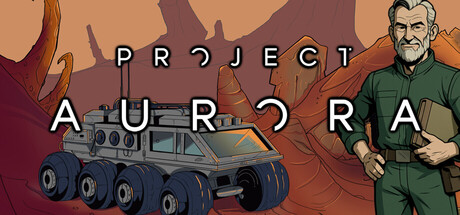
Aurora isn't as desolate as it seems. Survive amidst storms, lost technologies, and remnants of a vanished civilization—before you become part of them.Aurora is not as abandoned as it seems. As in classic sci-fi, discovering its secret means confronting the depths of cosmic horror.
Modeled estimate, not a reported figure. How we estimate →
Media

About
Not as abandoned as it seems...
A seemingly harsh planet, haunted by sandstorms and full of endless wastelands scattered with the ruins of a long-forgotten civilization. From orbit, it appears lifeless - yet you'll soon discover that someone, or something, is watching your every move.
You are the captain of a research mission on the surface of a newly discovered planet, Aurora. Your task is to lead the expedition by managing research facilities and directing trips into the planet's unexplored regions.
Learn about Aurora's past and search for traces of the previous expedition, whose last contact was an alarm signal... A truly terrifying one.
Venture into hostile, endless terrain where every path could lead to deadly danger. As captain of the expedition, you decide where to go and what risks to take to reach your goal. The unpredictable world of Aurora awaits you, and each new discovery may alter your understanding of this place. The fate of your crew depends on cold calculations, pure courage, and sometimes intuition - just remember, not everything you find here will be on your side.

You are about to embark on a journey that will raise more questions than answers. It is a dark and mysterious place where each step could be your last. Draw on the knowledge of scientists and specialists to determine if your mission is yet another scientific experiment or perhaps the next chapter in the history of cosmic horror...
You are leading a research mission on a strange and mysterious planet - everything here depends on you.
Manage supplies, expand the base, and develop its infrastructure. Your people need a strong leader, especially in case of illnesses, accidents, or paranoia... if they manage to make it back from their journey into the unknown. Every decision matters here - ignoring basic symptoms can lead to valuable personnel falling ill, while sending an expedition without proper equipment leads it to certain death on Aurora.
Weigh the risks, make decisions, and, above all, don't get yourself killed - exploring an alien planet is no joke!
Without the right infrastructure, the expedition will fail. You must decide how to allocate your precious resources and develop the main base. Remember, every choice has consequences. After all, without energy, new discoveries, or the minerals hidden in foreign soil, the entire mission could end in failure.
Developing the base structure, investing in new technologies, and opening mines, refineries, power plants, and laboratories is not just a task - it is a condition for your crew's survival.
Every aspect of this world is based on solid foundations of modern science. Your discoveries are not coincidental - they combine real biology, geology, archaeology, and physics, creating a network of connections that form the basis of Aurora's new civilization. The tools and methods at your disposal are not fantasy but actual research techniques and instruments drawn from real expeditions and excavations. Here, on Aurora, science is your guide through the dark abyss of space.
Uncover the fate of the planet, its long-forgotten inhabitants, and the missing team that came before you. Decide whether to follow the beaten track or find your own path. Things can easily become complicated, and the obvious explanation may turn out to be very disturbing.
Learn about the rich, multilayered history of a fallen culture and the fate of those who encountered the unknown. Prepare for a series of difficult decisions, none of which may be the right one, and face the consequences that will affect your life and that of your entire crew.


The aim of the project is to reach international markets and increase the recognition of the game abroad, with co-funding of PLN 80,000.
The project Project: Aurora developed by Tesseract Games, is co-financed by European Funds for a Smart Economy 2021-2027 under the KPT ScaleUp Booster program.
Stats
All-time low is the lowest price we've recorded for this game since we started tracking it.
Languages: English, Polish
Reviews
Highly recommended. The atmosphere is great, dark and creepy. It really captures the feel of classic science fiction and the exploration of an alien planet where you never know what to expect. The story kept me hooked. I actually wanted to know what happens next, which doesn’t happen often. The game also looks very aesthetic, in a grim kind of way. Every element expands your understanding of the world, and piecing together bits of information gradually lets you build a complete picture of the planet. Base and vehicle upgrades are fun and satisfying. Nothing feels like a waste.
Project: Aurora is an adventure game with basebuilding and management elements. Set in the far-off Gliese system, your team of intrepid (and well-compensated, as the game repeatedly emphasises) explorers have been tasked with discovering what happened to a previous expedition sent to the planet Aurora. Dropped on the planet, the team is equipped with a rover, a base, and a range of scientific skillsets, all poised to answer one question—what happened to the previous team? On the surface, there’s a lot here to love. Visually, the planet’s landscape is a treat, with a wide range of interesting plants and features that, as the team learns more about the planet, become a form of narrative all their own. Project: Aurora repeatedly emphasises that it’s seeking to recapture some of the magic of classic sci-fi, of Heinlein and Clarke, and that aim is obvious throughout the look and feel of the game. There is a clear invocation of Rendezvous with Rama and Alien that gives the game a delightful air of mystery and intrigue. This is a story that tells itself, with the player being brought along for the ride. However, in nearly every respect, this game does not succeed at telling the story it set out to tell. It is tedious. It is, at times, obnoxious, and playing it became a chore. This is a game that has a compelling story to tell, but buries it beneath such badly done mechanics and multitude of bugs that, however interesting that story may be, it isn’t anywhere near enough to salvage the abysmal gameplay. https://steamcommunity.com/sharedfiles/filedetails/?id=3725572013 Project: Aurora involves, as its primary goal, solving the mystery of what happened to the previous team on Aurora. This, of course, necessitates exploring the planet. Planetary exploration is done in two ways. First, there’s the obvious of piling crew members into a rover and seeing what there is to see, whether that be weird fungus, geologic formations, or the ruins of some long-lost civilisation. However, this crew needs somewhere to stay and recuperate from their adventures, hence the secondary mechanic of base expansion and upgrades. The crew uses the materials and discoveries they make as they explore Aurora to expand and grow their base, fuelling further and farther exploration. There is nothing inherently wrong with this premise. The difference is in the execution. In the case of both Rimworld and Alien Horizon, the basebuilding mechanics are the point of the game, with everything else that makes them special being secondary to how well the basebuilding is going. Gameplay mechanics centre on basebuilding, with exploration becoming necessary to better fuel the basebuilding and the base’s growth. Project: Aurora falls in an odd, nebulous space. It has clear basebuilding elements, where having a functional and streamlined base is part of the point, but it lacks any ability to really optimise or manage that base and its inhabitants. It lacks any real ability to automate, meaning players must constantly engage with the base in order to keep it functioning. While the base offers ways to upgrade the rover, this doesn’t undo any of the fundamental flaws with the rover’s actual execution. Project: Aurora’s exploration mechanics are fundamental to the game. They are the point. You are a scientific exploration team, and you are here to explore, and this is the entire point. For them to be so frustrating, then, in both concept and execution is deeply disappointing. The rover has a limited shield, battery, and space capacity, all of which are perfectly reasonable in theory. In practice, however, this becomes an exercise in absolute frustration. Take, for instance, the battery. The rover’s battery drains as the rover goes on its merry way across Aurora, whirling and buzzing as it wanders over surprisingly good terrain. The player can set up recharge points at remote mining bases, but otherwise, the rover needs to return to the main base or carry a spare battery to recharge. This battery does not last long, and when it is empty, the rover explodes, killing anyone and destroying any cargo that might have been inside. It’s a bit of a diva, but this is an alien planet, and there are no rules saying a rover can’t be a diva when on an alien planet. Given the consequences of poor battery management, then, the best strategy for the rover is to run it without any crew members on board, skipping from charging station to charging station until it finds something that requires a specific crew member, then going all the way back to the main base to pick them up. There is no way for the rover to research on its own—understandable, funding is tight—and which particular crew member will be needed is unpredictable. Even this could, in theory, work. Exploration is an end in its own right, and Aurora is a genuine treat to explore. However, this is the size of the map: https://steamcommunity.com/sharedfiles/filedetails/?id=3725572287 It’s a very, very long way to wander back and forth, over and over and over again, seeing the same sights, dodging the same hazards, and being constantly aware of how obnoxious it would be if you took one wrong turn and accidentally blew up the rover. This is, of course, all the theory of the game. In theory, this game’s design is flawed. In practice, all the tedium and boredom of driving this rover back and forth through the darkness is accentuated by bugs. Whether my little scientists feel like getting in the rover today is not up to me or the button that is meant to assign them to the rover, but to the gods of Aurora and their whims. Whether I will be able to leave a dialogue box without having to force quit the game for the third time in the last ten minutes is a matter of chance. Text is routinely cut off, specialists run the risk of being blipped out of existence when getting in and out of the rover, and the UI is confused about what views might actually matter to the player. These bugs left me unable to finish the game. I got to a point where progressing meant I needed to set up remote camps on the planet’s surface. However, the inability to scroll the parts workshop menu meant that I couldn’t construct camps, and the rover’s cargo container was bugged such that it no longer had space to hold the camping supplies. Also, the game switched to Polish after about two hours of play, making it even more difficult for me, a non-Polish speaker, to figure out what was going on. https://steamcommunity.com/sharedfiles/filedetails/?id=3725572421 Ironically, Project: Aurora might be one of the more accurate hard sci-fi games I have played. It is eerily accurate in its depictions of what that corporatised future in space might be like. A team gets sent out to undertake a mission, but along the way finds out that their gear and instruments are fundamentally ill-equipped for what they’re expected to do, and that no one designing the mission ever thought about what it would actually look like in practice. The resources they have are incomplete, everything is riddled with bugs, the tasks they’re expected to do are mind-numbing and inefficient to the point of near insanity, and death is one decision about resource allocation away. It is, in many ways, the perfect encapsulation of the corporate space exploration experience. In trying to depict a hard sci-fi exploration game, it unintentionally depicted the most accurate sci-fi reality of all—the experience of trying to be an explorer when your world has been taken over by corporations who do not care about anything, beyond shipping whatever it is they’ve produced with a shrug and an unbothered “good enough.” [quote] If you enjoyed this review, please check out the [url=https://summitreviews.biz/article/86/project-aurora-review] full version [/url] and the [url=https://store.steampowered.com/curator/41449676/] Summit Reviews curator page. [/url] Thanks for reading! [/quote]
Project: Aurora es un absorbente título de estrategia narrativa y supervivencia desarrollado por Tesseract Games. En él, tomamos el rol de un capitán al mando de una misión de investigación en un remoto y enigmático planeta alienígena. La Experiencia: Al ponernos a los mandos, la tensión se palpa rápidamente. No es solo un juego de avanzar a ciegas; tienes que construir y administrar la infraestructura de tu base con absoluta precisión. Hemos tenido que lidiar constantemente con la recolección de suministros, investigar nuevas tecnologías basadas en métodos científicos reales (como biología y geología) y, sobre todo, cuidar la salud física y mental de nuestra tripulación para evitar que sucumban a la paranoia en un entorno de auténtico terror cósmico. Lo mejor: Tensión constante: Sentir que en cualquier expedición puedes perder a un miembro de tu equipo o que la locura puede acabar con la misión le da un peso enorme a cada decisión que tomas. Ciencia y misterio: El brillante equilibrio entre utilizar herramientas científicas realistas para avanzar y el oscuro misterio alienígena que rodea a las expediciones desaparecidas anteriormente. Puntos a tener en cuenta: Gestión implacable: Mantener a tu tripulación con vida no es ningún paseo. Hay que medir muy bien los riesgos antes de salir a explorar, ya que un paso en falso condena a tu personal a la enfermedad o a una muerte segura. Conclusión: Una propuesta fantástica que sabe mezclar la construcción de bases con una narrativa envolvente de horror de ciencia ficción. Es una compra excelente para quienes buscan un desafío estratégico inmersivo que no perdona errores y que te mantiene pegado a la pantalla. Valoración: 🪐 Supervivencia: ★★★★★ (Gestión de base y recursos muy exigente) 🧠 Historia: ★★★★☆ (Terror cósmico y misterio absorbente) 🚀 Exploración: ★★★★☆ (Un mundo hostil lleno de decisiones críticas) 💸 Calidad/Precio: ★★★★☆ ¡Gracias por leer! Si eres desarrollador o quieres descubrir más joyas ocultas, puedes seguirme y contactarme a través de mi página oficial de Curator: https://store.steampowered.com/curator/45041832-Maestro-del-Pixel-Pixel-Master/
Related
Related
Trends
Concurrent players on Steam, sampled daily since tracking started.
Related
| CPU Invaders - Aim Hero | $1.3K | 55 | 100% | $0.99 |
| Dangerous Bullets | $1.3K | 67 | 64% | $0.99 |
| Witanlore: Dreamtime | $1.3K | 67 | 46% | $0.99 |
| Frantic Dimension | $1.3K | 67 | 91% | $0.99 |
| UFO - Unfortunately Fortunate Organisms | $1.3K | 67 | 87% | $0.99 |
| Black Moon 黑月 | $1.3K | 67 | 90% | $0.99 |