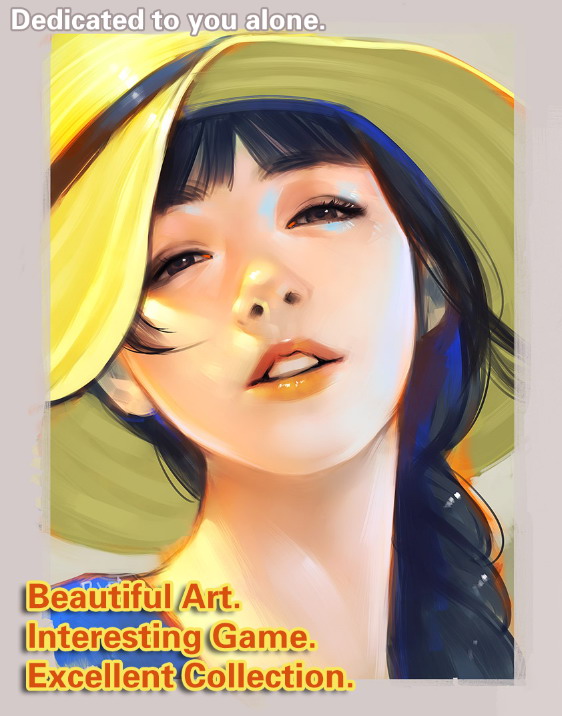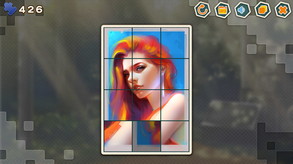
Elaborate jigsaw puzzle: 100 beautiful pictures, 100 custom difficulty, 100 game achievements.
Modeled estimate, not a reported figure. How we estimate →
Media

About
Genres
Stats
All-time low is the lowest price we've recorded for this game since we started tracking it.
Languages: Simplified Chinese, English, French, Italian, German, Spanish - Spain, Danish, Ukrainian, Russian, Bulgarian, Hungarian, Turkish +17 more
Engagement
Reviews
Themes across 40 recent reviews and how positive each mention is. A keyword signal, not full sentiment analysis.
Reviews
I’d like to play puzzles like this and see beautiful artwork.
Что бы получить все ачивки нужно собрать каждый пазл на максимальной сложности(24 детали), одну ачивку дают за каждые 20 собранных деталей(отображается слева сверху).
어흐한거 없어서 아쉬워 할 수도 있지만 생각보다 머리 아플 때 멍 때리며 하기 좋음 묘하게 맞춰갈 때 쾌감이 있음
Related
Related
Trends
Modeled estimate over time, reconstructed from Steam's monthly review histogram.
Hours played at review time, across 40 reviews with recorded playtime.
positive critical· bar length = how often the theme comes up
烂,100方块里很多色块一样的切碎了根本没法拼,都不知道做来干嘛
拼图 如题
Rompecabezas de monitas chinas. Para sacara cada logro es mejor hacer de 24 piezas. (empieza armando el marco)
Pleasure Puzzle: Portrait (趣拼拼:肖像画), developed and published by 冷笑黑妖, is a relaxed and straightforward digital jigsaw experience built around an appealingly simple promise—take beautiful portrait images, break them into pieces, and reassemble them at your own pace. It is not a game that attempts to disguise itself with elaborate progression systems, narrative framing, or gimmicks. Instead, it embraces the quiet, tactile satisfaction of puzzle solving and translates it into a clean, accessible format that players can return to whenever they want something calming, focused, and visually engaging. That commitment to clarity is one of its strengths, especially in a market where casual puzzle titles often attempt to complicate the formula unnecessarily. The presentation is polished in a way that immediately puts the player at ease. Portrait selections range across varied subjects and art styles, giving each puzzle a distinct mood and palette. Nothing feels like reused filler—each image appears thoughtfully curated to create interesting shapes, contrasting colors, and identifiable landmarks, which keeps the solving process engaging rather than repetitive. The minimalistic interface supports the artwork rather than competes with it. Piece placement feels responsive, the workspace is uncluttered, and players can concentrate fully on assembling the puzzle rather than wrestling with menu systems. For a game centered entirely around visuals, the developer’s willingness to let the images speak for themselves is a wise design choice. Customizable difficulty is where Pleasure Puzzle: Portrait gains longevity. Every image can be broken down into different puzzle sizes, allowing players to scale from a breezy session of large, easy pieces to a lengthy, more demanding assembly with dozens—or even hundreds—of fragments. This single feature dramatically broadens the game’s audience: newcomers, children, or casual puzzlers can enjoy a comfortable pace, while seasoned enthusiasts can push themselves with dense, intricate layouts. Because every puzzle supports adjustable difficulty, the same artwork may invite multiple replays, shifting from a relaxing visual meditation to a test of patience and spatial recognition. The game never pressures players to rush—time becomes a personal challenge rather than a requirement. Structurally, the game is extremely straightforward, and whether that is a positive or a limitation depends on player preference. There are no meta-progression systems, unlockable modes, elaborate scoring mechanics, narrative interludes, or thematic twists—just puzzles, one after another. For those who find joy in repetition, completion, and visual appreciation, this purity of design will be refreshing. But those looking for deeper mechanical variety—timed challenges, puzzle modifiers, customization of backgrounds or piece shapes, or community features—may eventually feel that the experience plateaus. The achievements, tied to puzzle completion, provide optional motivation, but they don’t meaningfully reshape gameplay. Pleasure Puzzle: Portrait understands that its appeal lies in simplicity, and it refuses to deviate from that foundation. As a relaxation tool, though, the game excels. The pacing is entirely player-driven, and the absence of failure states or urgency creates a meditative atmosphere. It’s the type of game that pairs naturally with music, a podcast, or a quiet evening wind-down routine. The low technical requirements and smooth performance help reinforce this role—it runs comfortably on even modest systems and loads puzzles quickly, allowing spontaneous short sessions. This makes it particularly suitable for players who want something peaceful and visually pleasing between longer or more demanding games. Its shortcomings come mostly from its narrow design scope. Even with 100 portraits included, completion-oriented players may find the structure uniform over long stretches. There is little to discover beyond new images and increased puzzle density, and the lack of mechanical experimentation means the experience remains largely unchanged from beginning to end. However, because the game is priced modestly and positioned clearly as a casual jigsaw collection, it does not oversell itself. Its value comes from consistent execution rather than innovation. Ultimately, Pleasure Puzzle: Portrait succeeds because it knows exactly what it wants to be—a curated gallery of portraits transformed into customizable, soothing puzzles. It delivers reliability, aesthetic enjoyment, and a stress-free gameplay loop without unnecessary distractions. For fans of jigsaw puzzles, digital art collections, or games designed primarily for relaxation rather than challenge, it offers hours of content and a pleasant, unhurried atmosphere. Players seeking narrative, competitive structure, or evolving mechanics may not find much to latch onto, but for those who appreciate quiet, thoughtful play, it’s an easy recommendation and a surprisingly polished entry in the digital puzzle space. Rating: 9/10
간단한 퍼즐 게임 심심할때 할만함
Just put the corner piece in the corner little bro
很容易让人沉迷的游戏。
Momentum
Pace estimated from the game's recent review growth (our daily snapshots) at its own sales-per-review ratio — a momentum signal, not booked sales.
Audience
Estimated from the language of this game's reviews — a proxy for where players are, not official Steam demographics.
Related
| Cats Around Us: Giant Cat | $2.9K | 117 | 98% | $1.59 |
| Finding Cats In Amusement Park | $2.9K | 98 | 92% | $2.09 |
| Draw It! | $2.9K | 95 | 82% | $1.99 |
| Wraith: The Oblivion - Afterlife | $2.9K | 114 | 63% | $1.99 |
| Shoot! & Ahhhhh~ | $2.9K | 66 | 86% | $1.99 |
| Dungeon Coup | $2.9K | 76 | 66% | $2.99 |