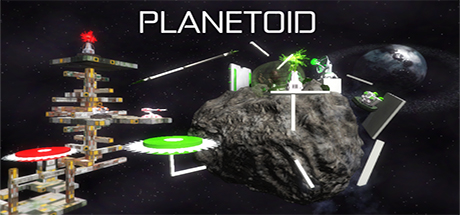
Planetoid is a compact indie game that combines construction, physics, defensive strategy, and action within the unusual environment of a tiny celestial body. Developed by GameWriterStudio and published by Conglomerate 5, the game was released in 2017 with a straightforward premise: establish useful facilities on a planetoid, fight hostile forces, and keep vulnerable inhabitants and important objectives alive. Rather than attempting to become an elaborate planetary management simulator, it concentrates on a relatively simple cycle of building and defending. This limited scope makes the game easy to understand, although it also prevents many of its ideas from developing into something deeper.
Construction is one of the central elements of Planetoid. Players are encouraged to build facilities that can help them deal with enemies and improve their ability to defend the small world. The unusual shape of the environment gives this otherwise familiar concept some personality. Instead of operating across a conventional flat battlefield, players work around a compact planetary surface where positioning and physics influence how the action unfolds. This creates a mildly experimental quality, since structures are not merely decorative additions but practical components of the player's defenses.
Physics play an important role in giving Planetoid its identity. The game is categorized around concepts such as building, sandbox play, tower defense, space, physics, strategy, action, and adventure, and these elements overlap throughout the experience. The physics systems can make movement and construction less predictable than they would be in a traditional strategy game. This encourages experimentation with placement and defensive arrangements, providing some entertaining situations when different objects and enemies begin interacting. Players who enjoy testing simple systems and observing the results are likely to appreciate this aspect more than those expecting carefully structured tactical encounters.
The player's responsibilities extend beyond simply eliminating enemies. Protecting humanoids and rescuing survivors are specifically presented as important goals, while an egg must also be kept safe. These objectives provide the basic motivation behind building defensive facilities. Instead of fighting only for points or territory, the player has vulnerable targets that can be lost if defenses fail. The idea works well enough to create urgency, but there is little narrative development surrounding these characters or objects. The game does not heavily explain who the humanoids are, why the egg is significant, or what larger conflict is taking place.
That minimal storytelling reflects Planetoid's broader approach to presentation. It is primarily interested in delivering its gameplay concept without surrounding it with extensive dialogue, cinematic sequences, lore, or complicated character development. For players who prefer games that quickly establish an objective and allow them to start experimenting, this directness can be appealing. On the other hand, the lack of narrative context makes the world feel less memorable than its unusual planetary setting initially suggests. A stronger story or more developed progression could have provided additional motivation for continuing beyond the novelty of the core mechanics.
The strategy component is similarly accessible rather than elaborate. Building the right facilities and protecting important targets requires some planning, but Planetoid should not be mistaken for a highly detailed colony simulator or sophisticated real-time strategy game. Its systems are relatively modest, and much of the enjoyment comes from interacting with the physics and discovering practical ways to survive. The tower-defense influence is recognizable because the player creates defensive infrastructure against enemies, but the game does not rigidly follow the traditional formula of predetermined enemy lanes and carefully organized waves.
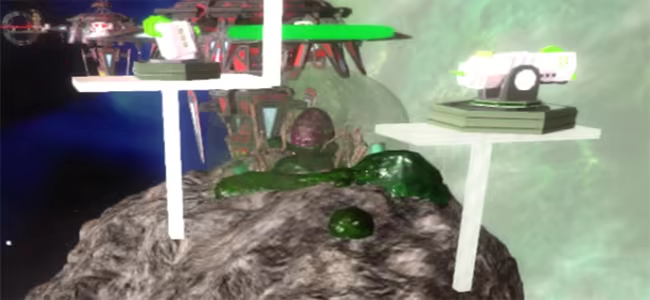
Visually and technically, Planetoid carries the characteristics of a small independent production from its period. Its presentation is functional rather than spectacular, placing greater emphasis on communicating objects, structures, enemies, and the planetary environment than on producing elaborate visual effects. The small-world setting remains the most distinctive visual feature because it immediately separates the game from ordinary construction and defense titles. The technical requirements are modest as well, reflecting a game designed around lightweight systems rather than cutting-edge graphical technology.
The main weakness is that Planetoid never fully capitalizes on the possibilities of its premise. Constructing defenses around a tiny world while protecting inhabitants sounds like the foundation for a much larger game, potentially involving extensive upgrades, increasingly sophisticated settlements, varied enemy factions, exploration, resource systems, and long-term planetary development. What is actually offered feels considerably more restrained. Once the novelty of the environment and physics becomes familiar, the limited variety becomes increasingly noticeable.
Despite these shortcomings, there is a certain charm to Planetoid's simplicity. It belongs to the category of experimental indie games that take a handful of recognizable ideas and combine them in an unconventional setting. Building facilities, defending humanoids, saving survivors, protecting the egg, and dealing with enemies create a clear collection of objectives without demanding a large investment in learning complicated systems. The game is therefore easier to appreciate when approached as a modest physics-driven building and defense experience rather than a comprehensive strategy title.
Overall, Planetoid presents an interesting foundation that never quite develops into the substantial experience its concept could support. GameWriterStudio created a distinctive combination of physics, construction, defense, and planetary gameplay, while publisher Conglomerate 5 brought the project to Steam as a small-scale indie release. Its unusual setting and experimental mechanics provide some entertainment, particularly for players who enjoy obscure sandbox-style games, but limited depth, sparse storytelling, modest production values, and restricted gameplay variety hold it back. There are enjoyable ideas within its miniature world, yet they frequently feel like the beginning of something more ambitious rather than a completely realized design.
Rating: 5/10