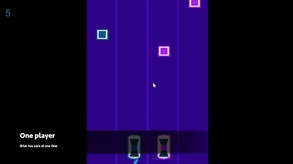
Pixel Car is a compact arcade racing game that turns a very simple driving concept into a test of concentration and coordination. Developed and published by azimuth team, the game belongs more to the casual reaction genre than to traditional racing. Instead of asking players to master realistic vehicle physics, complicated circuits, or extensive car customization, it focuses on controlling two vehicles at the same time. This unusual arrangement provides the game with its main identity and immediately distinguishes it from ordinary single-car arcade racers.
The fundamental objective is straightforward: keep both cars moving, collect as many bonuses as possible, and avoid obstacles. The challenge comes from having to watch two vehicles simultaneously. Human attention naturally tends to settle on one immediate problem, so Pixel Car deliberately forces the player to resist that instinct. Successfully avoiding an obstacle with one vehicle can easily lead to forgetting what is happening to the other. As the action continues, maintaining awareness of both sides becomes increasingly demanding. The result is a game where coordination matters more than sophisticated driving technique.
Bonus collection adds another layer to this otherwise minimalist formula. Players cannot simply concentrate on avoiding collisions because they are encouraged to collect beneficial objects while continuing to navigate safely. This creates a constant conflict between playing cautiously and pursuing a better performance. A bonus that appears easy to collect can become considerably more dangerous when the other vehicle simultaneously requires attention. The mechanics are uncomplicated, but the combination of collection and avoidance produces the kind of pressure that can make short arcade sessions unexpectedly intense.
The simplicity of the controls supports this approach. Pixel Car allows keyboard controls as well as gamepads, keeping the input system accessible enough that players can concentrate on reaction speed rather than memorizing complicated commands. The difficulty comes from executing simple actions correctly while processing multiple events at once. This is an effective design decision for a game built around divided attention because adding complicated controls would likely make the central concept frustrating rather than challenging.
Pixel Car also offers one-player and two-player modes. Solo play provides the purest version of the coordination challenge, allowing players to concentrate on improving their ability to manage both vehicles. The two-player option introduces a more social and competitive element, allowing friends to compete on the same screen. Shared and split-screen PvP support complements the arcade nature of the game particularly well. Remote Play Together support further suits a title whose multiplayer structure is based around straightforward local competition rather than an elaborate online ecosystem.
The multiplayer component arguably gives the concept more personality. Watching another player struggle with the same divided-attention challenge can turn mistakes into entertaining moments rather than simple failures. Because the rules are immediately understandable, Pixel Car can work as a lightweight competitive diversion without requiring lengthy explanations. At the same time, the limited mechanical variety means that multiplayer does not fundamentally transform the experience. It remains the same basic challenge of controlling vehicles, collecting bonuses, and avoiding hazards, only with competition added to the equation.
Presentation is deliberately modest and consistent with the game's arcade ambitions. Its pixel-oriented visual identity fits the uncomplicated mechanics, while the 8-bit soundtrack reinforces the retro atmosphere. The music is intended to add energy and momentum rather than create a deep emotional atmosphere. This approach works reasonably well because Pixel Car is fundamentally about rapid decisions and repeated attempts. Players attracted to minimalist retro games may appreciate this straightforward presentation, although anyone expecting visually elaborate tracks, detailed vehicles, or a substantial audiovisual spectacle will find the experience noticeably sparse.
Steam achievements provide an additional incentive for players who enjoy completing small objectives, while Family Sharing and Remote Play Together add convenience around the basic package. These features are useful additions, but they do not disguise the fact that Pixel Car is mechanically narrow. There is little indication that the game aims to provide a substantial campaign, detailed progression system, extensive collection of vehicles, simulation mechanics, or deep strategic development. Its longevity therefore depends heavily on whether the player enjoys repeating the central challenge and attempting to improve through practice.
That limited scope represents both Pixel Car's greatest strength and its most significant weakness. It wastes little time introducing its concept, making it easy to understand and immediately playable. The simultaneous vehicle control creates enough difficulty to prevent the premise from being completely effortless. However, once the novelty of managing two cars has been absorbed, there is not an enormous amount of complexity underneath it. Players who enjoy score chasing and reaction-based arcade games are more likely to appreciate its repetitive structure than those seeking a fully developed racing experience.
Pixel Car is ultimately better understood as a coordination game wearing the appearance of a racer. The cars and obstacles provide the framework, but divided attention is the real mechanic being tested. azimuth team has built the entire experience around that single idea, supplementing it with bonus collection, solo and competitive play, keyboard and gamepad controls, achievements, and an energetic retro soundtrack. It is approachable, occasionally demanding, and potentially entertaining in short sessions, especially when played competitively. Its minimal variety and modest depth prevent it from becoming a particularly memorable racing title, but the unusual two-vehicle mechanic gives it enough individuality to stand apart from countless other small arcade games. For players who enjoy quick reflex challenges and multitasking, it can provide some satisfying moments, while those wanting progression, variety, or deeper racing mechanics may lose interest relatively quickly.
Rating: 5/10