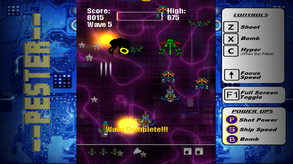
A blast from Flump Studios past! Pester was released on Xbox live indies back in early 2013 and was Flump Studios first game developed for public release. A remake of one of my early C64 games, Pester is a very fast paced and busy retro vertical shooter.
Modeled estimate, not a reported figure. How we estimate →
Media

About
Genres
Stats
All-time low is the lowest price we've recorded for this game since we started tracking it.
Languages: English**languages with full audio support
Engagement
Hours played at review time, across 46 reviews with recorded playtime.
Reviews
Themes across 46 recent reviews and how positive each mention is. A keyword signal, not full sentiment analysis.
positive critical· bar length = how often the theme comes up
Reviews
В описании указано, что это ремейк игры с Commodore 64 и что я могу сказать... это действительно похоже на старинную игрушку. Раз уж так, да ещё и за 30 рублей (по скидке за 15) и с карточками на борту, то и придираться мне сильно не хочется, к тому же, спустя такое время, а играется более чем хорошо! Ещё и имеются небольшие приятные бонусы, вроде открываемых музыкальных треков или же небольших корректировок изображения (например, чтобы выглядело, словно играем на старом телевизоре). Правда, по впечатлению, этих бонусов недостаточно для полноценного ремейка.
Pester, developed by Flump Studios and published by Funbox Media Ltd, is an uncompromising throwback to the raw intensity of classic arcade shoot ’em ups. It strips the genre back to its essentials—movement, firepower, pattern recognition, and survival—and builds an experience that is unapologetically focused on challenge and score chasing rather than narrative framing or modern accessibility. From the moment play begins, it is clear that Pester is not interested in easing players in gently; instead, it recreates the pressure and immediacy of old arcade cabinets, where every second on screen mattered and failure was an expected part of learning. Gameplay in Pester is built around traditional vertical scrolling shooter design, with the player controlling a lone ship at the bottom of the screen while waves of enemies flood in from above. Movement is precise but unforgiving, demanding constant attention to positioning as enemy formations, projectile patterns, and environmental threats overlap in tight spaces. The game’s pacing is relentless, rarely offering downtime between encounters, which reinforces the sense that mastery comes through repetition and memorization rather than improvisation alone. Enemy patterns quickly escalate in complexity, forcing players to internalize rhythms and anticipate threats before they fully appear on screen. This design philosophy makes every successful run feel earned, but it also means the learning curve can feel steep for players unfamiliar with classic shmup conventions. The controls and mechanics reflect the game’s retro sensibilities. Rather than layering in complex weapon systems or elaborate power-up trees, Pester keeps its arsenal relatively straightforward, placing emphasis on player skill rather than build optimization. Dodging becomes just as important as shooting, and survival often hinges on maintaining composure amid dense bullet patterns. This purity of design is one of the game’s defining traits, appealing strongly to genre purists who value clean mechanics and clear cause-and-effect gameplay. At the same time, the lack of modern quality-of-life features—such as generous checkpoints or forgiving difficulty scaling—can make the experience feel punishing, especially during early sessions. Visually, Pester embraces a remastered retro aesthetic that balances nostalgia with clarity. The pixel art is crisp and readable, ensuring that enemy silhouettes and projectiles remain distinguishable even during the most chaotic moments. While the art style does not aim for flashy spectacle, it succeeds in maintaining visual consistency and focus, which is crucial for a game where split-second reactions determine success or failure. Backgrounds are functional rather than elaborate, reinforcing the sense that the player’s attention should always remain on threats and movement rather than scenery. This minimalist approach fits the game’s arcade heritage and supports its emphasis on pure gameplay. Sound design plays a key role in reinforcing Pester’s intensity. The soundtrack leans heavily into electronic and techno-inspired rhythms that drive the pace forward and heighten the sense of urgency. These tracks complement the fast action well, creating an almost hypnotic loop where sound and movement blur together during extended runs. While the music may feel repetitive over long sessions, it aligns with the arcade tradition of looping tracks designed to sustain focus rather than provide cinematic variation. Sound effects are sharp and immediate, providing clear feedback for hits, enemy destruction, and player failure. One area where Pester adds a modern touch is in its array of configurable options and modifiers. Players can adjust various visual, audio, and gameplay elements, creating numerous combinations that slightly alter how the game feels. These options, along with score tracking and achievement-style goals, encourage replayability and experimentation, particularly for players who enjoy refining their performance and competing against themselves or others. While these features do not fundamentally change the core mechanics, they provide enough variation to keep repeated runs from feeling entirely identical. Despite its focused design, Pester is not without its limitations. The lack of variety in enemy behaviors and the absence of distinct gameplay modes can make extended play sessions feel repetitive once patterns are mastered. Additionally, control customization and interface options may feel limited by modern standards, reinforcing the sense that this is a game made first and foremost for fans of old-school shooters rather than a broad audience. These constraints contribute to its mixed reception, as appreciation for its authenticity often depends on a player’s tolerance for repetition and high difficulty. Ultimately, Pester stands as a sincere and focused homage to the vertical shoot ’em up genre. It does not attempt to reinvent or modernize its foundations, instead committing fully to the principles that defined arcade shooters decades ago. For players who crave intense, skill-driven gameplay and enjoy the satisfaction of mastering demanding patterns through persistence, Pester offers a compact but authentic experience. Those seeking narrative depth, mechanical innovation, or a more forgiving introduction to the genre may find it harsh or limited, but within its chosen design space, Pester delivers exactly what it promises: a relentless, retro-inspired test of reflexes, memory, and endurance. Rating: 5/10
kart düşürmelik oyun
Maybe it`s just me but this doesn`t feel like it works at all. Bullet hell isn`t really my genre but the controls and movement seem lumpy and inaccurate and I just couldn`t dodge anything with any success for more than a minute at a time and more often far less. The shooting is also offset at odd intervals which I just couldn`t wrap my head around. Not my idea of fun.
挂卡喜+1
Je rozdíl mezi tím udělat retro hru a mezi tím udělat tu nejvíc no effort věc s doslova nula inovacemi nad její dekády starou formou. Doslova jsem hrá lepší verze Shoot 'em up ještě na tlačítkovém telefonu. Jo, a je to xyz schéma které nejde rebindnout, takže instatantně víc napiču pokud používáte qwertz klávesnici. 3/10
нет
☀️
MÜQ
Pester ist ein nett gemachter vertikaler Shooter wie man sie aus den Anfangszeiten der PC-Spiele sehr gut kennt. Das Spiel macht definitiv kurzweilig Spaß, bietet aber nicht genug um auch langanhaltend Spaß zu machen. Die Steuerung ist angenehm und somit das Spiel auch spielbar. Für den aktuell niedrigen Preis für knapp einen Euro kann man für ein kurzweiliges Spielvergnügen gerne zugreifen.
Related
Related
Trends
Modeled estimate over time, reconstructed from Steam's monthly review histogram.
Momentum
Pace estimated from the game's recent review growth (our daily snapshots) at its own sales-per-review ratio — a momentum signal, not booked sales.
Audience
Estimated from the language of this game's reviews — a proxy for where players are, not official Steam demographics.
Related
| Monkey Doomsday | $2K | 61 | 82% | $1.99 |
| AENTITY | $2K | 68 | 71% | $0.99 |
| 25 Cadre of Death | $2K | 68 | 37% | $0.99 |
| Answer The Question | $2K | 138 | 98% | $0.99 |
| Payroll | $2K | 68 | 88% | $0.99 |
| NightZ | $2K | 102 | 37% | $0.99 |