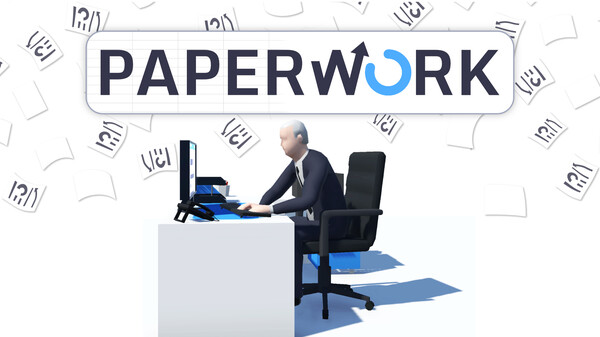
Paperwork is a first-person office-building incremental game where you optimize an office to generate more and more money. Step into the office of Clarity, become a productive worker and watch profits grow.
Modeled estimate, not a reported figure. How we estimate →
Media

About
Welcome to Clarity™Paperwork is a game about corporate growth.
Discover the office of Clarity™ as you join the company to lead a new division towards profit.
Build and place desks of various kinds, supports and meeting rooms to increase the office productivity.
Optimize your income using different synergies between adjacent desks.
Grow, grow and grow!
Clarity™ is expecting big and you are not letting us down.

Features:
4 office levels to explore and build into!
40+ upgrades to unlocks.
10+ desks, machines and rooms to place.
15+ different synergy bonuses that can be combined for the most efficient profit.
Stats
All-time low is the lowest price we've recorded for this game since we started tracking it.
Languages: English**languages with full audio support
Engagement
Hours played at review time, across 42 reviews with recorded playtime.
Reviews
Themes across 42 recent reviews and how positive each mention is. A keyword signal, not full sentiment analysis.
positive critical· bar length = how often the theme comes up
Reviews
build your own corporate hell
Good work! You're probably looking at this during a steam sale. It's worth it. Fun little puzzle game. Wish there was a sandbox so I could practice maximizing profits.
Fantastic puzzle game. It has money and efficiency in mind with a puzzle twist. 10/10 recommend.
Reminds me of my office days. The office, I remember when they first invited me to the office, sweet sweet office. I ALWAYS HATED IT! All jokes aside, this game is a lot of fun. Definitely worth the money.
Paperwork takes one of the most mundane concepts imaginable—corporate office management—and somehow turns it into a strangely addictive incremental simulation. Developed by Broken Record Studio, the game places players inside the sterile corporate world of Clarity™, where the goal is simple: maximize productivity, expand operations, and generate endless profit through increasingly efficient office layouts. What initially appears to be a straightforward idle management game quickly evolves into a satisfying optimization experience built around careful planning, synergy systems, and constant progression. The central gameplay loop revolves around constructing office spaces and arranging furniture in ways that maximize employee efficiency. Desks, printers, coffee machines, support stations, and meeting areas all interact with one another through bonus systems that encourage experimentation. Small layout adjustments can dramatically improve profits, turning even simple office redesigns into engaging strategic puzzles. The game constantly rewards players for refining their setups, and that steady stream of optimization creates an addictive “one more improvement” mentality that drives the entire experience forward. One of the game’s strongest qualities is how naturally its progression unfolds. Players begin with a tiny office and very limited resources, but over time they unlock larger workspaces, advanced productivity tools, and increasingly profitable systems. New upgrades consistently feel meaningful because they directly affect efficiency and income generation. Instead of overwhelming players with complicated mechanics immediately, the game introduces new concepts gradually, allowing the office to evolve in complexity at a satisfying pace. The first-person perspective also helps Paperwork stand out from most other incremental games. Rather than managing systems entirely through menus and spreadsheets, players physically walk through the offices they build. This creates a stronger sense of immersion because the player can directly observe the spaces they design. Rows of desks, glowing monitors, fluorescent lighting, and endless office noise all contribute to a strangely believable workplace atmosphere. Watching employees operate inside carefully optimized office layouts gives the game a unique sense of scale and progression that many menu-driven idle games lack. Beneath the gameplay systems lies a layer of subtle satire aimed at corporate culture and productivity obsession. The game constantly surrounds players with exaggerated business language, motivational slogans, and efficiency-focused upgrades that gradually become absurd. The humor works because it remains understated rather than overly exaggerated. Players slowly realize they have become obsessed with maximizing office productivity in exactly the same way the fictional corporation encourages. That self-aware design gives the game personality beyond its incremental mechanics. Visually, the game embraces a clean minimalist style that suits its corporate setting perfectly. Offices are simple but functional, with enough detail to make each room feel believable without cluttering the screen. Furniture and productivity systems are easy to identify, which becomes increasingly important as offices grow larger and more complex. The sterile visual design also reinforces the game’s satirical tone, creating an environment that feels simultaneously ordinary and strangely dystopian. The sound design contributes heavily to the atmosphere as well. Keyboard typing, printer sounds, air conditioning hums, and distant office chatter create a constant background noise that makes the workplace feel alive. Combined with the repetitive cycle of optimization and expansion, the audio helps reinforce the feeling of existing inside an endless corporate machine built entirely around productivity and profit. Another strength is the game’s pacing. Many incremental titles eventually become bloated with countless currencies, endless prestige systems, and overly complicated mechanics. Paperwork avoids this problem by keeping its progression relatively focused. It introduces enough new features to remain engaging while maintaining a manageable level of complexity. The game also has a more structured progression arc compared to endless idle games, which helps prevent burnout during long sessions. However, the simplicity that makes the game approachable can occasionally reduce long-term variety. Once players fully understand the synergy systems, much of the later gameplay revolves around refining layouts and maximizing percentages rather than discovering entirely new mechanics. Some players may also find the first-person movement slightly less efficient than traditional top-down management interfaces, especially when redesigning large offices repeatedly. Despite these limitations, Paperwork succeeds because it fully embraces its unusual premise. It transforms repetitive office management into a satisfying progression-focused puzzle where every desk placement and productivity bonus matters. The game understands the strange appeal of optimization and builds an entire experience around that satisfaction without overcomplicating the formula. For fans of incremental games, management simulators, and optimization-focused gameplay, Paperwork delivers a surprisingly entertaining experience hidden beneath its intentionally ordinary setting. Its combination of immersive office building, addictive progression systems, and subtle corporate satire creates a unique identity that separates it from more traditional idle games. What should feel repetitive instead becomes oddly difficult to stop playing, proving that even office paperwork can become compelling when paired with clever design and rewarding progression. Rating: 8/10
I love running a workplace democracy.
While it was fun. - IT'S BARELY A CLICKER AND AUTOMATION GAME You might see the theme being business and while the numbers goes up, it really isn't an automation game. The game is one big puzzle. You do have to figure out how to "Synergize" the different type of work stations for them to earn more money. And yes in the first 30 minutes, money might feel scarcity - but the rest of the game you are always going to have enough. Like everyone else has pointed out, the game is way too short. I just think that you way to easy earn money, and you can basicly buy the next thing right when you finish an area. I would have loved this to be a little bit more idle/afk-able. I didn't like that it was divided up in 4 levels. I would have loved for it all to be one big level, with the same money counter going up. Although i liked figuring out level 4, would have been better to combine all the levels somehow. The balancing part at the end felt a little uncreative and just filler part for completionist players. While the Synergizing part was fun in the beginning, it slowly felt less rewarding and more chaotic towards the end, especially in the balancing part. I might have had the wrong expectations going into this game, thinking it was going to be more of a idle-like game - but I still had fun though.
le jeu est super mais j'ai pas réussi à trouver le fichier de sauvegarde, ayant deux ordinateurs c'était un peu obligatoire pour pouvoir jouer sans jouer deux fois au jeu :/ mais si vous avez qu'un ordinateur je vous le recommande ! (ou attendre une update pour la sauvegarde steam)
Enfin un jeu qui sort du lot, ce jeu me fait penser à autre chose que le travail habituel, si vous cherchez un jeu mixant détente et réflexion c’est fait pour vous !
игра норм, чувствуется сырость в ней, ещё один чел сказал что ей не хватает тёмного режима, и я с ним согласен
Related
Related
Trends
Concurrent players on Steam, sampled daily since tracking started.
Momentum
Pace estimated from the game's recent review growth (our daily snapshots) at its own sales-per-review ratio — a momentum signal, not booked sales.
Audience
Estimated from the language of this game's reviews — a proxy for where players are, not official Steam demographics.
Related
| Master Spy | $8.9K | 397 | 78% | $0.99 |
| The Rivers of Alice - Extended Version | $8.9K | 105 | 78% | $4.99 |
| SWORDCAR | $8.9K | 96 | 98% | $4.99 |
| Cozy Twinkie | $8.9K | 81 | 83% | $2.99 |
| Tamagoneko | $8.9K | 72 | 90% | $5.99 |
| Magicians And Monsters | $8.9K | 72 | 67% | $5.99 |