Guide your very own civilization's destiny in this abstract strategy sim. Master a complex node system, overcome unique challenges, and evolve your society from humble beginnings to the mastery of the atom. Can your civilization *really* withstand the test of time?
Modeled estimate, not a reported figure. How we estimate →
Media

About
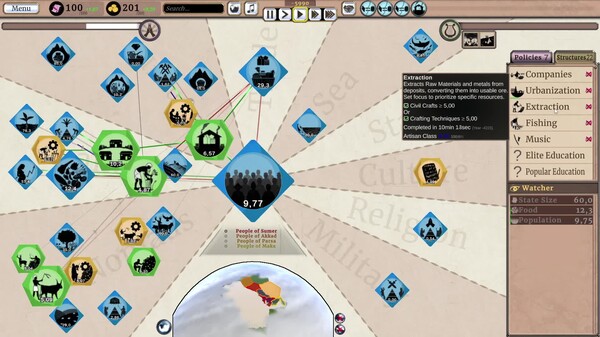
Orbi Universo II is a deep management-simulation-strategy game that puts you at the forefront of history itself. Through an innovative node-based system, you'll guide your society from the Neolithic era to the Atomic Age, making impactful decisions that ripple through time.
Harness a unique node system where every aspect of your civilization interacts in meaningful ways
Watch as your decisions create cascading effects across your society
Balance countless interconnected elements: from agriculture and commerce to religion and warfare
Navigate the delicate dance between stability and progress
Shape your civilization's unique cultural and religious traits
Each region has its own local resources and nodes
Adapt to your environment and create truly distinct societies
Challenge historical assumptions and craft your own alternate history
Engage with rival civilizations across a dynamic world map
Wage wars through tactical battle choices
Forge diplomatic alliances and trade relationships
Secure crucial resources through commerce or conquest
Abstract visual style that emphasizes clarity and readability
Multiple play styles
Diverse soundtrack inspired by many different cultures, evolving with you
Rich emergent storytelling through systemic interactions
Building upon the success of the original Orbi Universo, this sequel expands every aspect of the game while maintaining its unique identity. With completely rebuilt systems, enhanced visuals, and deeper gameplay mechanics, Orbi Universo II offers both veterans and newcomers an unparalleled civilization management experience.
Can you navigate the complex web of society's interconnected systems? Will your civilization flourish or falter under the weight of its own complexity? The destiny of your people awaits you.
Genres
Stats
All-time low is the lowest price we've recorded for this game since we started tracking it.
Languages: English, French, Japanese, German, Simplified Chinese, Traditional Chinese, Spanish - Spain, Spanish - Latin America
Engagement
Hours played at review time, across 40 reviews with recorded playtime.
Reviews
Themes across 40 recent reviews and how positive each mention is. A keyword signal, not full sentiment analysis.
positive critical· bar length = how often the theme comes up
Reviews
The big downside is the UI is simply offensive. I need a lot more room and some always-on or always-available displays like a pie chart of my population and lists of resources. Too much time is spent doing a mouseover to see things. The main enemy is the UI and based on conversations with the developer that’s the point. Making it tedious to find information is the design. For this, I recommend against buying the game. Don’t waste your time. It’s a good model hidden by a deliberately awful UI. The game has promise and it's so weird compared to most games I am almost compelled to support it. The arrogance of the developer quells that desire quickly. The UI is garbage-tier and the developer is insistent that it’s good. The model and the relationship between the nodes mostly makes sense, so I never felt like I was being screwed over by unreasonable mechanics. The opacity by design though makes understanding those mechanics difficult and somehow the developer wrongly thinks this makes for interesting gameplay.
I've really enjoyed the concept devs are going for here, but the simulation is so unbalanced I cannot recommend this. The polish of it is on the level of an early access release, not a full release. As other reviews said, it is very easy to snowball and eclipse AI, due to the cascading effects of nodes accumulating exponentially. However, some interactions between them feel really underdeveloped: 1. The influence taxes have on the economy is inconsistent. Taxation in Kind, Sales Tax and Trade Tax all have some effect on the respective economic facet (although it is really, really minor, so they would not be able to break an industry), but Direct, Wealth Tax and Religious Dues only impacting population opinion and that's it? Wild. 2. Your industries do not follow the supply and demand model. It is really easy to get a situation where your factories are just keep growing (mainly because of the Companies node), but there is no resources to keep up with it, and there is no actual demand for their production, thus spinning the system out of control unless you de-industrialize somehow. You'd think that in the absence of demand or command economy style state investment industry would just stop growing or shrink, but no. 3. Basically the same can be applied to the military industrial complex. You can limit your army size, but the industry will just keep pumping out military goods into the ether, while draining your economy of resources. You have a bit more control in the size of the MIC, but still - would be great if it could follow actual supply and demand instead of arbitrary modifiers that keep it growing. 4. The game really lacks an option of just abandoning supplying nodes with money and power. You can under-fund them and get back 50%, but I don't think it is really unprecedented in history where a government would just drop sustaining something and it falls apart quickly, albeit with some harsh transition period. Here, defunding or dismantling something always costs more resources on top, which makes escaping a crisis problematic. Not that it really matters since game is really easy. I could probably bring up much more stuff, but that would take too much time. Even if some interactions seem minor, them not interacting in a realistic and predictable way compounds rather quickly. Great idea on paper, but if you're into "number goes up infinte optimization" like I am, all of these issues get really annoying really quickly. Hope the devs would spend some considerable time into just running simulations and figuring out how everything works and what do interactions lack.
総評としてはゲーム全体を通して、前作より抽象度が増している。 前作は定められた歴史の流れを追体験する要素が強かったが、本作ではそういったストーリーラインが意図的に薄められている。新たに追加された地図により、拡張先を任意に選べるようになったのは大きいとおもう。前作に比べ戦略の幅は格段に広がったと思う。 一方で、現状のAIは特に中盤に物足りなさを感じる場面があった。ゲームの自由度が高い分、それに応じた手応えのあるAIがあると嬉しい。今後のアップデートに期待したい。
It's a cool game, but it's too easy to eclipse the AI if you have any idea what you're doing. Increasing the difficulty, and changing other settings, just makes it more contentious in the beginning, but eventually you're going to snowball until the AI can't provide any challenge. The game starts to feel like a puzzle that you've already solved. The devs need to focus on improving the AI's performance over time so that it stays at least moderately challenging throughout the game.
I finally had the chance to dive into Orbi II, and honestly, it feels like a true evolution compared to the first game. The improvements are immediately noticeable, not only in terms of accessibility but also in overall ergonomics. The whole experience is smoother, more intuitive, and therefore much more enjoyable to play. One of the features I really appreciated is the ability to pre-place nodes within specific zones. It might sound like a small detail, but it has a big impact: everything becomes clearer, more strategic, and less frustrating. The improved readability of the interface also contributes to a feeling of control and precision that the first game didn’t quite reach. Another big highlight is the war system. While simple in its mechanics, it’s surprisingly effective and adds an important strategic layer that was sorely missing in the original game. It gives more weight to decisions, creates tension at the right moments, and really enriches the flow of the game. The introduction of the trait system also stood out for me. It creates genuine dilemmas and adds depth to decision-making: choosing one path often means sacrificing another, which pushes you to think carefully about your long-term strategy. It’s a clever addition that reinforces replayability and makes each run feel different. In short, I already thought the first Orbi was a very cool and promising game, but Orbi II takes the concept further, polishing it and giving it more depth. You can really feel the developers’ effort to refine their ideas and expand the game’s identity. It’s tighter, smarter, and more rewarding. If you liked the first one, this sequel is a no-brainer. And if you’re new, this is definitely the best place to start.
前作が好きだったので楽しみにしていたが、UI/UXが非常に悪い。ゲーム性や新要素(文明特性・研究・ノードなど)は残し、UIは前作同様に戻して欲しい。 - 見たい情報が散逸して視点移動だけで疲れる。政治・経済・文化と、次の研究・アンロック条件は画面片側にまとめて欲しい。 - 画面の最大スクロールアウトが狭すぎる。全体像が見えないので操作が疲れる。アイコンを隠す操作も自動で付与されたタグをマウスホイールクリックで隠すだけなので、扱いづらい - 今作はアイコンが自動でタグ付け・整理されるようになり、前作の「汚いデスクトップを整理するアイコン片付けゲーム」のような楽しいプレイ感が消えてしまった。 - とにかくノードへの自動タグ付け・ウォッチリスト登録が邪魔すぎる。プレイヤーの整理整頓をゲーム側の自動登録で破壊されるのが不愉快。前作のように、「時代が進むとどんどん複雑になる国家経営を、プレイヤーが自分の頭で必死に整理する体験」に戻してほしい。 - 難易度調整が常に画面上に表示されるのはゲームとして如何なものか。とくに簡単モードは実質資源無限なので、辛いときに目に触れる位置にあるのは具合が悪い。 - 世界地図を誤クリックしてしまい自国を見失った。自国の地球の裏側などはスクロールできなくして欲しい。ホームポジションが無いので、数分探したが自国が見つからずやる気が失せた。
旧作に比べ領土システムの改善や文化や宗教などのボーナス、他にもほかの文明が明確に存在し外交により食料を輸入したりもできるなどゲームシステムは非常に面白くなった。ただユーザーインターフェースが少し使いずらかったりセーブの際たびたびフリーズするなどの問題はあります。 全体的に良い出来なのでシュミレーションゲームが好きな人なら買ってみるのもいいでしょう、特に前作のファンにとっては素晴らしい出来だと思います。
Fun game, I really enjoyed my time with it. My only concern is Im done with it. There are some cool things I could try but they dont seem interesting. I fully finished a run, conquered as much as I wanted. I recommend to play, really fun; tho I dont recommend paying this much for it. Either the dev needs to add more to it, or discount it.
Ui felt clunky and poor quality, could not find a correct resolution for my monitor, felt much more opaque and clunky to invest in nodes as opposed to one
I cant stop playing!
Related
Related
Trends
Concurrent players on Steam, sampled daily since tracking started.
Audience
Estimated from the language of this game's reviews — a proxy for where players are, not official Steam demographics.
Related
| 7 Days to Die | $425.3M | 403.5K | 87% | $44.99 |
| Mount & Blade II: Bannerlord | $309.8M | 293.9K | 88% | $49.99 |
| RimWorld | $149.6M | 205.9K | 98% | $34.99 |
| Don't Starve Together | $130.6M | 373.1K | 95% | $14.99 |
| Satisfactory | $164.4M | 275.8K | 97% | $27.99 |
| Hell Let Loose | $51.5M | 148.7K | 82% | $17.49 |
Related
| SOUL COVENANT | $69.7K | 55 | 75% | $49.99 |
| Virtual Ties: Isekaijoucho Träumerei | $69.6K | 97 | 91% | $34.99 |
| TOTALLY BASEBALL | $69.6K | 176 | 88% | $14.99 |
| Diary of Lucie | $69.7K | 444 | 88% | $12.99 |
| Naughty College 18+ | $69.6K | 224 | 54% | $9.99 |
| Bot Studio for Discord | $69.7K | 476 | 78% | $9.99 |