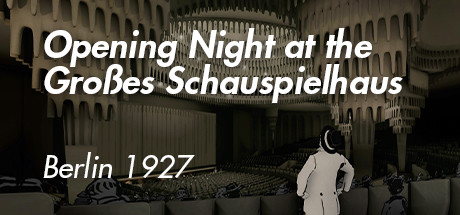
Visit Berlin 1927 and explore the VR-reconstruction of the famous theatre. Three storytellers, Walter, Fritzi and Otto, invite you to share their anticipation of the opening night – behind the scenes and on stage. Our digital theatre opens new perspectives; cultural heritage comes alive virtually.
Revenue comes from in-game items and microtransactions, which our price-based model doesn't estimate. Copies below reflect the player base, not paid sales.
Media

About
Genres
Stats
Languages: English, German**languages with full audio support
Engagement
Reviews
Ein Abend im Großen Schauspielhaus - Berlin 1927 von digital.dthg ist ein ganz schön sperriger Name für eine informative Reise in das ehemalige Theater. https://steamcommunity.com/sharedfiles/filedetails/?id=2509572779 Wir befinden uns also in den 20er Jahren des letzten Jahrhunderts in Berlin. Die Erfahrung lässt den Betrachter eine Premierefeier im Großen Schauspielhaus anhand dreier Protagonisten etwas persönlicher erleben. Walter, ein gewöhnlicher Berliner, der seinen ersten Besuch im Theater überhaupt erlebt. Er ist vorher lieber ins Lichtspielhaus gegangen. Fritzi, die Grande Dame der Premiere und eine berühmte Berliner Diva ihrer Tage. Die laut Presse wohl auch bald die letzten hat. Und Otto, einem Lichtarbeiter, der seinen Arbeitsplatz hoch oben über der imposanten Bühne hat und seiner geliebten Tänzerin aus dem Ensemble hinterherschmachtet. https://steamcommunity.com/sharedfiles/filedetails/?id=2509570261 Ein wirklich guter Sprecher, führt den Zuschauer durch die drei einzeln auswählbaren Geschichten. Auch die Sprecher der drei Rollen und alle anderen sind sehr professionell. Wir können uns allerdings dabei zu keiner Zeit wirklich selbst bewegen oder mit irgendetwas interagieren. Wie auf Schienen fahren wir sehr langsam durch das weitläufige Große Schauspielhaus. Motion Sickness kann hierbei kaum auftreten, lediglich der am Ende jeder Geschichte stattfindende Rundflug durch den Theatersaal könnte evtl. bei Menschen mit Höhenangst etwas für Unwohlsein sorgen. Allerdings ist die gesamte Darbietung in wenigen weichen Farbtönen der eher braunen Farbfamilie dargestellt und die Figuren sind tatsächlich nur Pappkameraden, keine 3D-Modelle. Die Figuren sind im Gegensatz zur Umgebung dann auch nur mit dem Filzstifft gekritzelt. Sie sollen wohl wie schnelle Skitzen eines Modeartdesigners der 1920 aussehen, aber mir hätten dreidimensionale Figuren wesentlich besser gefallen, als diese langweiligen Pappaufsteller. Diese hätte man auch individuell gestallten können. Das ganze Große Schauspielhaus ist insgesamt sehr detailarm, trotz der tollen organischen Architektur. Ich war erst etwas enttäuscht ob der fehlenden Details, aber Aufnahmen aus dem original Gebäude der Zeit sehen dieser virtuellen Kopie sehr ähnlich. Einzig die großen Pfeiler, die überall im Gebäude stehen sind mit Stuck aus Wellen verziert. https://steamcommunity.com/sharedfiles/filedetails/?id=2509571213 Wir werden jeweils von dem selben Intro, mit einer kleinen Vorgeschichte zur Entstehung der Idee zum Gebäude, in die verschiedenen Geschichten eingeführt. Das man dieses nicht abbrechen kann ist wohl der Tatsache geschuldet, dass das Programm auch im öffentlichen Raum, z.B. Museum oder Ausstellungen genutzt werden kann und die Geschichten frei wählbar sind. Somit verpasst man keine Information, wenn man z.b. nur Zeit für eine Geschichte hat, weil hinten eine Schulklasse rumschreit. Daher gibt es auch keine Möglichkeit der Bewegung. Man kann zu Beginn nur per Kopf die Sprache auswählen. Deutsch oder Englisch. Die Performance ist leider nicht so gut, wie man es erwartet hätte. Denn Grafisch bietet das Programm nicht sehr viel. Schraubt man in SteamVR die Supersampligrate hoch, weil die wenigen Texturen doch etwas verwaschen sind, ruckelt die Erfahrung doch merklich. Der Informationsgehalt des Programms ist hoch, die Geschichten interessant genug, dass man Lust hat sie sich anzuhören und es ist umsonst. Daher gibt es im Review hier einen Daumen hoch. Weil mit aber die Darstellung mit den Pappfiguren nicht gefällt und es Performanceschwächen gibt, im Kurzreview ein Informativ. Mehr 👀[url=https://store.steampowered.com/curator/32170554/]aus den Goldenen 1920 [/url] auf meiner Kurator Seite. 👑 Powered by HoI 4 Deu Curators group in German / English 👑⠀⠀⠀[list][*] [url=https://store.steampowered.com/curator/30388691/] Follow Main group [/url][*] [url=https://store.steampowered.com/curator/40282064/] Follow Second group [/url][/list] [u]English:[/u] --------------------------------------------------------> An Evening at the Grosses Schauspielhaus - Berlin 1927 by digital.dthg is quite an unwieldy name for an informative journey into the former theatre. So we find ourselves in the 1920s in Berlin. The experience lets the viewer experience a premiere party at the Großes Schauspielhaus a little more personally through three protagonists. Welter, an ordinary Berliner experiencing his first ever visit to the theatre. He preferred to go to the cinema before. Fritzi, the grande dame of the premiere and a famous Berlin diva of her day. Who, according to the press, will probably soon have her last. And Otto, a lighting worker who has his workplace high above the imposing stage and pines after his beloved dancer from the ensemble. A really good narrator guides the audience through the three individually selectable stories. At no time can we really move ourselves or interact with anything. We travel very slowly through the spacious Great Playhouse as if on rails. Motion sickness can hardly occur here, only the flight through the theatre at the end of each story could possibly cause some discomfort for people with a fear of heights. However, the entire performance is presented in a few soft shades of the rather brown colour family and the figures are actually only cardboard cutouts, not 3D models. In contrast to the surroundings, the figures are then also only scribbled with a felt-tip pen. They are probably supposed to look like quick sketches by a fashion designer of the 1920s, but I would have liked three-dimensional figures much better than these boring cardboard stand-ups. These could also have been individually designed. The whole Great Playhouse is very poor in detail overall, despite the great organic architecture. I was a little disappointed at first because of the lack of details, but pictures of the original building of the time look very similar to this virtual copy. Only the large pillars that are everywhere in the building are decorated with stucco made of waves. We are introduced to each of the stories by the same intro, with a little back story about how the idea for the building came about. The fact that you can't interrupt this is probably due to the fact that the programme can also be used in public spaces, e.g. museums or exhibitions, and the stories are freely selectable. So you don't miss any information if, for example, you only have time for one story because a school class is shouting at the back. Therefore, there is also no possibility of movement. At the beginning, you can only select the language by head. German or English. Unfortunately, the performance is not as good as one would have expected. Graphically, the programme doesn't offer much. If you turn up the superamplification rate in SteamVR because the few textures are somewhat washed out, the experience is noticeably jerky. The information content of the programme is high, the stories interesting enough to make you want to listen to them, and it's free. Therefore, the review gives it a thumbs-up. However, because I don't like the presentation with the cardboard figures and there are performance weaknesses, the short review gives it an informative. More 👀[url=https://store.steampowered.com/curator/32170554/]from the Golden 1920[/url] on my curator page. 👑 Powered by HoI 4 Deu Curators group in German / English 👑⠀⠀⠀[list][*] [url=https://store.steampowered.com/curator/30388691/] Follow Main group [/url][*] [url=https://store.steampowered.com/curator/40282064/] Follow Second group [/url][/list]
Related
Related
Trends
Concurrent players on Steam, sampled daily since tracking started.
Hours played at review time, across 24 reviews with recorded playtime.
⠀
[h1]Experienced on the Oculus Quest 2[/h1] This is a purely 360 cinematic experience in VR with no interactions. Whole thing takes about 30 minutes. You basically have 3 different historical perspectives on the Groben Schauspielhaus (theater) - one from a fan in the crowd, one from the stage actress, and one from the lighting backstage. You basically use gaze based perspective to choose which of the three you want to see and also what language. The experience does have voice narration in German and you can choose English sub-titles. All 3 selections start with the same intro, but you can skip it (although there is a bug when you try to skip on the lighting backstage where the app crashes or just hangs). Experience is running on the Unity Engine. On my RTX 3080, I was getting severe variable frame rates from 90 to 20 fps, which did effect my experience. I got several jaggies as well. Unfortunately, this pretty much made the experience not that pleasant. Also, the material is pretty dry unless you're just really into theater history. The art style just wasn't very impressive either. [b]Rate 4.5/10. I mean it was free. However, I don't really recommend it unless you're really into the subject matter and you're okay with the above bugs / limitations. [/b]
Opening Night at the Großen Schauspielhaus - Berlin 1927 is a free VR experience. It worked on my HTC Vive and Index and Meta Quest 3 via Steam Link system, looked ok, played ok, sounded ok, was understandable. This only has German voice overs from four or more persons, with English subtitles. This program has gaze controls only and does not use the tracked hand controllers, but did not need the keyboard also. This program has you moving on rails and turning around all over the place. You will have to go through the same Intro and Outro three times when viewing the three different tracks. Takes about 30 minutes to complete. Warning: some people might get motion sick using this program. Try it for free, if you understand German and interested in theater history.
I enjoyed going back to the great 1920s. I tried the 3 persons in the German language option. Very nice done.
"Opening Night at the Großen Schauspielhaus - Berlin 1927" is not a game. Games contain meaningful gamelike interaction and game loops, which are absent in this software. This application gives you a short virtual tour of the Grosse Schauspielhaus in Berlin, with some voice work by tired actors wondering how it came to this, who go over how excited they are to be watching the opera 100 years ago. For those unfamiliar with what actually makes something a game, a "game loop" describes the interaction and feedback a gamer has when playing a game. Tetris, for example, has a game loop where a random block appears, the gamer interacts with the block to position it, and then the game decides if that finishes a row or not, increases the players score if any rows were completed, then gives the gamer another block to position. Counter-Strike has a game loop where a player seeks another player, tests their skill against that player by shooting them or being shot, the computer rewards the player if they win, and then if the player survives, they repeat that loop. There's no loop here, no true interactive feedback. It simply is not a game, it cannot be "played". This has misleadingly been launched in the "Games" section of Steam instead of the "Software" section. This is a common mistake for developers who are new to Steam, or don't understand the difference between games and software which isn't a game. It seems this software published incorrectly as a game is simply lack of experience/knowledge of the correct process. Here's a link for the process to publish non-game software on Steam: [url=https://help.steampowered.com/en/wizard/HelpWithPublishing?issueid=925]Steam Developer Help With Software Publishing[/url] It's unfortunate this process was not known about/followed, resulting in a software application being published in the wrong place. Publishing things which aren't games on Steam in the Games section as games is misleading to gamers and somewhat harmful, because it pollutes the Steam marketplace and takes away visibility and market exposure for genuine game developers who do the right thing and make games for gamers. There are no gameplay loops in this software, no "gameplay", no meaningful game like interaction. It's a software application and as such has no merits as a video game for gamers. Because of this, I cannot recommend this non-game software as a game to gamers.
Großen Schauspielhaus - Berlin 1927'deki Açılış Gecesi ücretsiz bir VR deneyimidir. HTC Vive sistemimde çalıştı, iyi görünüyordu, iyi çalındı, iyi ses çıkardı, anlaşılırdı. Bu sadece dört veya daha fazla kişiden İngilizce altyazılı Almanca seslendirme içeriyor. Bu program yalnızca bakış kontrollerine sahiptir ve paletli el kumandalarını kullanmaz, ancak klavyeye de ihtiyaç duymaz. Bu program, raylar üzerinde hareket etmenizi ve her yerde dönmenizi sağlar. Üç farklı parçayı görüntülerken aynı Intro ve Outro'yu üç kez geçmeniz gerekecek. Tamamlanması yaklaşık 30 dakika sürer.
its a short but nice and comfortable experience back to the pre-war berlin. the building and theater was one of the most impressive and innovative in its time. it got revived in this game from old pictures and scratches.
Impressively produced historical VR experience. I knew absolutely nothing about the topic but felt like I was transported straight to 1927 Germany. Very immersive use of ambient noise and dialogue, and the scale of the theatre itself was remarkable to experience.
Audience
Estimated from the language of this game's reviews — a proxy for where players are, not official Steam demographics.