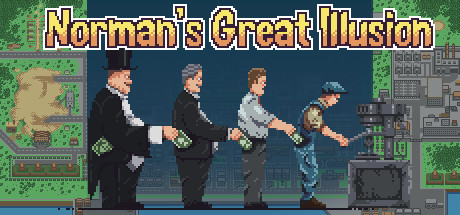
Norman’s Great Illusion is a narrative-focused visual novel developed and published by Civil Savages that explores political tension, personal responsibility, and social instability through a grounded and often uncomfortable interactive story. Rather than relying on action sequences or traditional gameplay systems, the experience builds itself around decision-making and consequence, placing players inside the life of an ordinary person living through increasingly uncertain times. The result is a story-driven experience that aims less to entertain through spectacle and more to encourage reflection about society, ideology, and individual choices.
Players step into the role of Norman, a factory engineer whose daily routine slowly becomes complicated by growing unrest and division surrounding him. The story begins from a relatively ordinary perspective, deliberately avoiding grand hero narratives or world-saving objectives. Norman is not presented as an extraordinary figure. Instead, he represents an average citizen attempting to navigate difficult circumstances while balancing personal values, work responsibilities, and changing social conditions.
One of the strongest aspects of Norman’s Great Illusion comes from how effectively it captures the feeling of uncertainty. The narrative steadily builds tension without depending on dramatic twists or explosive moments. Everyday interactions begin carrying greater weight as external pressures gradually influence Norman’s decisions. Small conversations and seemingly minor choices slowly develop into larger consequences, reinforcing one of the game’s central themes: individual actions matter more than they may initially appear.
Choice-driven storytelling serves as the foundation of the experience. Decisions influence relationships, events, and long-term outcomes throughout the narrative. Rather than offering simple morality systems where choices clearly represent good or bad outcomes, Norman’s Great Illusion often presents situations with no completely satisfying answer. Players are encouraged to weigh priorities carefully and accept that decisions may create consequences that are difficult to predict.
The branching structure strengthens replay value considerably. Multiple endings encourage experimentation and create opportunities to view situations from different perspectives. Returning to earlier choices often reveals how dramatically outcomes can change depending on player behavior. This approach gives the story additional depth while reinforcing the game’s broader themes surrounding responsibility and social influence.
Political and social commentary play a major role throughout the experience. The game openly explores difficult topics connected to society, ideology, economic pressure, and political division. Rather than keeping these ideas hidden beneath symbolism alone, Norman’s Great Illusion actively engages with them. The story frequently challenges players to consider larger systems surrounding Norman’s life and how individuals respond when those systems become unstable.
The writing carries much of the game’s emotional weight. Dialogue emphasizes realism and gradual escalation rather than dramatic exaggeration. Conversations often feel grounded and personal, helping establish stronger immersion despite the relatively simple presentation style. Civil Savages clearly prioritizes thematic depth over spectacle, and much of the game’s effectiveness comes from its willingness to remain focused on uncomfortable questions rather than easy conclusions.
Visually, the pixel art presentation complements the narrative direction surprisingly well. Character designs and environments remain relatively simple but effective, creating a subdued atmosphere that supports the heavier themes without overwhelming them. The visual approach allows attention to remain centered on choices and dialogue rather than distraction through technical presentation.
Smaller gameplay diversions occasionally appear to break up pacing, but Norman’s Great Illusion remains firmly rooted within visual novel traditions. Players expecting complex mechanics outside decision-making systems may find the experience limited mechanically. The emphasis remains almost entirely on story progression and personal interpretation.
The game’s greatest strength ultimately comes from commitment to its ideas. Norman’s Great Illusion does not attempt to appeal universally or soften difficult subject matter for broader accessibility. It openly explores social issues and ideological tension while trusting players to engage thoughtfully with the material. That ambition gives the game a distinctive identity compared to more conventional narrative experiences.
At the same time, its focused direction naturally limits its appeal. Players looking primarily for gameplay depth or fast-paced progression may struggle with its slower structure. Some may disagree strongly with certain viewpoints or interpretations presented throughout the story. The game intentionally invites discussion, and not every player will respond to its themes in the same way.
However, players interested in story-heavy experiences built around consequence, reflection, and social themes may find Norman’s Great Illusion surprisingly memorable. Its willingness to challenge players intellectually gives it an identity that remains distinctive long after completion. Rather than offering escapism alone, it asks difficult questions about people, society, and responsibility without pretending simple answers exist.
Norman’s Great Illusion succeeds by fully embracing its purpose as an interactive narrative built around thought-provoking ideas. It delivers a grounded and emotionally reflective experience that prioritizes meaningful storytelling over conventional entertainment design, creating a visual novel that feels personal, uncomfortable, and surprisingly relevant.
Rating: 6/10