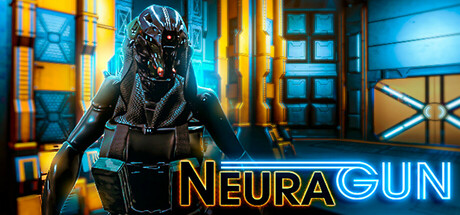
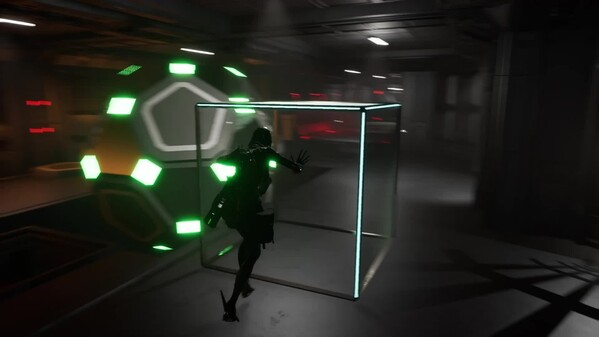
NeuraGun is an atmospheric sci-fi puzzle adventure developed and published by Whale Rock Games, presenting itself as a minimalist, enigmatic journey through a cold and cryptic research facility. Rather than relying on exposition, the game drops you into a sterile technological labyrinth with little explanation of who you are, what happened in the complex, or why your path forward is blocked by elaborate security mechanisms. This ambiguity becomes the driving force behind the experience: each door you open, corridor you traverse, and room you unlock hints at a larger mystery hidden behind layers of steel, neon lighting, and malfunctioning machinery. The result is a game built around mood and environmental tension rather than traditional narrative clarity.
Gameplay centers around environmental puzzles that test spatial reasoning rather than reflexes. Much of NeuraGun’s design revolves around interacting with cubes, pressure pads, laser grids, and security sensors in order to open doors or activate new areas. You frequently manipulate objects using a gravity-gun-like tool that allows you to lift, reposition, or throw blocks across the environment. While this mechanic promises a level of physical puzzle-solving reminiscent of genre classics, the actual implementations tend to focus on basic placement challenges—slotting the right object into the right receptacle, triggering color-coded sequences, or finding the correct order of switches. At its best, the game invokes a sense of discovery as you test the environment and slowly piece together what each room expects you to do. At its worst, the puzzles can feel directionless due to limited feedback, forcing players to rely on trial and error rather than cleverly deduced solutions.
One of NeuraGun’s strongest qualities is its visual presentation. The game leans heavily into a sleek, neon-tinged aesthetic, combining sterile laboratory corridors with unexpected bursts of color and moody lighting. Chambers glow with blue, purple, and green highlights that give the facility a dreamlike, almost virtual feel. This atmosphere is enhanced by the level design’s verticality and scale—huge rooms with suspended platforms, towering machinery, and cavernous halls reinforce the sense of isolation. For players who enjoy atmospheric exploration, the game’s visual identity offers a compelling backdrop to the puzzles, making even simple rooms feel like part of a larger, ominous whole. Yet the environments can also feel empty, as if awaiting further development; many hallways lack interactive elements or environmental storytelling touches that could have enriched the world’s implied lore.
Despite its sleek visuals, NeuraGun shows its rough edges in both pacing and technical execution. The lack of narrative structure means objectives are often vague, expressed only as brief prompts like “Escape the Neon Jungle,” leaving players to decipher what area that refers to or which obstacle must be solved next. This vagueness contributes to stretches of aimless wandering, especially in larger multi-room hubs where progression depends on noticing a small, easily overlooked detail. Technical issues occasionally disrupt immersion as well—some players report clipping problems, awkward collisions, or uneven physics when manipulating objects. These issues reinforce the impression that NeuraGun is still evolving, with mechanics and systems that feel more like a prototype or conceptual foundation than a fully realized puzzle-adventure.
Nevertheless, the game does offer moments of engagement that highlight its potential. When a puzzle clicks—when you finally understand how a sequence of lasers should be aligned or when a heavy door rumbles open after several attempts—the sense of accomplishment feels earned. The minimalist design gives players freedom to think, experiment, and tinker with the environment without handholding. For those who enjoy figuring things out independently, the lack of explicit guidance may even be a feature rather than a flaw. Combined with its relatively low price point, NeuraGun becomes a curious, atmospheric diversion that rewards patience and a willingness to explore abstract spaces.
In its current state, NeuraGun stands as a project rich with atmosphere but uneven in execution. It offers striking visuals, a mysterious sci-fi setting, and a collection of environmental puzzles that occasionally shine, yet it lacks the narrative context, mechanical depth, and polish needed to elevate the experience to something more memorable. Players seeking a tight, story-driven puzzle game may find it too sparse, while those who enjoy experimental indie projects with strong aesthetics may appreciate what it brings to the table despite its shortcomings. NeuraGun is ultimately a puzzle framework with allure—a game that knows how it wants to look and feel, even if it hasn’t fully found its mechanical or narrative voice.
Rating: 7/10