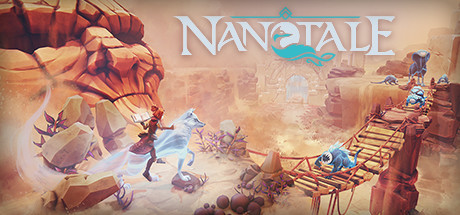
Something is wrong with the heart of magic. Play a young archivist venturing out into a dying world, cataloging its mysteries and its wonders to unearth the truth. Nanotale is the new adventure from the Typing Chronicles franchise and the spiritual successor to the acclaimed Epistory.
Modeled estimate, not a reported figure. How we estimate →
About

Stats
All-time low is the lowest price we've recorded for this game since we started tracking it.
Languages: English*, French, Italian, German, Spanish - Spain, Polish, Portuguese - Brazil, Simplified Chinese, Japanese, Korean, Russian, Hungarian*languages with full audio support
Engagement
Hours played at review time, across 42 reviews with recorded playtime.
Reviews
Themes across 42 recent reviews and how positive each mention is. A keyword signal, not full sentiment analysis.
positive critical· bar length = how often the theme comes up
Reviews
一直打字,会很累_(: 」∠)_
huge
l
[h1] Nanotale delivers a fun time that doesn't quite follow up the predecessor Epistory, it just needed a more solid foundation in order to even match. It's still a fun game, but it does warrant the "warning." [/h1] I did like 'Nanotale,' it continues what 'Epistory' does, not the story itself as it's more of an anthology here, but the game design itself. It's interesting and cool to see, however and I mean a big [b] HOWEVER [/b] this does almost everything worse than the previous title. It just fumbles the bag in a lot of areas, but it still is a fun time and if you liked the previous game you'll probably enjoy this too. Below I will list pros and cons as I think it'll be easier to list and to read as well. Probably more cons as the game is significantly worse than the previous game. I am not categorizing since it's still comparing 'Nanotale' to 'Epistory' for the most part so even though you'll understand, this is how I'm doing it. [h3] + = Good and - = Bad. [/h3] +The game itself feels much smoother to control than Epistory. The animations are smoother so it doesn't feel clunky, you get to navigate faster right from the get-go, etc. -Navigating the maps can be a chore especially when removing fast travel, while it was minimal in Epistory it at least allowed you to go to the start of certain sections, which here it would've been more than appreciated when dealing with convoluted levels. + This is going to be more than subjective, but the aesthetic the game goes with is still more than gorgeous. It really does immerse you here, I don't think I would say it's better than 'Epistory's' as it goes really well with putting you in the story book there, but I wouldn't say this is terrible or worse by any means. - Optimization in this game is absolute garbage. I have no clue what they did here as 'Epistory' ran absolutely fine, this game while it doesn't struggle for the most part, you will have more than noticeable issues. I saw no performance gain going from 'Ultra' to 'Very Low' neither did I see any graphical changes other than shadows being eliminated or just being present. Cutscene audio is not in sync in the beginning of the game and the framerate was terrible until I got into the game itself in which everything ran absolutely fine. The game does stutter during certain boss sections, not in the main game itself, but especially when fighting the guardians during the last level of the game. It's just bonkers here. While I didn't experience any glitches or anything, the performance wasn't exactly great. -/+ For me this is a negative, but it may be a plus considering who you are especially if you might be younger or aren't the average typist or are just looking for something to chill with, but the difficulty in combat is much easier this time around. The first game made the pacing feel natural as you had to learn things in order to slay hordes of enemies while this game you feel like an absolute god right from the beginning. This doesn't feel bad, but if you wanted it to build up like I was expecting, it's just not here. - The pacing is pretty bad here, I'm just gonna be honest. This game places intentional blockades without the ability of interacting directly with things like electrical poles, 'Epistory' let you learn the zap ability specifically to power poles up to open gates, 'Nanotales' makes it to where you have to interact with something else in the environment whether it be an enemy or plants, but you still have to then hit said item directly just causing issues at times being unable to hit it directly even with the ray, large, or spread abilities for the spells. It makes you run around in circles intentionally causing artificial length in gameplay, it just makes you go "What the f**k?" It's just bad when you can see it going on is all. +Achievements are much easier than 'Epistory' if you are an achievement hunter. Literally just play the game through making sure to collect everything and do some side missions. I don't mean to sound overly negative because the game for the most part is good, but it feels like 'Fishing Cactus' took every idea that made 'Epistory' good, but then threw that s**t out the window and made a lot of the game mechanics worse. It just ends up feeling like a title that isn't a "sequel," but feels like a title that was the first, I know it's not technically a sequel, but I hope you know what I mean. It's a good game, but if you were like me and played 'Epistory' first you are more than likely going to go "Oh why didn't they bring fast travel back?" "Oh this doesn't work nearly as good as it did in Epistory!" etc, etc. It just draws comparison for obvious reasons. This ends up feeling like either a sequel the developers just didn't understand what made the first great or it ends up feeling like a sequel that just feels like the first title instead because of how poorly it can be structured. I got both games for $3 altogether so obviously I would recommend. I would recommend regardless, definitely not at $20, but certainly at sale price. It's good but severely flawed, if you are in a pickle of wanted to choose 1, either choose this first because of how poor it is or choose 'Epistory' first for how much better that feels.
Chcesz poprawić swoje umiejętności bezwzrokowego, szybkiego pisania na klawiaturze? To lepiej zagraj w Epistory (tak jakby poprzednia cześć). Nanotale to gra co najwyżej średnia przez różne problemy ze sterowaniem czy błędy w grze (nawet w menu jest informacja, że jeśli postać się gdzieś zablokuje to należy wczytać zapis ostatniego punktu kontrolnego). Kolejna gra, której nie wiadomo jaką ocenę wystawić, bo aż tak źle nie było żeby zasługiwała na negatywa, ale jednocześnie jest męcząca i irytująca przez błędy. Wystawię negatywa dla przestrogi.
Nanotale - Typing Chronicles is a bold and imaginative adventure RPG that fully commits to an idea most games only flirt with: making typing the core of every meaningful interaction. Developed by Fishing Cactus and published by Fishing Cactus alongside PID Games and 2PGames, it expands on the studio’s earlier experiments in keyboard-driven gameplay and presents a world where language itself is power. Rather than treating typing as a novelty or optional input method, the game builds its entire identity around words, transforming the keyboard into a tool for combat, exploration, problem-solving, and storytelling. You play as Rosalind, a young Archivist tasked with exploring a vibrant fantasy world that is slowly being overtaken by corruption. The premise is rooted in discovery rather than conquest, framing your journey around cataloging creatures, studying environments, and uncovering forgotten knowledge. This focus fits naturally with the typing mechanic, as nearly every action requires engaging directly with language. Enemies are fought by typing the words attached to them, spells are cast by entering specific terms, conversations unfold through keyword input, and even environmental interactions demand precise textual responses. The result is a game that feels intellectually active, constantly asking the player to think, read, and react through words. Combat is where the typing system becomes most immediately engaging. Encounters unfold in real time, with enemies displaying strings of text that must be typed accurately to deal damage or apply effects. As battles grow more complex, words become longer, modifiers stack, and multiple targets demand attention at once. This creates a unique tension that blends reflexes with literacy, rewarding accuracy and calm focus under pressure. Spellcasting adds another layer, allowing players to combine typed effects in different ways to control crowds, manipulate the environment, or deal direct damage, turning combat into a kind of linguistic puzzle rather than a test of button-mashing speed. Outside of combat, typing remains just as central. Exploration is guided by textual interaction, from activating ancient mechanisms to nurturing plants that open new paths. Dialogue avoids traditional dialogue wheels, instead asking players to type keywords that reflect curiosity, empathy, or investigation. This design choice subtly reinforces the game’s themes, making the act of communication feel more deliberate and meaningful. Rather than passively selecting options, players actively participate in conversations, which helps the world feel more responsive and alive. Visually, the game presents a colorful and stylized fantasy setting that complements its whimsical premise. Environments are varied and expressive, ranging from lush forests and sunlit plains to eerie, corrupted regions that hint at deeper narrative stakes. The art style is clean and vibrant rather than hyper-detailed, ensuring that on-screen text remains readable even during hectic moments. Subtle animations and sound cues help reinforce feedback, making successful typing feel satisfying and mistakes immediately apparent. Progression is handled through traditional RPG systems, with Rosalind gaining experience, unlocking new abilities, and improving her typing-based toolkit as the journey unfolds. This sense of growth is both mechanical and personal, as increased familiarity with the game’s vocabulary and systems naturally improves performance. Over time, players begin to recognize patterns, anticipate word structures, and type more confidently, creating a rare synergy between player skill and character development. That said, the game’s commitment to typing also defines its limitations. Players who struggle with fast or accurate typing may find the experience demanding, especially during intense combat scenarios. The pacing of the narrative can feel uneven at times, with stretches of exploration that lack clear direction, and tutorials occasionally leave mechanics underexplained. These rough edges can make the early hours feel daunting, particularly for those unfamiliar with nonstandard control schemes. Despite these challenges, Nanotale – Typing Chronicles stands out for its willingness to fully embrace its concept. It doesn’t dilute its identity to appeal to broader tastes, instead trusting players to meet it halfway and engage with its systems on their own terms. When everything clicks, the experience feels genuinely fresh, turning language into a tangible force and making mastery of words as rewarding as mastering combat mechanics in more traditional RPGs. Ultimately, Nanotale is a game for players who enjoy experimentation, wordplay, and thoughtful interaction. It offers a distinctive blend of typing challenge and fantasy adventure that rewards patience, curiosity, and practice. While it may not resonate with everyone, it succeeds as a confident and creative exploration of what games can do when they treat the keyboard not as a passive input device, but as the heart of the entire experience. Rating: 7/10
If you like to type - and are pretty fast - you will love this game :)
Letting my kids play this game to improve their typing skills. they love it! Their typing is definitely improving and they're enjoying the adventure.
I really wanted to love this game because Epistory was great, but something just got lost between then and now. The pacing, difficulty progression, and story were all over the place. New elements and mechanics were introduced in random bunches and then dropped again. I haven't experienced as many bugs as other reviewers mentioned, but the whole thing definitely just felt kind of rushed. I still feel like this studio has a lot of great potential, but this game just wasn't it - all it did was make me want to go back and replay Epistory again instead of continuing this one.
Unfortunately it still doesn't work on Linux, even with proton. I'll happily re-by it and change my review the day it will be.
Related
Related
Trends
Modeled estimate over time, reconstructed from Steam's monthly review histogram.
Momentum
Pace estimated from the game's recent review growth (our daily snapshots) at its own sales-per-review ratio — a momentum signal, not booked sales.
Audience
Estimated from the language of this game's reviews — a proxy for where players are, not official Steam demographics.
Related
| Myst III: Exile | $43.7K | 461 | 94% | $5.99 |
| Praetorians | $43.7K | 704 | 81% | $2.49 |
| Syder Arcade | $43.7K | 695 | 83% | $2.49 |
| Voltaire: The Vegan Vampire | $43.7K | 176 | 66% | $7.99 |
| Niko: Through The Dream | $43.7K | 231 | 73% | $9.99 |
| Zapling Bygone | $43.7K | 110 | 83% | $15.99 |