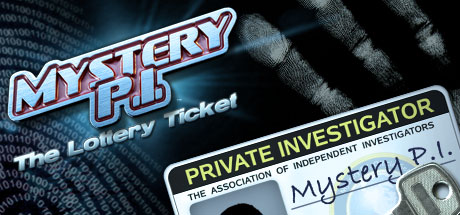
You are the world-famous Mystery P.I. and you've been hired by Grandma Rose to find her $488 million dollar winning lottery ticket that has gone missing! Retrace Grandma's steps to collect clues by finding hidden objects and solving puzzles. Search the city for the clues and piece them together to solve the case.
Modeled estimate, not a reported figure. How we estimate →
Media
About
Genres
Stats
All-time low is the lowest price we've recorded for this game since we started tracking it.
Languages: English
Engagement
Hours played at review time, across 40 reviews with recorded playtime.
Reviews
Amazing. Honestly brings me back to my childhood when I first played it. One of my first PC games, and it's still one of the best!
Game works on Linux using Proton Experimental on this date.. It's a good time waster. My goal is just to unlock the Unlimited Mode. Fun when you play with a group of people especially children.
Mystery P.I.: The Lottery Ticket, developed by SpinTop Games and published by Electronic Arts, is a classic hidden object game that captures the essence of casual puzzle design from its time. It presents a simple premise—a missing winning lottery ticket worth a massive fortune—and builds an entire experience around the act of searching, observing, and piecing together clues through repetition. It does not attempt to innovate or expand beyond its formula, but instead focuses on delivering a consistent and approachable gameplay loop that is easy to understand and engage with. The story is deliberately minimal. Players take on the role of a detective hired to locate a misplaced lottery ticket before it is lost forever. This setup provides a clear objective and a sense of urgency, but it remains largely in the background as the game progresses. There is little in the way of character development or narrative twists, and the investigation itself unfolds through gameplay rather than storytelling. This approach keeps the focus firmly on the puzzles, though it also means the experience lacks a deeper emotional or narrative payoff. Gameplay revolves entirely around hidden object scenes. Each location is densely packed with items, and players must locate specific objects listed on the screen within a set time limit. The challenge comes from the sheer number of objects and how cleverly they are concealed among similar shapes and colors. Early on, this creates a satisfying sense of discovery as players begin to recognize patterns and improve their observational skills. However, the game relies heavily on revisiting the same environments multiple times, each with new object lists, which gradually shifts the challenge from discovery to memorization. To provide some variation, the game includes a selection of mini-games between stages. These range from memory challenges to simple puzzle tasks, offering brief breaks from the main loop. While they help diversify the pacing, they are relatively basic and do not significantly alter the overall experience. They function more as interludes than as meaningful additions, and the core gameplay remains unchanged throughout. The pacing is steady and predictable. The time limit adds a layer of pressure, encouraging players to work efficiently, but it rarely feels overwhelming. As players become more familiar with the layouts and object placements, the difficulty can diminish, making later stages feel less challenging than intended. At the same time, some objects are intentionally small or obscure, which can create moments of frustration when they are difficult to distinguish from the background. Visually, the game reflects its era with detailed but static scenes designed to maximize object density rather than artistic flair. The environments are functional and often cluttered, serving the gameplay but lacking modern polish. The interface is clean and easy to navigate, ensuring that players can focus on the task at hand without unnecessary distractions. The audio design is understated, with simple background music and sound effects that support the experience without standing out. Accessibility is one of the game’s strongest qualities. The mechanics are straightforward, the controls are intuitive, and a hint system is available to assist when players get stuck. This makes the game suitable for a wide range of players, particularly those looking for a relaxed and low-pressure experience. However, this same simplicity also limits its depth, as there is little room for strategic thinking or skill development beyond improving speed and accuracy. Replayability is somewhat limited. While players can revisit levels to achieve higher scores or find all hidden items, the lack of variation in gameplay reduces the incentive to do so. The experience is best enjoyed in short sessions, where the repetition is less noticeable and the core loop remains engaging. Ultimately, Mystery P.I.: The Lottery Ticket succeeds in delivering a clear and consistent hidden object experience that aligns with its casual design goals. It does not push the genre forward, but it provides a dependable and easygoing puzzle game that is accessible and easy to enjoy. In the end, it stands as a solid example of its genre, offering a straightforward and familiar experience that will appeal most to players who enjoy methodical searching and simple puzzle mechanics. While it may feel dated and repetitive by modern standards, it remains a functional and enjoyable title within its niche. Rating: 7/10
10 Numara 5 Yıldız oyun serisi valla çocukluğumdaki criminal case havasını buram buram taşıyor çocukken kördüm bulamazdım diyordum amk hala bulamıyom bir şey değişmemiş
classic point and find game. bought it at 80% discount.
If you want an object finding game, it's just that. Nothing special, just your regular gaming norm from 2007. Mainly bought it because of nostalgia.
i
Good CLean FUn. NO Evil Crap. Wholsome & pleasent :)
为童年回忆买单 +1
I was expecting this to be an interesting hidden object game but the time constraints put a severe damper on the casual game play. In the latter levels it becomes worse having to complete up to about 10 hidden object games in 45 minutes. Not for the casual player as the time constraint requires full attention and good speed.
Related
Related
Trends
Modeled estimate over time, reconstructed from Steam's monthly review histogram.
Momentum
Pace estimated from the game's recent review growth (our daily snapshots) at its own sales-per-review ratio — a momentum signal, not booked sales.
Audience
Estimated from the language of this game's reviews — a proxy for where players are, not official Steam demographics.
Related
| Grotesque Tactics 2 – Dungeons and Donuts | $7.6K | 262 | 54% | $0.99 |
| One Night With Stalin | $7.6K | 276 | 82% | $0.99 |
| The Curse of Feldar Vale | $7.6K | 63 | 89% | $4.49 |
| Hero Allstars: Void Invasion | $7.7K | 91 | 89% | $4.99 |
| Miko Sniper | $7.6K | 70 | 96% | $3.99 |
| PLUTONIUM | $7.6K | 190 | 45% | $1.99 |