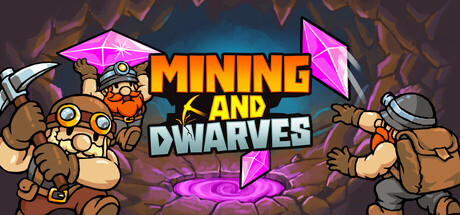
Mining and Dwarves takes the familiar appeal of incremental progression and wraps it around a fantasy mining operation where steady improvement is the main attraction. Developed by Sockhouse Studios and published by Aarimous and Thornity, it focuses on mining resources, recruiting dwarves, improving efficiency, and gradually turning a modest operation into an increasingly productive enterprise. The premise is intentionally uncomplicated, allowing the satisfaction of growth and automation to take priority over complicated mechanics or an elaborate narrative.
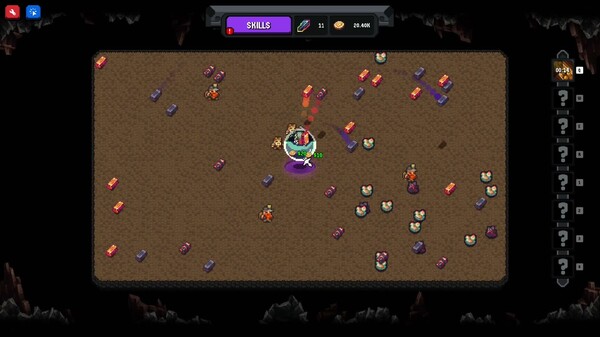
The basic progression loop revolves around mining rocks and gathering valuable resources that can be reinvested into improvements. Early involvement encourages the player to participate directly, but the experience increasingly shifts toward automation as dwarves join the workforce. This transition is important because it creates a tangible feeling of advancement. Instead of merely watching statistics increase, players can see their personal workload gradually being supplemented by workers capable of maintaining production on their behalf.
Five different dwarf types add some welcome variety to the workforce. Building up a collection of workers becomes an important component of long-term progression, with greater efficiency allowing resources to accumulate more quickly. The concept works naturally with the incremental genre because dwarves and mining already suggest labor, expansion, and resource accumulation. As the operation develops, attention shifts from simply extracting materials toward improving the overall effectiveness of the system.
Active players are not forgotten once automation becomes available. Eight unique abilities provide additional ways to influence production and accelerate progress. These abilities give players something meaningful to interact with rather than reducing the experience entirely to waiting for automated workers. This creates a useful compromise between an idle game and a more involved incremental experience. Players can allow the system to function with limited attention while still benefiting from becoming actively involved whenever they choose.
A substantial skill tree provides another important progression layer. Improvements affect both the player and the dwarves, reinforcing the feeling that almost every investment contributes toward a stronger mining operation. Incremental games depend heavily on maintaining a convincing chain of achievable goals, and the upgrade structure serves that purpose here. There is usually another improvement to pursue, another efficiency increase to obtain, or another aspect of production that can be strengthened.
One particularly notable design decision is the absence of a prestige mechanic. Many incremental games eventually ask players to erase a large portion of their progress in exchange for permanent bonuses before beginning the cycle again. Mining and Dwarves takes a different approach by emphasizing continuous advancement without forced resets. Everything earned contributes to an ongoing journey forward. For players who dislike repeatedly rebuilding an operation they have already developed, this can be one of the game's most attractive characteristics.
The presentation uses a colorful 2D style that complements the relaxed nature of the experience. Rather than aiming for realistic mining or complicated simulation, the visuals support clear progression and give the dwarven theme some personality. Watching an expanding workforce perform increasingly productive tasks provides much of the visual satisfaction. The straightforward presentation also prevents unnecessary complexity from interfering with the resource-management loop.
There are light management and strategic elements involved, particularly when considering upgrades, dwarf development, ability usage, and overall production efficiency. However, this should not be mistaken for an elaborate colony-management simulator. The strategic decisions exist primarily to strengthen the incremental progression rather than create a deeply demanding economic system. Players interested in optimizing numbers and improving productivity are therefore likely to get more from the experience than those expecting extensive tactical challenges.
Its greatest limitation is also closely connected to its genre. Mining, upgrading, accumulating resources, and increasing production naturally involve repetition. Anyone who needs frequent changes in objectives, extensive exploration, substantial storytelling, or action-oriented mechanics could eventually find the routine too predictable. The appeal comes from watching small improvements compound into major increases in productivity. Players who enjoy that particular form of progression are much more likely to appreciate what the game is trying to accomplish.
Steam Deck compatibility is encouraging. The game supports SteamOS and Linux, and its stated technical information indicates testing on a Steam Deck OLED 1TB. While this should not automatically be interpreted as an official Steam Deck Verified rating, it suggests that handheld use has received direct consideration. The relatively relaxed incremental gameplay also seems naturally appropriate for portable sessions, where checking production, buying upgrades, activating abilities, and managing dwarves can be accomplished in shorter bursts.
Overall, Mining and Dwarves succeeds by keeping its priorities focused. Five dwarf types, eight active abilities, extensive upgrades, automated production, and a sizeable skill tree give its straightforward mining premise enough structure to support continued progression. Most importantly, eliminating prestige resets creates a persistent sense that time invested is always pushing the operation forward. It may be too repetitive for players who are not already interested in incremental games, but for fans of automation, permanent upgrades, resource accumulation, and steadily increasing efficiency, it offers an accessible and potentially satisfying mining experience.
Rating: 7/10