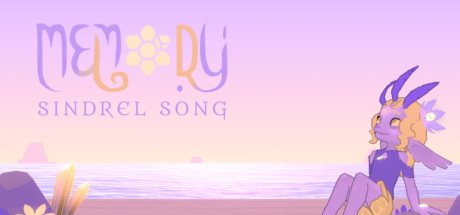
Mimic memorised musical melodies to give life light despite the darkness in your mind.
Modeled estimate, not a reported figure. How we estimate →
Media

About
Genres
Stats
All-time low is the lowest price we've recorded for this game since we started tracking it.
Languages: English
Reviews
I've been following the creator of this game since he was making Flash games. This is far and ahead the best of his work. The mechanics are pretty simple, but it's a delight to learn each new song, and there was a moment in each one where the disjointed "listen-then-play" melodic bits finally /clicked/ and I could play through with confidence. The length of the game was just right as well--enough to explore different musical concepts and give a satisfying difficulty curve between the songs without dragging on. The story focuses on mental health and mortality, and each character takes a different view on why life is worth living (for other people, for personal achievement, for creative fulfillment, and so on). While some of them didn't work as well for me, the dialogue was charming, and Memody's "inner voice" felt very real. I have several close friends who struggle with depression and anxiety who have expressed inner thoughts that map closely to Memody's sometimes irrational fears. As far as criticism, I think the lore could have gotten just a bit less focus to really let the characters shine. It does a good job of setting up the themes that the game tackles, but can sometimes fall into the "it's X, but with a different name" style of worldbuilding, which doesn't really add anything for me. I'll also add that this game holds a very heteronormative worldview, which felt kind of grating at times. It's used for a decent narrative purpose, but it kind of rubbed me the wrong way. Your mileage may vary. To cap off this rambling review: this is easily worth playing. I'm looking forward to what comes next.
Related
Related
Trends
Concurrent players on Steam, sampled daily since tracking started.
[h1]Memody: Sindrel Song - Like a Game, Like a Person[/h1] Playing [i]Memody: Sindrel Song[/i] is like making friends with a new person; it's a little awkward, it feels a little rough around the edges, and it takes time. [i]Sindrel Song[/i] does as good a job as possible to ease you into the experience, to bring you into its world and to help you understand its rules, the game is an excellent guide on the journey it wants to take you on. However, its melody mimicking gameplay is still novel and difficult to get the hang of, it takes time to get used to. Just as well, its world and lore are rich and unique, and take time to appreciate. Like meeting a new person, you may feel uncertain during your first moments with [i]Sindrel Song[/i], but if you take the time to get to know it and appreciate it, there is [b]a lot[/b] to love about this game. It's a very honest and genuine game, the kinda that you have to go into with an open heart. At [i]Sindrel Song[/i]'s best, it provides truly moving experiences where music, character and gameplay meet at a perfect intersection, and at it's worst, well, it at least gives you some painfully catchy melodies that'll stick in your head for days.
I have beta tested this game, and I can definitely say it's a real gem worth checking out for both its gameplay appeal and its tightly woven narrative. A very innovative take on the concept of a rhythm game, the focus in Memody: Sindrel Song is placed on memories and melodies. While NPCs play their songs for you, the player character has to quickly memorize and play back the same songs, figuring out patterns and methods to gets these repeat segments as close to the original as possible. This makes for very satisfying gameplay when the player harmonizes perfectly and gets fully in tune with the NPCs. This is supplemented strongly by the game's narrative which focuses on connecting and harmonizing with others, the differences in frequency between people that lead to conflicts, and the internal challenges caused by discordant mental illness, all possibly culminating in a moment of triumph, provided you're determined enough to get there. It's definitely worth talking to every NPC every time they have something new to say, all NPCs have their own ongoing story arcs to discuss with Memody, and they all get fleshed out and interesting characterization as a result! The game also features distinct modes for people wanting a challenge, people going for top scores and people who just want to experience the story and narrative. This is definitely a game that anyone can pick up and play!
Not your average rhythm game, you have to pay attention to the melody and use your memory. (... it's in the title) Also contains a story that tackles the topic of personal health, which does need more attention. For fans of Tobias's previous works, his writing and music are a draw, as always.
This is a game that grows on you… And in you, like a flower daemon. I have to admit, I had trouble getting into this game at first. I went in expecting a rhythm game, and played it like one. But Memody: Sindrel Song isn’t a rhythm game, and in fact it’s not even really a music game - at least, not exclusively. Yes, the music is there, yes, it’s really hard when you first start out and you’ll fail a lot, yes, the songs are varied and nice to listen to (especially considering the total of 12 unique notes used over 7 songs), and yes, I did spend way too long trying to get 180% on all the songs. But under each song is also a carefully and intricately crafted character. And that’s where Memody: Sindrel Song begins to take on a new shape. Over the course of playing each character’s song, you get to know them. The character designs are absolutely beautiful, and each one has personality and depth to it. Clear thought was put into all seven of them, and it shows in both their dialogue and the feel of their songs. The dialogue itself is undeniably hit or miss; sometimes it broke my immersion through heavy-handedness or jarring awkwardness, and at other times it surprised me with its cleverness. But while the dialogue certainly could have benefited from careful editing, the unique essence of each character and charm of the world they inhabit always shows through. The character models themselves, for as bizarre as being part-canine, part-plant, multicolored aliens inlaid with gems, are equally expressive, thanks in part to the stylized art designs used. Sindrel Song is definitely a game that you can enjoy on a really deep level if you take it on its terms. It combines the pure, outlandish imagination of a child with very down-to-earth, adult themes that it handles with care and maturity. But despite that, the game doesn’t take itself 100% seriously. In a way, it does feel like a full range of human experience. I played it a second time through, and even though I knew all the characters along with their songs and stories already, I was able to discover new layers in each that I hadn’t before. Yes, Sindrel Song is technically a music game. And it’s not bad at being that by any means. But it also has a lot more to offer the more you get to know it. So if there’s one piece of advice I’d give to anyone who wants to pick up this game, I could sum it up in four words: Don’t be a stranger.
Wow! This game really captivated me. It transmits a strong hopeful message to those of unsure footing in life. It's not perfect as a game but it is very unique. Let's get those cons out of the way: - Initially feels a little on the nose. - Some of the writing felt a little unnatural to me at first, but repetition / getting used to the protagonist legitimizes I guess: towards the end it didn't feel off at all. It's not a game you play to pick it apart. - A few glitches and inconsistencies during the songs. - I, at least, got some keyboard lag that took time to get used to and made it even more difficult to be perfect with my rhythm. - You can't really follow the song lyrics at all initially when you're spending all your effort trying to keep up with the notes being played. This could be seen as a natural way to gradually get attuned to the message, however, so you might not see it as a con. - I don't personally know what to think of experience points and achievements but at least the former doubles as feedback on how well you played the last phrase. - Whenever you fail at a phrase, it brings the song to a very abrupt halt that interrupts any flow. Should this be handled more gracefully? At least you could say this way it fits in better with Memody's experience of failure, but I'm not convinced that's a big enough reason. - No sound volume slider for some reason. The game is too quiet. - The ending is a little bit too short probably. Something about the pacing feels a tiny bit off. Now onto why I think this game is very worthwhile: - This is an outstanding effort (compared to the standard in games) at capturing deep philosophy about life and death in a microcosm built to furnish it. The cast are relatable. You can sense the author's personal style. - The music is memorable (it has to be!) and varied. - The gameplay has got to be unique amongst games that aren't designed solely to teach music. Like it promises, it feels like you're learning an actual instrument and you'll start getting much better at it with more practice. - The difficulty feels fair at least up to the point where the input lag starts being significant, especially in faster phrases. (I eventually got 190%+ on everything but I don't think I'll try to be perfect). In any case, there's a "casual" mode as well. A few notes: When you play the game, you might want to go back and re-do previous songs now and then because they will be relevant again near the end. You can sing to yourself if you just return to the tent during any day before you've completed that day's objective. You can pause or abort a song by hitting space.
I'll update this review when I get more time to play, but I doubt my recommendation will change.
After playing and progressing into this game partway, I was happy to find a charming gem. Realizing the music is fun to play along to, makes it even easier to care for and appreciate each person we meet, because each melody expresses the essence of each personality in a deep way. The core mechanic of listening and mirroring is a deep one that feels refreshingly simple. Understand that falling into sync with the melody is satisfying, since it naturally feels effortless to know how to flow with the music. I recommend this memory of a melody called Memody, a valuable experience for a thrifty price. if you want to play without pressure there is a more casual story focused mode, as well as a challenge mode to track progress and how precisely each song is played. I enjoy this game.
Memody: Sindrel Song is a short-but-sweet journey through the inner workings of the mind. Tobias is an expert of blending charming characters with fun gameplay, and this game may be his best endeavor in doing so yet. You really feel for the characters as you traverse the island, and their songs match each one's personality very well. The gameplay is quite challenging, but the inclusion of casual mode makes it accessible to any player. If you're a completionist type or a fan of music/rhythm style games, you will definitely get a lot out of this game perfecting all the songs. If you're more invested in the characters and world, you'll get a story with a lot of heart that's certainly worth listening to.
It's hard to give this game a poor review—not so much because the game is without fault but because of the backstory behind it and the man doing the development. (Just do a little investigation into why this game was made and you'll get the picture. Do a little more research on Toby himself, and . . . well, his mind isn't in the best place, he reads reviews, and he doesn't take negative ones particularly well.) I totally get the idea creating a passion project and releasing it because it'd be a shame not to—I've done that myself with creative writing (also about cancer, coincidentally—Google "Taialin oblivion" for that). But that makes reviewing the game by its own merits difficult. If you're reading this, Toby, I criticize the game, not the person—it takes astounding courage to publish something like this. STORY I didn't expect much, to be honest, but it's more engaging than you might expect.. The Alora Fane universe is built very well, and its themes are sound. I'm thankful I don't have mental illness myself, but I know enough people with depression that this quite literal demon inside Memody will resonate with a lot of people. It does for me about halfway, through no fault of the game (I'm introverted, if not depressed). Exploring this theme through talking with the other characters of this game, each with a different perspective, is a classic, if effective, form of storytelling. Life and death and depression is rarely explored to this depth. That being said, while those themes are developed well, memory is an additional one that really isn't explored much until the end of the game. Plus, all this storytelling does occasionally happen during a song through lyrics, which is challenging to follow when the songs themselves are challenging. GRAPHICS Good for an indie developer in Unity? They're not really the focus of the game, and they're quite charming. But I can say each and every character is recognizable and memorable, which for as many as this game has (7, 8 if you count the demon) is extremely impressive. This can be attributed to all of story, graphics, and music making each character original. GAMEPLAY Easily the strongest part of this game. I've played many music/rhythm games and have musical experience, and there's nothing yet like this I've seen. I thought I'd have a leg up on this game by my past experience, but this concept was as novel to me as any other. It has a learning curve, and it is genuinely challenging. So much so this game has a pretty fast burnout rate—I need to take a break after some 90 minutes when notes stop making sense. This really could become a genre of game in and of itself—it is that strong. One niggle—it's hard to get a "AAA" on songs for me because there's a slight delay of some quarter second between hitting a key and it actually registering, meaning I have to hit keys about a quarter second before they happen to be "on beat." All music games have this problem to some extent. And while I know this isn't a rhythm game, an "offset" function in settings would really help. MUSIC Obviously, this is a game about music, so it'd better be good, right? Well . . . kind of. I personally think Vivace's theme is probably the strongest and catchiest of the lot, and the ones leading up to Course's are great too. But when you go past that, they get complicated quickly. I get that this is to make the game harder, but I'd argue this kind of game doesn't necessarily need that scaling. The game and the music is best when you can "feel a groove" and understand what's coming next—when the notes and rhythms are complex and their motifs don't resolve, that groove is missing. I won't mention what the last song is for spoilers, but it's 12 (!) minutes long, quite difficult, and wanders too much to be more than a memory test with little music. Toby throws you a bone by making that song (on initial playthrough) no-fail, but the theme it explores is too anemic to pull everything together. I stumbled through that one, never actually "learning" it (and I don't really desire to). As a "victory procession" song, it doesn't need to be the hardest song (or that hard at all—it's satisfying enough to play something reasonably difficult while taking in Memody's character development). Overall, yes, this is a good game, and for someone who identifies more with its themes, probably a great one. Just don't be afraid to switch to Casual (no-fail) mode if you'd just like to progress the story.
Momentum
Pace estimated from the game's recent review growth (our daily snapshots) at its own sales-per-review ratio — a momentum signal, not booked sales.
Related
| CYBER EMOJI TALE 2099 | $2.8K | 111 | 88% | $0.99 |
| Repit | $2.8K | 83 | 86% | $1.99 |
| Raceborn | $2.8K | 94 | 81% | $1.49 |
| Dodge | $2.8K | 82 | 79% | $1.99 |
| 69 Ways to Kill a Zombie | $2.8K | 141 | 62% | $0.69 |
| The Wisbey Mystery | $2.8K | 115 | 65% | $1.59 |