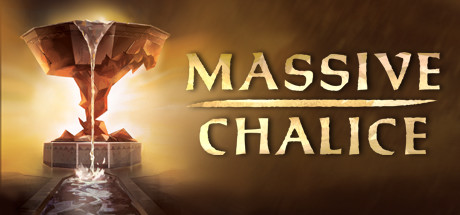
Massive Chalice is a rare kind of strategy game—one that thinks in centuries rather than seasons—and that long-view design philosophy defines nearly every system Double Fine Productions built into it. Set in a fantasy kingdom slowly being consumed by an encroaching supernatural force known as the Cadence, the premise places you not just as a battlefield commander, but as an immortal ruler responsible for safeguarding the realm over 300 years. The titular Massive Chalice, a sentient artifact voiced with dry wit and calm authority, serves as both advisor and spiritual anchor, framing the experience as a generational war that can only be won through patience, sacrifice, and careful long-term planning. Instead of focusing solely on tactical skirmishes, the game asks players to consider lineage, inheritance, demographics, and time itself as strategic weapons.
The structure alternates between two layers: the kingdom-management metagame and the turn-based tactical battles. The overworld functions like a slow-burning grand strategy simulator, where players assign heroes to govern territories, marry into noble families, oversee research institutions, or serve as Regents of newly constructed Keeps. Time passes whether you’re ready or not, pushing heroes toward aging, retirement, infertility, and eventually death. This aging mechanic isn’t just flavor—it forces hard decisions. A brilliant young hunter may be your best battlefield asset now, but pairing them with a compatible partner could produce future generations of heroes with powerful genetic traits. Conversely, keeping too many veterans on the front lines risks losing an entire house if they fall in combat. Massive Chalice becomes a game about stewardship—managing bloodlines, balancing short-term survival with long-term resilience, and accepting that even your greatest heroes will one day vanish from the roster.
Battles themselves resemble a streamlined, faster interpretation of tactical games like XCOM, but with their own personality. Squads consist of five heroes drawn from your available noble houses, each belonging to one of several hybrid classes that reflect their parentage—Alchemists lob explosive flasks, Caberjacks wield massive battering rams, Hunters specialize in ranged stealth attacks, and later, specialized class variants emerge depending on lineage combinations. Each battle map introduces environmental hazards, elevation, fog of war, and enemies that force adaptation rather than rote tactics. The Cadence enemies are visually distinct and mechanically disruptive—some explode on death, others permanently drain experience, and some teleport unpredictably, creating constant battlefield tension. The pacing is brisk, with smaller encounter sizes that favor strategic positioning and effective team composition rather than endless attrition.
What gives combat emotional weight is the knowledge that every loss is permanent and impacts the kingdom’s future. That caber-wielding veteran who carried you through two decades of victories? If they fall to a poorly judged push, they won’t just leave an empty slot on the battlefield—they’ll erase a bloodline, weaken your genetic pool, slow research progress, and dilute your defensive capabilities for generations. Success often feels like minimizing irreversible damage rather than dominating the enemy, and that vulnerability makes even minor victories feel meaningful. As years pass, players develop attachments not just to individual heroes, but to entire families—celebrating promising children, mourning generational decline, and anxiously sending elderly champions on one final mission.
The kingdom layer deepens as the campaign progresses. Building new Keeps expands your hero population, while Sagewrights’ Guilds improve research speed, and Crucibles train young recruits. Each structure requires dedicating heroes—often talented ones—which creates opportunity cost. Events periodically appear, offering moral or political choices with unpredictable consequences, injecting narrative texture and humor into otherwise sober decision-making. Double Fine’s signature writing style shows up frequently: wry, self-aware, and gently comedic without undermining the stakes. The Massive Chalice itself serves as a chorus of wisdom and sarcasm, making the passage of years feel entertaining rather than mechanical.
Visually, the game embraces a stylized, angular art direction reminiscent of mid-century illustration—clean shapes, bold silhouettes, and saturated colors that make characters readable even decades into battle-hardened old age. The UI supports long-term strategy elegantly, conveying lineage information, trait inheritance, and timeline progression clearly enough that players rarely feel overwhelmed. Sound design and music reinforce the melancholy heroism of the setting—restrained, atmospheric, and occasionally triumphant when earned.
However, Massive Chalice isn’t without structural limitations. Map and enemy variety can feel thin across a 300-year campaign, leading to repetition in late-game encounters. The genetic trait system, while conceptually compelling, can be unpredictable, occasionally rewarding or punishing players more through luck than planning. Difficulty swings can emerge if early generations produce poor heirs or if crucial houses collapse before infrastructure stabilizes. Because the game prioritizes systems over cinematic storytelling, players seeking character-driven narrative arcs may find its plot comparatively lightweight. And once the central campaign is completed, replay value depends largely on whether you enjoy experimenting with different house strategies rather than chasing new content.
Yet even with those shortcomings, Massive Chalice remains distinct and memorable. Few strategy games embrace mortality so sincerely or treat time as a mechanic rather than a backdrop. It asks players to think generationally—to accept impermanence, to plan responsibly, and to take pride not just in the heroes they command, but in the future they secure. Its design encourages reflection on leadership, legacy, and the sacrifices required for civilizations to survive. For fans of tactical combat, long-form strategy, or thoughtful experimentation within familiar genres, Massive Chalice offers a compelling, clever, and emotionally resonant experience. It may not shout loudly, but its ideas linger—just like the names of the fallen etched into a kingdom’s memory.
Rating: 7/10