Masky is a deceptively simple indie title that transforms a single mechanical idea into a tense, rhythmic, and surprisingly strategic experience. Developed by Digital Melody and published by Forever Entertainment S. A., the game places players in the middle of an elegant masked ball and asks them to do one thing: keep their balance. What initially appears to be a lighthearted, almost whimsical concept quickly reveals itself as a game about control, anticipation, and adapting to escalating chaos. Masky does not rely on complex systems or layered mechanics; instead, it builds intensity through accumulation, asking players to manage increasing risk with every successful decision.
The core gameplay revolves around guiding a central character who invites other masked dancers to join a growing line. Each new dancer attaches either to the left or right side, adding weight that affects balance. As the line grows longer, even minor misjudgments can cause everything to topple, abruptly ending the run. This constant tension between greed and restraint defines the experience. Players must decide whether to push forward and collect more dancers for a higher score or play conservatively to maintain control. The elegance of the design lies in how intuitive it feels while remaining demanding in practice, especially as reaction windows shrink and the margin for error becomes razor thin.
Adding further unpredictability are special masks worn by certain dancers. These masks introduce temporary effects that disrupt normal play, such as reversed controls, visual distortions, altered movement speed, or other disorienting changes. These effects do not last indefinitely and can be canceled by collecting another dancer, forcing players to make quick tactical decisions under pressure. The result is a gameplay loop that constantly shifts between moments of calm precision and sudden chaos, keeping even experienced players on edge. Rather than feeling unfair, these disruptions emphasize adaptability, rewarding players who can stay composed when the game deliberately pulls the rug out from under them.
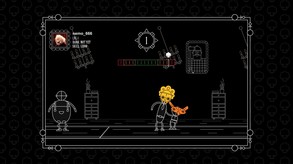
Visually, Masky adopts a striking minimalist style that relies heavily on silhouettes, bold outlines, and high-contrast colors. Characters are instantly readable, and the growing chain of dancers becomes a visual indicator of both success and impending danger. The environments are abstract yet evocative, capturing the atmosphere of a surreal masquerade without unnecessary detail. This clarity is crucial, as the game demands constant visual awareness to judge balance and spacing. Complementing the visuals is a strong musical presence, with rhythmic tracks that reinforce the flow of movement and subtly influence the player’s pacing without turning the game into a traditional rhythm title.
Replayability is driven by score chasing and mastery rather than progression systems. Each run is short, making it easy to jump in for a quick session or repeatedly attempt to beat personal bests. As players improve, they begin to recognize patterns in dancer behavior and mask effects, allowing for more deliberate risk-taking. The game also supports multiplayer modes, which add a competitive and social dimension to the otherwise solitary balancing act. Competing against friends intensifies the experience, as mistakes are immediately visible and success feels more dramatic when witnessed by others.
Despite its strengths, Masky is intentionally narrow in scope. Its single mechanic, while refined and engaging, does not evolve significantly over time. Players seeking narrative depth, long-term progression, or mechanical variety may find the experience wears thin after extended play. However, this focus is also part of its identity. Masky never pretends to be more than it is, and its appeal lies in how well it executes its core idea rather than how many features it offers. It feels closer to a refined arcade challenge or party game than a traditional standalone experience.
Overall, Masky stands out as a confident example of minimalist game design done right. By centering everything around balance and escalation, it creates a memorable and tense experience that is easy to understand but difficult to master. Its distinctive visual style, effective use of music, and addictive core loop make it an excellent choice for players who enjoy high-score challenges, quick sessions, and competitive local multiplayer. While it may not provide long-lasting depth for every audience, Masky succeeds in delivering a focused, polished, and surprisingly intense indie experience that lingers precisely because of its simplicity.
Rating: 7/10