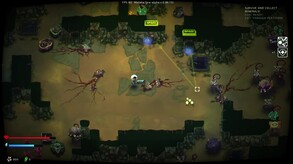
Maraka, developed by David Kaleta and Lukas Svrcek and published by David Kaleta, is an ambitious physics-based roguelike that attempts to merge environmental manipulation with tense, skill-driven combat. It is set on an alien planet where survival depends not on brute strength or conventional weaponry, but on the creative use of magnetism. You play as a lone explorer stranded deep beneath the surface, navigating through a labyrinth of caves filled with strange structures, hostile lifeforms, and the lingering wreckage of failed expeditions. Rather than presenting a linear story, Maraka frames its narrative as a gradual discovery, revealing fragments of a past catastrophe while emphasizing the player’s isolation and resilience in a hostile environment.
What makes Maraka immediately stand out is its focus on physics-driven gameplay. The central mechanic revolves around a magnetic device that allows the player to attract, repel, and manipulate objects in the environment. Rocks, debris, and even enemies become tools in your arsenal, transforming every encounter into a sandbox of potential strategies. The magnetic system is versatile—you can pull enemies toward hazards, fling objects to crush them, or clear paths by hurling debris aside. The destructible environments make every battle dynamic, forcing you to adapt on the fly as the battlefield literally changes shape. This design approach creates a level of unpredictability that is both exhilarating and challenging, rewarding players who learn to think spatially rather than relying solely on reflexes.
The game’s structure follows a roguelike progression system with procedural cave generation, resource gathering, and a risk-versus-reward loop. Each run tasks you with delving deeper into the caverns to collect materials that can be used for crafting upgrades and enhancing your magnetic powers. The deeper you go, the greater the rewards, but also the higher the danger. This creates an ongoing tension between ambition and caution—do you press forward for rare resources or retreat to secure your progress? The procedural design keeps runs fresh, but it also introduces uneven pacing. Some levels feel sparse, with little to challenge or reward exploration, while others crowd you with enemies and hazards that can feel overwhelming. Despite this imbalance, the loop of exploration, scavenging, and upgrading remains engaging, largely because of the magnetic system’s creativity and the satisfaction of mastering its physics.
Visually, Maraka adopts a minimalist, stylized look that prioritizes function over flash. The environments are composed of hand-crafted assets with subdued color palettes that fit the tone of desolation and danger. The emphasis is on readability: the player must be able to identify interactive objects quickly during chaotic moments. The art direction strikes a balance between atmosphere and clarity, creating a world that feels alien yet coherent. While some animations and transitions lack polish, the visual simplicity ensures the action remains fluid and easy to follow even when debris and enemies fill the screen. The audio design complements the visuals with understated soundscapes—echoing cave noises, the hum of magnetic energy, and subtle ambient tracks that enhance immersion without distracting from gameplay.
Performance-wise, Maraka benefits from its modest visual style but is not without technical shortcomings. The physics engine, while impressive, can occasionally produce unpredictable results. Objects may clip through walls, enemies can get stuck, or debris may behave erratically after collisions. These moments, though not constant, can break immersion and disrupt the flow of combat. Frame rate drops and minor stutters occur during scenes with heavy destruction or large numbers of interactive objects, but they are rarely severe enough to render the game unplayable. Considering its independent origins, Maraka performs reasonably well, and its technical issues, while noticeable, do not overshadow its more creative aspects.
The combat experience is both the game’s greatest strength and its biggest risk. Because the magnetic mechanics are so central, the gameplay rewards experimentation rather than repetition. Every encounter can be approached differently depending on how you use your surroundings. Some players will find this liberating, enjoying the ability to improvise creative kills or chain environmental reactions, while others may find it inconsistent or chaotic. The unpredictability of the physics system sometimes makes precision difficult, and not every fight feels equally balanced. Enemy variety is modest, but the dynamic nature of combat ensures that even familiar foes can pose fresh challenges depending on the environment. Boss battles introduce larger-scale encounters where magnetic manipulation becomes essential rather than optional, and these moments showcase the system’s potential at its best.
Progression outside of combat revolves around upgrading equipment and refining abilities through resources found during each expedition. Crafting and enhancement options are limited but meaningful, encouraging players to experiment with different builds or adapt to their preferred playstyle. The upgrade path is tied closely to the game’s extraction mechanic: you can choose to return to base safely with your collected materials or risk pressing deeper into the caves for greater rewards. This decision-making process mirrors the tension that defines the best roguelikes, where greed and caution constantly compete. Though the crafting system could benefit from more depth or visual feedback, it provides a tangible sense of growth that complements the game’s otherwise minimalist presentation.
In terms of atmosphere, Maraka succeeds in cultivating a sense of isolation and mystery. The world feels harsh and indifferent, yet alive with strange energy. The environmental storytelling, though subtle, gives glimpses of a broader lore through scattered ruins, strange symbols, and remnants of past explorers. The absence of overt dialogue or exposition invites players to interpret the world for themselves, lending the experience a haunting and introspective tone. This restraint in storytelling allows the gameplay to take center stage while leaving room for imagination.
Maraka’s reception has been mixed, which is unsurprising given its experimental nature. Some players praise its originality, emergent combat, and inventive use of physics, while others criticize its technical roughness and uneven pacing. It is a game that thrives on its core idea but occasionally falters in execution. The ambition is clear: to give players not just a weapon, but an entire world to manipulate. When everything works as intended, it offers moments of brilliance that few games achieve—when it doesn’t, the rough edges remind you that this is a daring but imperfect creation.
Ultimately, Maraka stands as a distinctive entry in the indie roguelike genre—an imperfect but inspired fusion of physics, action, and environmental storytelling. It demands patience, creativity, and a willingness to embrace chaos. It’s not a polished blockbuster experience, but it doesn’t need to be. Its greatest strength lies in its unpredictability and the satisfaction of mastering a system that feels alive and reactive. For players who value experimentation and atmosphere over predictability, Maraka delivers a compelling, sometimes frustrating, but undeniably memorable experience. It’s a game that may stumble in places, yet it pushes boundaries in ways that few others dare, leaving a lasting impression long after its final magnetic pulse fades.
Rating: 6/10