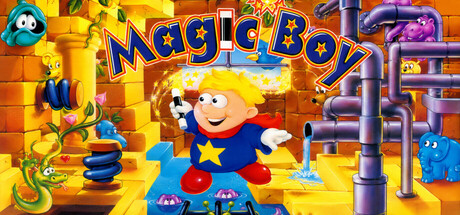
Little Hewlett is top of his class at Sorcery school. One evening he stays behind to finish some work and accidently lets the grand wizard collection of grazy pets out of the basement. Can you help Hewlett get them all back before his master returns in the morning.
Modeled estimate, not a reported figure. How we estimate →
Media

About
Little Hewlett is top of his class at Sorcery school. One evening he stays behind to finish some work and accidently lets the grand wizard collection of grazy pets out of the basement. Can you help Hewlett get them all back before his master returns in the morning. Warning! this platform game is extremly addictive!
4 graphically stunning areas to explore, each with its own individual inhabitants.
64 levels, 4 of which can be accessed at any one time.
32 bonus packed secret levels for Hewlett to find and explore.
Hidden features; extra powers for Hewletts wand, invincibilty potions, hidden blocks, extra lives and extra continues.
Progressive difficulty level.
Password system to access later levels.
Superb cartoon animation.
If Hewlett is to return life to normal at the Sorcery School he is going to need all of his agility and cunning, as well as a touch of Magic!
Stats
All-time low is the lowest price we've recorded for this game since we started tracking it.
Languages: English**languages with full audio support
Reviews
Yes! More retro dos gaming goodness on Steam please!
Magic Boy is a vibrant throwback to an earlier era of platforming design, a game that embraces the charm and difficulty curve of early 1990s action-puzzle hybrids. Revived on Steam after its original release decades ago, it preserves both the strengths and the stubborn quirks of its vintage origins. The premise is immediately whimsical: you play as Hewlett, a young magician’s apprentice who has made an enormous mess by accidentally releasing magical creatures into the world. The task is simple in theory but demanding in execution—capture every creature you’ve unleashed and restore order before your master discovers what you’ve done. That narrative setup gives the game a lighthearted, cartoonish tone that carries through to its colorful visuals, energetic sprites, and cheerful sound cues. At its core, Magic Boy is a blend of platforming, action, and light puzzle solving. Instead of racing to the end of a stage, your primary goal is to track down, stun, and capture monsters scattered throughout each level. Once captured, they must be deposited into designated containers positioned around the map. This alone separates the game from many traditional platformers of its era—the responsibility to manage enemies rather than merely defeat them changes the rhythm of play. Because captured creatures don’t stay contained forever, there is a persistent time pressure hanging over each level, turning what might seem like simple navigation into a balancing act of efficiency and planning. The game often demands not just skill but a thought-through order of operations: which enemies to capture first, which routes to clear before others, and which hazards are worth taking risks around to avoid losing progress. This structured approach is supported by level design that—while bright and playful on the surface—is frequently unforgiving. Platforms collapse under your feet, hazards punish even slight missteps, and enemy movement patterns sometimes require strict timing to maneuver around safely. The controls themselves lean into the era’s conventions: Hewlett’s movement has a slightly “floaty” quality, jumping can feel stiff, and hit detection is not always consistent. For players accustomed to modern precision-platforming, this can be a hurdle, but for those with patience, the quirks become part of the game’s identity. Each level becomes a micro-challenge of planning, memorization, and mastering a movement system that does not bend easily to the player’s intentions. The aesthetic presentation carries the same retro sensibility. The backgrounds are colorful and varied, each themed world offering a distinct flavor—from airy outdoor landscapes to denser, more perilous environments. Characters and enemies are cartoonish in a distinctly early-’90s way, with exaggerated animations and bold outlines that reinforce the game’s playful energy. The sound work, though dated, contributes to that sense of nostalgic charm, even if some repeated capture and stun effects may feel repetitive over time. What the game lacks in modern polish, it compensates for with an earnest visual identity that remains recognizable decades later. Magic Boy’s biggest point of contention for modern players is its difficulty structure. The game expects precision and repetition, with mistakes often requiring a full restart of the stage. There are no generous checkpoints, no modern accessibility features, and no attempt to smooth out difficulty spikes that can abruptly halt progress. This design philosophy was common in its era, and for players seeking a tough, old-school experience, it fits the bill. But for those who prefer flexible save systems or gradual learning curves, the game can feel harsh, especially when the control quirks amplify those challenges. Its trial-and-error nature may either encourage persistence or provoke frustration, depending entirely on the player’s mindset. Despite these challenges, Magic Boy offers a type of experience that is increasingly rare: a compact, tightly structured platformer with puzzle elements that does not rely on spectacle, narrative depth, or complex systems. Instead, it delivers straightforward, level-driven gameplay with a focus on mastering mechanics and learning enemy behaviors. It maintains a unique personality—a mash-up of cheerful presentation and ruthless difficulty—that gives it distinctive charm. For players who enjoy retro titles and are willing to engage with a game on its own terms rather than expecting modern refinements, Magic Boy can be a rewarding rediscovery. For others, its age shows clearly, and the rough edges may overshadow the nostalgia. Ultimately, it remains a snapshot of a design era defined by bright visuals, simple concepts, and unforgiving execution, and in that niche, it stands firmly and unapologetically. Rating: 6/10
전체화면이 안되지만 쉽고재미있어요 1366 768 이라서 그런가?
Yes.
I bought this game because it was the first game I played as a child back when it was on floppy disk. Despite looking and sounding like it did back in the 90s, unfortunately the game is unplayable. The scoring system doesn’t work; no matter how many fruits you collect, the score remains zero. And when you collect all the monsters, the level doesn’t end so you can’t actually complete a level. I played on the steam deck first of all. I had to do a lot of tweaking with the controls. The default controls were useless, especially when there’s no Enter key assigned to a button which you need to get past the first screen. Then I moved to my PC and the controls were fine, but now the screen didn’t fit my monitor. Kept missing about an inch of screen on the right hand side with no way to adjust the screen resolution. So, not great. Slightly regretting buying it but it was only a quid.
Related
Related
Trends
Modeled estimate over time, reconstructed from Steam's monthly review histogram.
Momentum
Pace estimated from the game's recent review growth (our daily snapshots) at its own sales-per-review ratio — a momentum signal, not booked sales.
Related
| Forest and Girls | $340 | 55 | 82% | $0.99 |
| Work And Girls | $347 | 56 | 86% | $0.99 |
| Cosmic Journey PC Live Wallpaper | $336 | 52 | 71% | $0.99 |
| Bongo Quest | $322 | 52 | 46% | $4.99 |
| Dances and Girls | $322 | 52 | 83% | $0.99 |
| Glasses and Girls | $316 | 51 | 82% | $0.99 |
Related
| Black Myth: Wukong | $794.9M | 1.2M | 97% | $59.99 |
| No Man's Sky | $636.2M | 412.8K | 85% | $59.99 |
| DayZ | $532.6M | 466.5K | 78% | $49.99 |
| DARK SOULS™ III | $467.1M | 438.3K | 94% | $59.99 |
| 7 Days to Die | $425.3M | 398.5K | 87% | $44.99 |
| Palworld | $415M | 463.2K | 94% | $29.99 |