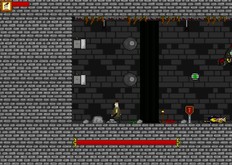
You a hero, so have to explore a world full of dangers. overcome various difficulties, traps and demons.
Modeled estimate, not a reported figure. How we estimate →
Media

About
Genres
Stats
All-time low is the lowest price we've recorded for this game since we started tracking it.
Languages: English, Russian
Engagement
Hours played at review time, across 40 reviews with recorded playtime.
Reviews
Themes across 40 recent reviews and how positive each mention is. A keyword signal, not full sentiment analysis.
positive critical· bar length = how often the theme comes up
Reviews
💋
Okay, look, the game absolutely isn't good - your weapon is useless and it's nearly impossible to not get hit by every single enemy you fight because you only have a reach of half an inch and every enemy takes 3-5 hits to kill, the spritework isn't particularly clear where there are spikes and areas of floor you can fall through, a bunch of the 20 "levels" are just one room with a door and nothing else, and each "boss" is more poorly designed than the last. To play Madness is to steal 30-45 minutes from yourself that you'll never be able to get back. BUT THAT HAVING BEEN SAID, according to the cheevos screen, the "Start The Game" achievement has only been picked up by .5% of players. That tells me that 99.5% of the players are so bad at games they couldn't figure out that clicking one of the Russian words on the start screen would start the game... so I understand if you take the other negative reviews with a grain of salt.
Not even worth $0.49: [list] [*]Starts in Russian with no obvious way to change to English - none of the options on the main menu lead to a settings menu. [*]Slow, boring gameplay. Why on Earth can you not attack when moving? It guarantees that you will take damage from any enemy you try to kill. [*]An [b]extremely[/b] jittery camera. Seriously, it's nauseating. [/list]
this is madness!
Basic mechanic but got stuck after second boss
Madness is an indie action platformer developed by Indie Games Studio and published by Enoops that attempts to capture the spirit of classic side-scrolling adventure games. Built around simple mechanics and a retro-inspired presentation, the game focuses on fast reflexes, combat encounters, and platforming challenges. Rather than offering an elaborate narrative or complex progression systems, the experience centers on navigating a dangerous world filled with enemies and environmental hazards. The design reflects the philosophy of many early arcade-style titles, where success depends on timing, persistence, and gradually mastering the mechanics of movement and combat. The premise of the game places players in the role of a solitary warrior venturing through a land that has fallen into chaos. The world is overrun with hostile creatures and dark forces that threaten to destroy everything in their path. While the narrative itself remains fairly minimal, it provides a straightforward motivation for the player’s journey. The protagonist’s mission is to travel through multiple regions, defeat enemies, and ultimately confront the powerful forces responsible for the devastation. The story unfolds largely through the progression of levels rather than through dialogue or cinematic sequences. Gameplay takes place in a two-dimensional side-scrolling environment where players must guide the character through a series of levels filled with obstacles and adversaries. Movement is built around familiar platforming mechanics such as running, jumping, and attacking enemies along the way. The control system is deliberately simple, making it easy for players to learn the basic actions needed to survive the game’s challenges. However, mastering these mechanics requires practice, especially as the levels become more demanding and hazards appear more frequently. Combat forms a central part of the gameplay experience. Throughout each level, players encounter various enemies that attempt to block their progress. These creatures vary in behavior and attack patterns, forcing players to adapt their strategies depending on the situation. Some enemies rush directly toward the player, while others attack from a distance or occupy strategic positions within the environment. Because the combat mechanics remain relatively straightforward, success often depends on reacting quickly and positioning the character correctly during encounters. The game features a structured level progression that gradually increases in difficulty. Early stages introduce the player to the basic mechanics and enemy types, allowing time to become comfortable with the controls. As players advance further into the game, the level designs grow more complex and the enemies become more dangerous. New traps, tighter platforming sections, and tougher opponents appear in later stages, requiring players to carefully time their movements and anticipate threats before they strike. Environmental hazards add another layer of challenge to the gameplay. Spikes, pits, moving obstacles, and other dangers are scattered throughout the levels, forcing players to remain alert while navigating the terrain. These hazards often appear alongside enemy encounters, creating situations where players must simultaneously avoid traps and fight opponents. This combination of platforming and combat ensures that each stage remains engaging and requires constant attention. Boss encounters serve as major milestones within the game’s progression. At certain points during the adventure, players must face powerful enemies that are far more challenging than the regular foes encountered throughout the levels. These bosses typically feature unique attack patterns and require careful observation to defeat. Players must learn when to dodge incoming attacks and when to strike in order to gradually wear down the boss’s health. These battles provide moments of intensity that break up the regular flow of platforming and combat. Visually, Madness adopts a pixel-art style that reflects the influence of retro gaming. The characters and environments are designed using simple but recognizable sprites that evoke the aesthetic of older arcade and console games. While the graphics are not highly detailed, they are functional and clearly communicate important gameplay elements. Platforms, enemies, and hazards are easy to identify, which is essential in a game that demands quick reactions from the player. The environments themselves vary across different stages, offering some visual diversity as players progress through the adventure. Dark caves, dangerous landscapes, and eerie settings help create a world that feels hostile and unpredictable. Although the visual style remains consistent throughout the game, these changing environments help prevent the experience from becoming visually repetitive. Sound design contributes to the overall atmosphere of the game. Background music accompanies the action with energetic and sometimes tense melodies that fit the game’s fast-paced nature. Sound effects signal important gameplay events such as attacks, enemy defeats, and environmental interactions. While the audio presentation remains relatively simple, it supports the gameplay by providing feedback that helps players stay aware of what is happening on the screen. One of the defining aspects of Madness is its straightforward structure. The game does not include complex skill trees, character upgrades, or branching storylines. Instead, it focuses entirely on delivering a series of action-focused levels that challenge the player’s reflexes and persistence. This simplicity makes the game easy to pick up, as players can quickly jump into the action without needing to learn complicated systems. However, this simplicity also means that the gameplay loop remains largely unchanged from beginning to end. Players who enjoy games with evolving mechanics or deeper progression systems may find the experience somewhat repetitive after extended play. The game’s design is intentionally minimalistic, emphasizing challenge and repetition rather than variety. Despite these limitations, Madness succeeds in delivering a compact action platformer that captures the spirit of classic arcade-style gameplay. Its focus on precise movement, quick combat encounters, and increasingly difficult levels provides a straightforward challenge for players who enjoy skill-based games. The retro-inspired visuals and simple mechanics contribute to a nostalgic atmosphere that may appeal to fans of older platforming titles. Overall, Madness offers a modest but engaging experience built around traditional platforming principles. While it does not attempt to innovate heavily within the genre, it provides a solid example of a small indie game that emphasizes challenge and straightforward gameplay. For players looking for a simple action platformer that relies on reflexes and persistence rather than complex systems, Madness delivers a short but entertaining journey through a dangerous and chaotic world. Rating: 5/10
Is this a joke? I actually had to let the game running so i could reach 5 minutes and write a review. The game is in Russian and possibly the worst game i ever saw EVER
[h1][b]Not Recommended[/b][/h1]
ein gelegenheitsspiel für zwischendurch. einige levels mit paar bosses. musik ist in ordnung. der preiß für dieses spiel ist im angebot in ordnung. hat sammelkarten. alle errungenschaften funktionieren.
被包货,加一,掉卡,成就挽救的游戏。we need cloud save, cn. 202408,steam,steam掉卡抵扣,它处自定义包入的本体约5元。爱人如己,目前就这,看以后追评。
Related
Related
Trends
Modeled estimate over time, reconstructed from Steam's monthly review histogram.
Momentum
Pace estimated from the game's recent review growth (our daily snapshots) at its own sales-per-review ratio — a momentum signal, not booked sales.
Audience
Estimated from the language of this game's reviews — a proxy for where players are, not official Steam demographics.
Related
| Oik Memory 3 | $2.8K | 100 | 90% | $0.72 |
| Corporate Suck Up | $2.8K | 80 | 98% | $1.99 |
| Writer. Chapter 1 | $2.8K | 54 | 76% | $1.49 |
| Project Threshold | $2.7K | 53 | 79% | $2.99 |
| Void Survivors | $2.7K | 74 | 88% | $1.99 |
| Alien Insanity | $2.7K | 52 | 88% | $2.99 |