Loot Box Quest by Going Loud Studios is a deceptively simple incremental game that uses the familiar structure of clicker mechanics as a platform for satire, quietly dissecting the very systems it imitates. At its surface, it appears to be another entry in the long line of idle games built around clicking, upgrading, and watching numbers steadily inflate. However, the longer you engage with it, the clearer it becomes that the game is less interested in mechanical innovation and more focused on commentary—specifically, on the culture of monetization, artificial progression, and psychological hooks that define many modern gaming experiences.
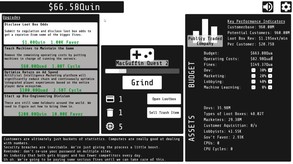
The gameplay begins in a deliberately straightforward way, with the player clicking to generate currency and unlocking upgrades that improve efficiency. This early phase is hands-on, requiring constant input, but as is typical for the genre, the game gradually transitions into automation. Systems begin to run themselves, production scales exponentially, and the player’s role shifts from active participant to passive overseer. This loop is intentionally familiar, almost to the point of exaggeration, and it becomes clear that the predictability is part of the design. The game leans into the satisfaction of incremental growth while subtly exposing how easily players become absorbed in these feedback loops.
What gives Loot Box Quest its identity is how it contextualizes this progression. Rather than presenting abstract upgrades, it frames advancement through a narrative lens that mirrors the real-world gaming ecosystem. Players move through different roles and perspectives, gradually shifting from consumer to creator and beyond, blurring the boundary between those who engage with monetization systems and those who perpetuate them. This progression is not heavy-handed, but it is consistent, reinforcing the idea that the systems being critiqued are cyclical and self-sustaining. The humor is often exaggerated, but it lands because it reflects recognizable patterns within the industry.
The writing plays a central role in maintaining engagement. Dialogue snippets, upgrade descriptions, and event text are filled with self-aware humor that pokes fun at industry clichés—whether it’s exaggerated grind mechanics, hollow reward systems, or the infamous language used to justify monetization practices. The tone strikes a balance between playful and cynical, never becoming overly harsh but also never losing sight of its underlying critique. Even when the gameplay becomes repetitive, the writing provides a reason to continue, as players are often curious to see what new absurdity or observation will appear next.
Visually, the game adopts a minimalist approach that aligns with its genre but does little to elevate it. The interface is functional and easy to navigate, but it lacks visual flair or variety. Most of the player’s attention is directed toward numbers, menus, and upgrade trees, with little in the way of dynamic presentation. While this simplicity ensures clarity, it also contributes to a sense of monotony over time. The audio design follows a similar pattern, offering minimal accompaniment that rarely stands out or enhances the experience in a meaningful way.
One of the more interesting aspects of the game is how its design reinforces its message. The repetitive nature of the gameplay, the gradual shift toward automation, and the diminishing need for player input all mirror the systems it critiques. In a way, the player becomes part of the satire, engaging with the same mechanics that the game is subtly questioning. This creates a layer of meta-commentary that is clever, though not always entirely satisfying from a gameplay perspective. For some players, this alignment between theme and mechanics will feel intentional and thought-provoking; for others, it may simply highlight the limitations of the experience.
The main drawback lies in its longevity. While the early and mid-game progression can be engaging, the experience tends to plateau once automation takes over and meaningful interaction decreases. Without new mechanics or significant variation, the game begins to rely heavily on its writing to sustain interest. Additionally, its relatively short runtime means that it can be completed quickly, leaving limited room for replayability beyond revisiting achievements or re-experiencing the humor.
Despite these limitations, Loot Box Quest succeeds in delivering a focused and memorable experience. It does not attempt to compete with more complex incremental games in terms of depth or longevity, instead carving out its own niche as a satirical take on the genre. Its strength lies in its clarity of purpose: it knows exactly what it wants to say and uses its mechanics effectively to support that message. While it may not hold attention for extended periods, it leaves a lasting impression through its writing and its willingness to reflect on the systems it embodies.
Rating: 7/10