Logos, developed by Logos Universe and published by Bertalan Zoltán e.v., is an ambitious and unconventional strategy simulation that places the player in the role of a supreme organizing intelligence overseeing the destiny of an entire planet across vast stretches of time. Rather than focusing on cities, armies, or individual leaders, Logos operates at a higher, almost philosophical level, asking players to guide life itself through millennia of growth, collapse, mutation, and renewal. The result is a game that feels less like a traditional strategy title and more like an experimental god game, where long-term consequences matter far more than short-term efficiency.
At the heart of the experience is the concept of the “Main Logos,” an abstract governing force that shapes planetary development through the use of Fate cards. Each turn represents roughly a century, and over the course of a full playthrough the player influences nearly thirty thousand years of evolution. These cards affect global variables such as population growth, reproduction, ethics, health, technology, ecology, and even existential threats. Playing a single card rarely produces immediate, dramatic results; instead, its effects ripple forward across multiple eras, interacting with previous choices in subtle and sometimes surprising ways. This long temporal perspective gives the game a grand, almost mythic sense of scale that few strategy games attempt.
Gameplay revolves around carefully balancing competing systems. Encouraging rapid population growth may strain ecological stability, while prioritizing ethics and harmony can slow technological progress and leave civilization vulnerable to external threats. Random events such as alien invasions, zombie outbreaks, natural disasters, or sudden evolutionary shifts can upend even the most carefully planned trajectory. This constant tension between control and chaos defines Logos’ identity, as players are never fully in command but instead nudging an enormously complex system toward outcomes they hope will be sustainable.
The card-based design introduces both flexibility and unpredictability. Because card availability and draw order play a significant role, each playthrough unfolds differently, even when pursuing similar goals. This encourages experimentation, as players learn how different combinations of choices interact over time. However, it also means that success can sometimes feel influenced as much by luck as by strategy, particularly when rare or extreme events appear at inconvenient moments. For some players, this randomness enhances replayability and emergent storytelling; for others, it undermines the sense of deliberate mastery.
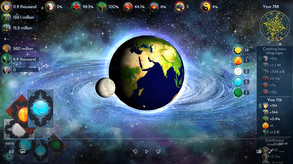
Visually, Logos adopts a functional and information-focused presentation. The interface centers on cards, numerical indicators, and planetary status displays rather than animated cities or detailed landscapes. While this approach lacks visual spectacle, it reinforces the game’s conceptual focus on abstract systems rather than physical detail. The planet becomes less a place to admire and more a living data structure, reflecting the player’s role as a distant, cosmic overseer rather than a hands-on ruler. Sound design and music are similarly restrained, serving primarily to support atmosphere without distracting from decision-making.
The pacing of Logos is deliberately slow and contemplative. Because each turn represents such a long span of time, feedback is gradual, and early stages can feel uneventful until systems begin to compound. This can be challenging for players accustomed to immediate rewards or clear cause-and-effect loops. Over time, however, patterns emerge, and the satisfaction comes from recognizing how early decisions shaped outcomes centuries later. The game rewards patience and reflection, making it particularly appealing to players who enjoy long-term planning and emergent narratives over tactical optimization.
Logos’ greatest strength is also its biggest barrier: its abstraction. The game rarely explains its systems in depth, leaving much of the learning process to trial, error, and observation. While this reinforces its experimental feel, it can also make the experience opaque, especially for newcomers. Some mechanics and interactions remain unclear even after extended play, which can lead to frustration when outcomes feel disconnected from intent. This lack of transparency contributes to the game’s polarized reception, as players either embrace the mystery or struggle against it.
Despite its rough edges, Logos stands out as a rare attempt to simulate civilization and life from a truly macro perspective. It is less concerned with winning or losing in conventional terms and more interested in exploring how complex systems evolve under pressure, ideology, and chance. Each completed run feels like a self-contained cosmic history, shaped by the player’s philosophy as much as by mechanics. Some worlds flourish into balanced, resilient ecosystems, while others spiral into chaos, extinction, or bizarre evolutionary endpoints.
Ultimately, Logos is not a game for everyone, nor does it try to be. It trades polish and accessibility for ambition and scope, offering a sandbox where players can reflect on control, consequence, and the limits of foresight. For those drawn to experimental strategy games, god simulations, and long-form systems thinking, Logos provides a distinctive and thought-provoking experience. While its execution may be uneven and its mechanics sometimes obscure, its willingness to tackle civilization on a planetary and temporal scale makes it a memorable and unusual entry in the strategy genre.
Rating: 5/10