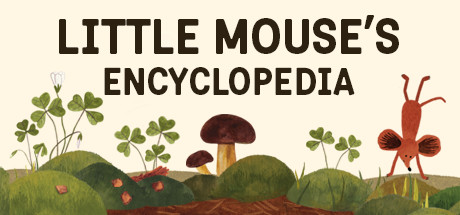
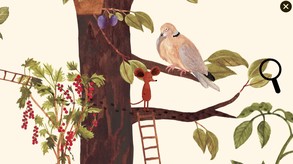
Little Mouse’s Encyclopedia is a calm, imaginative, and beautifully illustrated interactive journey through nature, created by Circus Atos as a blend of storybook charm and educational exploration. Rather than aiming for traditional gameplay with objectives, challenges, or progression systems, it instead invites players—especially young children and families—to wander through serene habitats while learning about the animals and plants that inhabit them. The experience is gentle from the very first moment: you guide a tiny mouse through four interconnected biomes, each depicted in a richly hand-drawn style reminiscent of classic children’s picture books. The game’s foundation rests on curiosity and discovery, making it an inviting digital space for early learners or anyone who enjoys relaxing, visually expressive environments.
The art direction plays a central role in shaping the game’s identity. Every scene feels like a meticulously crafted illustration, filled with soft colors, playful character designs, and subtle animations that breathe life into each setting. Forests sway with light breeze, ponds ripple softly, and garden insects crawl or flutter in small, charming loops. These touches create a world that feels warm and comforting, even before you engage with any of its educational elements. The style is deliberately simple, but it is consistently expressive, giving the mouse—and every creature you meet—personality through visual storytelling alone. The soundscape reinforces this tone, offering quiet background music and natural ambient noises that never overwhelm the viewer but instead help settle them into a peaceful rhythm.
Interaction in Little Mouse’s Encyclopedia is intentionally minimal and intuitive. You move the mouse through sprawling but manageable scenes, and when you approach a plant or animal, a prompt allows you to learn more. The information cards are illustrated entries that present a small description of the organism, including basic facts about diet, habitat, and behavior. Each entry also includes an animation for the creature, offering a tactile sense of presence—frogs hop, beetles crawl, birds shake their wings. This combination of text and animation transforms each discovery into a miniature learning moment. The simple control scheme, along with the option to play in a wide range of languages, makes the game welcoming for very young children and accessible to families of many backgrounds.
The educational value is clear in every aspect of the experience. With over 160 species to encounter, the game provides a broad overview of wildlife and plant life across familiar natural settings. Rather than overwhelming players with deep scientific terminology, the descriptions remain approachable and age-appropriate, focusing on recognizable characteristics and foundational knowledge. The game encourages learning through immersion rather than instruction; children are free to explore at their own pace, revisit favorite areas, and linger on creatures that spark their interest. It is particularly well suited for joint play between children and parents, where conversations can naturally grow from the on-screen discoveries. As a result, it functions not just as a game, but as a digital tool for environmental curiosity and early scientific engagement.
However, the strengths of Little Mouse’s Encyclopedia also point to its limitations. The game does not offer goals, puzzles, progression systems, or problem-solving challenges, which means players looking for more structured gameplay will likely find it too passive. Because all information is accessible from the start, there is no sense of unlocking content or achieving milestones. This design choice supports free exploration, but it also means replay value relies entirely on the viewer’s interest in revisiting scenes rather than on mechanical depth. Older children or adults seeking more detailed biological information may find the entries too brief or simplistic, and some may wish for more interactive elements beyond animation and reading. The experience is also fairly short if approached as a one-time tour, though it remains engaging as a repeated activity for very young players.
Despite these limitations, Little Mouse’s Encyclopedia excels in what it sets out to do. It provides a gentle, whimsical space for learning about nature in a format that is safe, warm, and visually memorable. Its hand-drawn aesthetic is uniquely inviting, and its focus on observation over challenge makes it an ideal introduction to the natural world for children just beginning to explore wildlife and environments. For families, educators, or anyone who values quiet, curiosity-driven digital experiences, it offers something rare: a calming, screen-based activity that encourages connection with the natural world rather than fast-paced stimulation.
In the end, Little Mouse’s Encyclopedia is less a traditional videogame and more a beautifully crafted interactive nature book. Its charm, accessibility, and educational focus make it a lovely choice for young learners, while its serene presentation ensures it remains comforting and pleasant for accompanying adults. Players seeking deeper mechanics or narrative will find it limited, but for its intended audience and purpose, it stands as a thoughtful and delightful exploration of the small wonders that fill our forests, ponds, and gardens.
Rating: 9/10