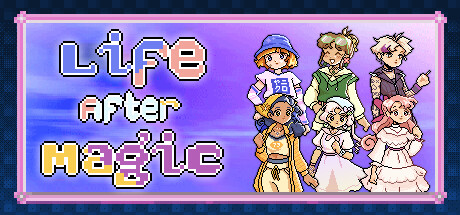
Can you save magic before the clock strikes midnight on New Year’s Eve? Life After Magic is a queer, retro visual novel that follows jaded ex-magical girls as they reconnect, deal with young adulthood, and face off against one last threat before Y2K hits.
Revenue comes from in-game items and microtransactions, which our price-based model doesn't estimate. Copies below reflect the player base, not paid sales.
Media

About


Stats
Languages: English
Engagement
Reviews
Themes across 40 recent reviews and how positive each mention is. A keyword signal, not full sentiment analysis.
Reviews
[b]My Playtime:[/b] 9.7h (100% achievement, finished the game three times) [list][*][i]Main game[/i]: 5h [*][i]Bonus story[/i]: 2.2h[/list] [b]My First Playthrough:[/b] 5h [b]Grindy Achievement(s):[/b] No. [b]Optional Achievement(s):[/b] Yes (15 achievements). [b]Difficult Achievement(s):[/b] No. [h1]Intro[/h1] [i]Life After Magic[/i] is a romantic LGBTQ+ visual novel mostly between girls. It tells the story of magical girls and what happened after the world was saved several years later. [b]Pros:[/b] - Multiple romance endings - A lot of functionalities: skip text, read backlog, voice the displayed text, etc [b]Cons:[/b] - Most functionalities are hidden [b]Specs[/b] AMD Ryzen 7 7800X3D, 16GB RAM, AMD Radeon RX 9060 XT [h1]Should you play this game?[/h1] [i]If you enjoy LGBTQ+ romantic visual novel, this one is for you.[/i] [hr][/hr] [h1]In-Depth Review[/h1] [h3]The Game[/h3] [i]Life After Magic[/i] tells the story of six magical girls after they have saved the world, years later. It tells the story of their reunion after they drift apart and strive to rebuild their relationship... maybe with some romantic outcome out of it. As a magical girl leader who saved the world, Akiko is now working as a customer service representative in a cosmetic store. Sounds quite realistic, to be honest, especially since there weren't any more bad guys to catch. Strangely, the world doesn't plunge into chaos or even change with all of the magical girls—our group isn't the only magical girls in the world, and even though ours are pretty much disbanded, others are still active. https://steamcommunity.com/sharedfiles/filedetails/?id=3266362586 Since the only connection between you and your group is the magical girl days, they will reminisce a lot about that past. It means that you might not understand what they are talking about when they tell those stories. However, the game still explains them in a way that won't let you leave out. Past characters are explained in detail, mainly in monologues from our protagonist. It still feels like being given an info dump from time to time, though. The story is linear. Magic is vanishing, and our group is trying to figure out who the culprit is and how to take them down. Despite the existence of other magical girl groups, our dysfunctional group seems to be the only one that cares and can do something about it, even if it means resurrecting the already-dead group in the first place. They got something out of it, at least, and that's how their relationship is being mended. https://steamcommunity.com/sharedfiles/filedetails/?id=3269914577 The story will focus mostly on Akiko's daily life, with slight remarks on the main plot at the end of the day. Add it with some optional visits to other girls from time to time, and you'll be set. During the personal time with others, you'll be able to get to know them better, which will affect the ending. Every option—during personal time or not—might or might not affect your relationship with that person, and if you get enough points, you'll be able to ask them out for the romantic route. Keeping a friendship route also exists, by the way. https://steamcommunity.com/sharedfiles/filedetails/?id=3270436934 As a visual novel game, it has many functionalities. However, most of them are hidden, and it might take a while to figure out how they work. At first, I thought there wasn't an option to read the backlog. It turns out that you can find them by using the middle mouse button. Moreover, after a lot of tweaking, I found that there is also a way to let a machine voice out the text dialogues! This can be helpful for those who can't read the texts. [b]Length and Replayability[/b] I finished the game in 5h. I spent the rest of my playtime replaying the game three more times and finishing the optional story that unlocks after finishing the game, totaling 9.7h. The game is meant to be played multiple times. There are different scenes that you can get from talking with other people, or even being in a romantic relationship with the rest of the candidates. Plus, there is an extra story after you beat the game, which will take 2h more of your playtime. [h1]Conclusion[/h1] [i]Life After Magic[/i] is a romantic visual novel with mainly slice-of-life content. Since the pairs are mostly female, it caters mostly to those who are content with this kind of content. As a visual novel, the story was fine, although they make up for it with the beautiful pixelated presentation and the plethora of accessibility options.
Related
Related
Trends
Concurrent players on Steam, sampled daily since tracking started.
Hours played at review time, across 40 reviews with recorded playtime.
positive critical· bar length = how often the theme comes up
Go play this. Play all the romance routes first, then the secrets, then the side story thingie. And then feel the void this game will leave in your heart when it's over.
this game is so so good. the lgbt rep, writing, and art is absolutely charming!! its a damn crime this game is free, but that gives everyone more of a reason to play this amazing yuri visual novel. highly recommend!
Jackie i love you pls marry me. Really good pacing, story-wise it's a treat, and emotionally-wise, REALLY AMAZING. The artstyle is amazing, the music is enjoyable, and the story is genuinely a great moment all-around
yuri <3
Giving this a thumbs up for the music and the NG+. I won't spoil it here. It's a free game! Takes about 6 hours to 100% if you're a speedy reader.
It's cute, it's short, it's free??? A perfect combination to play when I'm in the mood for a short visual novel to work to. Honestly, between the mix of no longer being in my early 20s or having any particular nostalgia for the Sailor Moon anime, I had a hard time really gelling with the cast at first. I feel like that's chalked up to me being more 'I'm 30 to 40 years old I don't need this' then any inherent flaw with the game; maybe a more whimsical heart then mine would be more easily charmed, or players closer to the character's ages. I did actually feel a pang of guilt when I finished the game for the first time and ARA and Leez's ending ended up being a lot more melancholy then I expected since I did not get close to them during the game, and the DLC route mentioning that it was gonna be the 'one true route' did encourage me to at least get all of the other romantic routes before dreading into the DLC. My personal favorites: - Leez is very cute: I do feel like out of the cast, she was the one who's antics did charm me the most, and it always made me happy to have her be more involved. It makes me happy that even when you don't pursue her route, she still has the potential for a canonical romance with someone else. - ARA girl you are soooooooo messsssyyy - I did fall into KJ's route the first time I played and wasn't fully feeling the plot. I think she felt like one of the more mature members of the cast, and it was fun to have the former shy girl change the most drastically and seeing peeks of that old self still pop out. - Jackie is also one of the more mature members of the cast, and my initial debate was between her and KJ when I first played. I do think her relationship with her prodigee is incredibly endearing, and it's one of my favorite bits of the game. -Miranda feels like one of the weakest routes in the game. First off, girl you're in a wood shop with a midriff exposing crop top and arm warmers what the hell. Secondly, while I do appreciate a big part of her route is learning how to communicate with her, I felt like there could have been more? I do think it's very sweet to pair her with Leez though. Ultimately though, I think the DLC route is my favorite. Maybe it's because it's the last bit of writing for the game and thus the devs are more used to playing with these characters/world. Maybe it's because it's a romance with an older woman who's more mature and has more baggage to work through. It felt strange to have the game go 'this is what -really- happened' and effectively declare the rest of the game up to this point non-canon, but it does lead to the happiest ending I've managed to get where everyone is still in touch and friends well into their 30s, so it all works out. The visuals are cute as hell and were incredibly endearing. The nitpicky part of me wants to go 'man this isn't what late 90s/early 2000s culture was like at all', but you quickly learn to let that part go and just embrace that this is a 2020s idea of what the Y2K era was like. The transition between scenes wasn't always the most smooth (finishing a date at night in the park only to immediately go to the park again but earlier in the day, the 'going to bed' transition talking about staying up late to read shoujo manga when you're literally having the final showdown the next day), but nothing that destroyed the ability to enjoy the plot. I do find it frustrating that I would have to go into the settings every time I wanted to set up autoplay, and it took more digging outside of the game itself to find what the skip button was (for the record: you can skip text via the 'tab' key).
Life After Magic takes an unusual approach to the magical girl formula by focusing not on world-saving adventures themselves, but on what remains after those adventures are over. Developed by Team Starlight and published by Chirashi Games, this narrative-focused visual novel explores adulthood, fading friendships, lost ambitions, and the struggle to reconnect with parts of yourself that time has buried. Rather than delivering a traditional fantasy story filled with constant battles and heroic triumphs, it offers something quieter and far more reflective, creating an emotional experience centered around change, memory, and personal growth. The story follows Akiko, a former member of a magical girl team known as the Sentinels of Justice. Years ago, she and her friends protected the world from dangerous threats and lived the kind of extraordinary life most people only imagine. Those days are gone. Akiko now works an ordinary retail job, living through routines that feel increasingly disconnected from the person she once was. The transition from heroism to adulthood forms the emotional backbone of the experience. Life feels smaller now, responsibilities feel heavier, and old friendships have slowly faded with time. Things begin to change when Akiko notices something impossible happening. Magic itself is disappearing. Powers that once defined her identity are weakening, and former teammates who have long since moved on from their heroic past begin facing similar problems. What starts as personal uncertainty gradually develops into a larger mystery that forces old friends back together. The game builds its narrative around both supernatural investigation and emotional reconciliation, balancing larger fantasy elements with grounded personal struggles. One of the game's strongest qualities is its handling of relationships. Reconnecting with people after years apart rarely happens smoothly, and Life After Magic captures that reality remarkably well. Conversations carry emotional history. Characters feel shaped by time rather than frozen in place waiting for the protagonist to return. Old disagreements remain unresolved, personalities have evolved, and rebuilding trust requires effort. These interactions give the cast authenticity that strengthens the emotional weight of the story. Player choice plays an important role throughout the experience. Relationship paths allow players to develop friendships and explore romantic possibilities while shaping how Akiko reconnects with people from her past. The game places strong emphasis on character-driven storytelling, and those choices help create emotional investment beyond simply progressing through the central mystery. Optional romance elements integrate naturally into the narrative without overwhelming its larger themes, offering additional depth without sacrificing pacing. Another standout element comes from how effectively the game contrasts magical fantasy with everyday adulthood. Akiko may have once saved the world, but now she deals with customer service, work schedules, financial responsibilities, and ordinary routines. These grounded moments reinforce the game's central ideas about growing older and confronting reality after youthful dreams fade away. Rather than making adulthood feel depressing, Life After Magic explores it honestly, showing both disappointment and growth through its characters' experiences. Presentation contributes heavily to the overall atmosphere. Pixel art visuals create a nostalgic aesthetic that complements both the magical setting and the late-1990s backdrop. Character sprites carry personality, environments feel warm and expressive, and visual design reinforces the bittersweet tone running throughout the story. The soundtrack further strengthens emotional moments, supporting scenes ranging from lighthearted interactions to more serious introspective conversations. Together, these elements create a world that feels comforting while carrying underlying melancholy. What ultimately separates Life After Magic from many visual novels is its willingness to explore life after accomplishment. Most magical stories celebrate becoming a hero. This game asks what happens when heroism ends and ordinary life begins. It examines burnout, drifting friendships, uncertain futures, and the complicated process of rediscovering meaning after losing direction. Those ideas give the narrative maturity without becoming overly cynical. The pacing may feel slower for players expecting action-heavy gameplay or complex mechanics. As a visual novel, the experience relies heavily on dialogue, character interactions, and emotional storytelling. However, players willing to embrace its slower rhythm will likely find a thoughtful and rewarding experience that succeeds because of its writing rather than despite it. Life After Magic delivers a memorable blend of nostalgia, mystery, romance, and emotional introspection. Team Starlight creates a story that feels deeply personal while still embracing magical fantasy elements, resulting in a visual novel that stands apart from genre expectations. Its strongest moments come not from supernatural revelations, but from watching characters confront the distance between who they once were and who they have become. Rating: 9/10
Life after magic is one of the most delightful Visual Novels I had played in a while. The premise is charming and well executed: You're the former leader of a magical girl group who have been retired from the magical girl life. However, not all is well as the repercussions of constantly balancing a double life in your teenage years caught up with you, as now being a highschool dropout struggling to make ends meet paints a much less flattering image of adult life than your mahou shoujo years would have had you guessing. However, as a new, unseen force looms over the horizon threatening to destroy magic forever, you get in contact with your former teammates and friends, trying to sort this out while also navigating the years of drifting apart. Honestly, a superbly written visual novel. It follows a short time period, as others tend to do, and while it is on a shorter time investment compared to other games (completed in 3~5 hours depending on your reading speed and pace), it's very carefully crafted. All characters are a delight to see and interact with, each with their own unique storylines and personalities, but also the different ways you can make Akiko, the main protagonist, react to things. She's malleable to your choices while still being well defined. She may be more open or close minded to certain approaches, but you can tell how her personality is like through dialogue and you can easily envision how the group was in their younger years and how they came to be as they are now. One of the aspects I really like about this is how reactive the narrative is in subtle ways. While it doesn't necessarily open new routes or brand new entire endings, you have multiple characters you talk to and depending on when you have certain interactions, people react differently to certain pieces of information, as hanging out with some characters earlier might have your character be more knowledgable in main cutscenes about certain aspects of their lives. The game also has a nice balance between humor, heartfelt moments and some somber appraisings of trying to make sense of yourself in adult life. It's bitter where it has to be, but it never overdoes it, balancing nicely not only with its cute aesthetics, but also a genuine hopeful stance in figuring yourself out. This game is a labor of love, especially for those who grew up in the 90s with magical girl shows and it wears that love on its sleeve, both with the tropes it plays, the retro pastel aesthetic the whole game and even the setting it has on the verge of the new millenium. Honestly, one of the most lovely VNs out there. Doesn't take too long, doesn't cost a dime and if you love magical girls, especially of the gay variety, then hop on. And for those who don't want to be forced into romance, you're also allowed to develop purely platonic relationships with your gal pals, so it's a win for everyone
Only an hour in but i have already laughed and smiled so much from how charming everything about this game is Leez my beloved ♥
Momentum
Pace estimated from the game's recent review growth (our daily snapshots) at its own sales-per-review ratio — a momentum signal, not booked sales.
Audience
Estimated from the language of this game's reviews — a proxy for where players are, not official Steam demographics.
Related
| Garry's Mod | $102.9M | 1.3M | 97% | $4.99 |
| Factorio | $140.7M | 232.4K | 98% | $35.00 |
| Human Fall Flat | $109.3M | 225.7K | 95% | $19.99 |
| House Flipper | $65.8M | 110.8K | 94% | $24.99 |
| People Playground | $62.2M | 315.5K | 98% | $9.99 |